Power Independence Home 
Home Search search Menu menu Not logged in - Login | Register

 Moderated by: Joe Kelley Page:  First Page Previous Page  ...  5  6  7  8  9  10  11  12  13  14  15  ...  Next Page Last Page  
New Topic Reply Printer Friendly
More  Rating:  Rating
AuthorPost
 Posted: Wed Jul 9th, 2008 03:11 pm
  PM Quote Reply
181st Post
Joe Kelley
Administrator
 

Joined: Mon Nov 21st, 2005
Location: California USA
Posts: 6399
Status: 
Offline
Mana: 
http://www.renewableenergyworld.com/rea/partner/story?cid=5213&id=53003
NanoMarkets Predicts Thin-Film Solar Cell Industry Will Produce More than 26 Gigawatts by 2015
 

Back To Top PM Quote Reply  

 Posted: Wed Jul 9th, 2008 11:00 pm
  PM Quote Reply
182nd Post
Joe Kelley
Administrator
 

Joined: Mon Nov 21st, 2005
Location: California USA
Posts: 6399
Status: 
Offline
Mana: 
http://gas2.org/2008/07/09/company-unveils-home-based-hydrogen-refueling-station/


Step forward ITM Power, a UK company that has developed a hydrogen refueling station that could be installed at home, providing a ready-made solution for fuel-cell car owners.

The station works via an electrolyser, which produces the gas from water and electricity, providing enough hydrogen overnight to fuel a 25 mile journey. If required, the unit, which has been tested on a converted Ford Focus, can also convert the gas back into electricity for use in the home.


Back To Top PM Quote Reply

 Posted: Sat Jul 12th, 2008 12:47 pm
  PM Quote Reply
183rd Post
Joe Kelley
Administrator
 

Joined: Mon Nov 21st, 2005
Location: California USA
Posts: 6399
Status: 
Offline
Mana: 
http://www.popularmechanics.com/blogs/automotive_news/4272875.html


So how long will that battery pack last? Electrorides says a full 10 years, assuming one charge/discharge cycle every day. And now ... the cost: $126,000. That’s about $100,000 more than the price of a normal Isuzu truck. About $50,000 of the cost, however, comes from the lithium polymer packs. Expensive? Sure, but here’s how the math apparently works out. With an E-truck, Electrorides says, business owners can control their fuel costs. They say a typical monthly payment on an Isuzu NPR is around $850 or $900. And the typical monthly gas or diesel fuel bill for a truck could range from $1200 to $1800, if you include oil changes and assume 100 miles driven per business day. The Zero Truck can be leased for seven years at $1900 a month, for example. And the cost to charge one of the EV haulers is about $3 off-peak here in Southern California—not bad at all.


Back To Top PM Quote Reply  

 Posted: Sun Jul 13th, 2008 07:08 pm
  PM Quote Reply
184th Post
Joe Kelley
Administrator
 

Joined: Mon Nov 21st, 2005
Location: California USA
Posts: 6399
Status: 
Offline
Mana: 
http://www.ecomodder.com/blog/2008/07/13/mistubishis-electric-car-will-be-released-in-2009-for-37500/



Mitsubishi’s Electric Car Will Be Released in 2009 for $37,500

Despite the similarities in pricing and release date, the two cars are very different beasts. The iMiev is based on a current Kei-car produced by Mistubishi for Japan, and has a 47kW electric motor powered by a 330-volt lithium ion battery pack. The car will have a top speed of 80 mph and an all electric range of about 100 miles. Charging will take place via a normal power outlet and should take about 14 hours to completely charge the battery, though there is all a 220V charge option, which only takes 7 hours.

On the other hand, the Volt will feature a sportier 120kW motor and 100+ mph top speed, but will only have an electric range of 20 or 40 miles (depending on the speculation and model selection), after which is will switch over to your standard dinosaur burning engine like in most cars these days. Chevy claims that most people never drive over 40 miles in a day, but I’m sure these Volts will be burning enough fossil fuels that calling them “electric cars” will leave a bitter taste in some peoples’ mouths. I think series hybrid or plug-in hybrid is much more appropriate.


Back To Top PM Quote Reply

 Posted: Sun Jul 13th, 2008 07:11 pm
  PM Quote Reply
185th Post
Joe Kelley
Administrator
 

Joined: Mon Nov 21st, 2005
Location: California USA
Posts: 6399
Status: 
Offline
Mana: 
http://www.ecogeek.org/content/view/1867/


The electric and diesel propulsion systems together are expected to get a whopping 235 miles per gallon, that much we know. We also hear that the fuel savings is maximized with a few little tricks – the engine shuts off at stop lights, for instance, the body is very light weight (the concept car weighs 640 pounds, with a body made of carbon fiber), and the aerodynamics are superb (the concept car’s drag coefficient is about half that of an average car).

Dimensions are about 11.4 feet long, 4.1 feet wide and 3.3 feet tall – talk about itty bitty! It’s not far off in size from their three-wheeler idea. But apparently it’s safe, as VW reports that the One-Liter Car is as safe as a GT sports car registered for racing, and comes complete with airbags and crunch control. Yeah, but that doesn’t do much to put your mind at ease when you’re essentially sledding down the road at high speeds.

Because the concept car is made of carbon monocoque, VW planned to wait intil the price of the material dropped to a reasonable amount, which they guessed would be in 2012. However, they’ve decided the cost is competitive enough to go ahead and get cracking, though that means the sticker price may fall between $31,750 to $47,622, according to Britain's Car magazine’s “well placed source.”


Back To Top PM Quote Reply  

 Posted: Tue Jul 15th, 2008 10:33 am
  PM Quote Reply
186th Post
Joe Kelley
Administrator
 

Joined: Mon Nov 21st, 2005
Location: California USA
Posts: 6399
Status: 
Offline
Mana: 
http://www.treehugger.com/files/2008/07/17-electric-cars-overview-2005-to-2008.php

Electric Cars: You Want 'Em? We've Got 'Em!

Over the past 3 years, we've written about many electric cars here on
TreeHugger. We think it's time to look in the rearview mirror, so here's an overview. If you see anything you like, just follow the links to see the original articles.


Last edited on Tue Jul 15th, 2008 10:33 am by Joe Kelley

Back To Top PM Quote Reply

 Posted: Wed Jul 16th, 2008 11:51 am
  PM Quote Reply
187th Post
Joe Kelley
Administrator
 

Joined: Mon Nov 21st, 2005
Location: California USA
Posts: 6399
Status: 
Offline
Mana: 
http://news.cnet.com/8301-11128_3-9991028-54.html?part=rss&subj=news&tag=2547-1_3-0-20


"On cost per watt, we're cheaper than PV (photovoltaics)," said CEO Darren Kimura. "But that's not what really matters. We can do more production. We actually get more sun energy every day."

With a higher output, the payback on an initial investment comes quicker, he argued. The troughs can be used by corporate customers as well for on-site power generation.


How much time before payback?

One Solar Panel maker reported a one year payback interval.


http://www.thedailygreen.com/green-homes/eco-friendly/evergreen-solar-panels-460608


According to Evergreen, the carbon footprint of these new panels is up to 50% smaller than those of competitors, and they have a quicker energy payback -- reportedly as fast as 12 months for installed panels. This last point is particularly exciting, since the amount of energy required to make solar panels has long been a bone of contention among critics of the technology.

Back in the late 90s, energy paybacks for solar panels were as high as seven years. Today, they are often reported as "1-5 years."

style="BACKGROUND-COLOR: #f8f8f8" 

http://www.evergreensolar.com/app/en/home/

There’s never been a better choice for solar panels than Evergreen Solar. Our panels are made by state of the art manufacturing featuring our unique String Ribbon wafer technology. Add the fact that we manufacture everything — wafers, cells and panels — all under one roof for ultimate quality control, and it’s not surprising then that our solar panels are among the highest quality products in the industry. And that’s not all. Because of the unique way they’re made, they are the most environmentally friendly solar panels in the business.


Back To Top PM Quote Reply  

 Posted: Wed Jul 16th, 2008 12:04 pm
  PM Quote Reply
188th Post
Joe Kelley
Administrator
 

Joined: Mon Nov 21st, 2005
Location: California USA
Posts: 6399
Status: 
Offline
Mana: 
http://gas2.org/2008/07/15/an-air-car-you-could-see-in-2009-zpms-106-mpg-compressed-air-hybrid/


Compressed air from the tanks will run directly to the engine under speeds of 35 miles per hour. That means that under 35 mph the car qualifies as a zero emissions vehicle. At higher speeds the engine will burn a small amount of fuel to create more compressed air, sort of like how a plug-in hybrid like the Chevy Volt produces on-the-fly electricity. The hybrid air-car setup should be able use any number of fuels, including gasoline, propane, or ethanol.

1 tank of air + 8 gallons of gas = 848 mile range


The car’s compressed air tank can be refilled in about 3 minutes from a service station. To fill it up at home the car would be plugged in, where an onboard compressor would refill the tank in about 4 hours, at an electrical cost of about $2.


Back To Top PM Quote Reply

 Posted: Thu Jul 17th, 2008 08:49 am
  PM Quote Reply
189th Post
Joe Kelley
Administrator
 

Joined: Mon Nov 21st, 2005
Location: California USA
Posts: 6399
Status: 
Offline
Mana: 
http://www.google.com/search?hl=en&q=Moringa+Oleifera+

http://peacecorps.mtu.edu/resources/studentprojects/moringa.htm

 Moringa oleifera is a fast growing, aesthetically pleasing small tree adapted to arid, sandy conditions.  The species is characterized by its long, drumstick shaped pods that contain its seeds.  Within the first year of growth, moringa has been shown to grow up to 4 meters and can bear fruit within the same first year (Folkard and Sutherland, 1996).  Virtually every part of the tree is beneficial in some way, which is of great importance in areas where people have a direct dependence on trees, crops and animals for their livelihood.  The studies that have been performed on moringa have taken place primarily in India and Africa, but it seems that there may be a growing interest in the cultivation possibilities in the more humid tropics, including Central and South America.  Depending on the purpose and quantity desired, moringa can be grown in a nursery as a community project or on a smaller scale at the family level.  It can function as windbreaks for erosion control, live fences, as an ornamental or intercropped to provide semi-shade to species requiring less direct sunlight


According to the research I have done, the benefits of Moringa oleifera are almost too numerous to name.  However, several benefits seem to be repeated again and again, therefore leading me to believe these are the most important and useful in extreme situations, like drought conditions in arid regions or areas in the wet tropics experiencing rapid rates of deforestation.  Moringa is naturalized in Tanzania, Nicaragua, Malawi, Brazil, Niger, Indonesia and Senegal (Optima of Africa, Ltd.).  The problems in these types of environments are plentiful:  lack of food during the dry season, lack of fodder for animals, reduced amounts of firewood, poor nutrition and unsanitary drinking water, to name a few.  Can moringa solve all of the tropical world's problems?  Definitely not.  Can it be integrated into agroforestry systems to raise the quality of life even just a little?  Hopefully.

Back To Top PM Quote Reply  

 Posted: Thu Jul 17th, 2008 01:00 pm
  PM Quote Reply
190th Post
Joe Kelley
Administrator
 

Joined: Mon Nov 21st, 2005
Location: California USA
Posts: 6399
Status: 
Offline
Mana: 
http://www.eurekalert.org/pub_releases/2008-07/ps-rgh071508.php

Grimes' process splits water into its two components, hydrogen and oxygen, and collects the products separately using commonly available titanium and copper. Splitting water for hydrogen production is an old and proven method, but in its conventional form, it requires previously generated electricity. Photolysis of water solar splitting of water has also been explored, but is not a commercial method yet.
Grimes and his team produce hydrogen from solar energy, using two different groups of nanotubes in a photoelectrochemical diode. They report in the July issue of Nano Letters that using incident sunlight, "such photocorrosion-stable diodes generate a photocurrent of approximately 0.25 milliampere per centimeter square, at a photoconversion efficiency of 0.30 percent."


Back To Top PM Quote Reply

 Posted: Fri Jul 18th, 2008 03:16 pm
  PM Quote Reply
191st Post
Joe Kelley
Administrator
 

Joined: Mon Nov 21st, 2005
Location: California USA
Posts: 6399
Status: 
Offline
Mana: 
http://cleantechnica.com/2008/07/17/world%e2%80%99s-first-commercial-scale-tidal-power-system-begins-feeding-electricity-to-the-grid/

The tidal current turbine, known as SeaGen, has briefly generated 150kW of power onto the grid as part of its commissioning work, ahead of it achieving full capacity a few weeks from now. SeaGen’s power is being intentionally constrained to 300kW during the commissioning phase, but once fully operational, it will generate 1.2MW of clean, renewable energy to the equivalent of 1000 homes.


Back To Top PM Quote Reply  

 Posted: Fri Jul 18th, 2008 03:37 pm
  PM Quote Reply
192nd Post
Joe Kelley
Administrator
 

Joined: Mon Nov 21st, 2005
Location: California USA
Posts: 6399
Status: 
Offline
Mana: 
http://redgreenandblue.org/2008/07/17/florida-gives-green-light-to-largest-solar-power-plant-in-us/

The Florida decision follows a raft of recent political moves to boost the development of solar and other renewable energy sources in the U.S. Last week, Pennsylvania launched a Bill establishing a $650 million energy fund to support the sector. Earlier in the month, the U.S. Senate introduced the 10 Million Solar Roofs Act of 2008, while the end of June saw House Democrats introduce a national feed-in tariff for renewable energy projects.


Back To Top PM Quote Reply

 Posted: Tue Jul 22nd, 2008 09:41 am
  PM Quote Reply
193rd Post
Joe Kelley
Administrator
 

Joined: Mon Nov 21st, 2005
Location: California USA
Posts: 6399
Status: 
Offline
Mana: 
http://www.cnn.com/2008/TECH/07/17/solar.office/index.html


• Environmental concerns would be a driving force in every aspect of the company.

• Six weeks of paid time off.

• A concept called FOH -- frank, open and honest -- to help eliminate gossip and grudges.

• Employees, no matter what their job description, have the same pay scale.

• One percent of yearly revenues goes to solar systems donated to community groups.

• All major decisions would be made by consensus of all company employees.


Back To Top PM Quote Reply  

 Posted: Tue Jul 22nd, 2008 09:43 am
  PM Quote Reply
194th Post
Joe Kelley
Administrator
 

Joined: Mon Nov 21st, 2005
Location: California USA
Posts: 6399
Status: 
Offline
Mana: 
http://www.physorg.com/news135860146.html

Biogeoscientists show evidence of 90 billion tons of microbial organisms—expressed in terms of carbon mass—living in the deep biosphere, in a research article published online by Nature, July 20, 2008. This tonnage corresponds to about one-tenth of the amount of carbon stored globally in tropical rainforests.


Back To Top PM Quote Reply

 Posted: Tue Jul 22nd, 2008 09:44 am
  PM Quote Reply
195th Post
Joe Kelley
Administrator
 

Joined: Mon Nov 21st, 2005
Location: California USA
Posts: 6399
Status: 
Offline
Mana: 
http://nextbigfuture.com/2008/07/blacklight-power-covered-on-cnn-money.html


Another scientist disputing Rathke's analysis, Ronald C. Bourgoin, of the Edgecombe Community College, published a peer-reviewed paper in the journal Advanced Studies in Theoretical Physics, not only supporting the theoretical possibility of hydrino states, but further stating that the general wave equation of quantum mechanics predicts the very same reciprocal energy states as does Mills' theory.

Mills reports that limitations on confinement and terrestrial conditions have prevented the achievement of hydrino states below 1/30, which would correspond to an energy release of approximately 15 keV per hydrogen atom.

Back To Top PM Quote Reply  

 Posted: Tue Jul 22nd, 2008 09:46 am
  PM Quote Reply
196th Post
Joe Kelley
Administrator
 

Joined: Mon Nov 21st, 2005
Location: California USA
Posts: 6399
Status: 
Offline
Mana: 
Water as fuel forums:

http://waterfuelcell.org/phpBB2/index.php

http://waterfuelforall.com/forum/index.php

http://oupower.com/phpBB2/

Back To Top PM Quote Reply

 Posted: Tue Jul 22nd, 2008 12:38 pm
  PM Quote Reply
197th Post
Joe Kelley
Administrator
 

Joined: Mon Nov 21st, 2005
Location: California USA
Posts: 6399
Status: 
Offline
Mana: 
http://www.brasschecktv.com/page/376.html

Back To Top PM Quote Reply  

 Posted: Tue Jul 22nd, 2008 02:07 pm
  PM Quote Reply
198th Post
Joe Kelley
Administrator
 

Joined: Mon Nov 21st, 2005
Location: California USA
Posts: 6399
Status: 
Offline
Mana: 
http://www.youtube.com/watch?v=wrT4X113imk&eurl=http://www.computerworlduk.com/toolbox/green-computing/blogs/index.cfm?entryid=926

FloDesign Wind Turbine
http://www.google.com/search?hl=en&q=FloDesign+Wind+Turbine

http://www.flodesignwindturbine.org/

Contact FloDesignWindTurbine

I sent the following e-mail (I almost never receive a reply to my cost/benefit questions):

To Whom It May Concern:


I am a beginning writer who has an interest in power independence. My question to you concerns the cost benefit realities of your wind turbine.


What is your expected price for an example wind turbine?


What is your expected total value of production for the entire life of one of your units?

 
  1. Price in dollars
  2. Production is dollars
 

Please be accurate.


Joe

 
The idea is to arrive at a Liberty Day for one unit.

Example:

A is 10,000 dollars.

B is 20,000 dollars.

If the unit wears out in 20 years, then the pay off day (Liberty Day) is 10 years after the begining of production.

What happens if the price of the unit is 1 million dollars and the total output of production is 100 million dollars for 50 years?

A. 1/2

B. 1/100

Which is better?


Last edited on Tue Jul 22nd, 2008 02:11 pm by Joe Kelley

Back To Top PM Quote Reply

 Posted: Tue Jul 22nd, 2008 02:35 pm
  PM Quote Reply
199th Post
Joe Kelley
Administrator
 

Joined: Mon Nov 21st, 2005
Location: California USA
Posts: 6399
Status: 
Offline
Mana: 
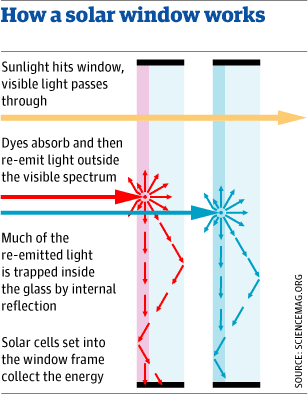
http://www.guardian.co.uk/environment/2008/jul/10/solarpower.renewableenergy

Back To Top PM Quote Reply  

 Posted: Tue Jul 22nd, 2008 02:36 pm
  PM Quote Reply
200th Post
Joe Kelley
Administrator
 

Joined: Mon Nov 21st, 2005
Location: California USA
Posts: 6399
Status: 
Offline
Mana: 
http://www.buypowernotpanels.com/


Back To Top PM Quote Reply

Current time is 03:41 pm Page:  First Page Previous Page  ...  5  6  7  8  9  10  11  12  13  14  15  ...  Next Page Last Page    
Power Independence > Good News > Good News > More Top


UltraBB 1.17 Copyright © 2007-2008 Data 1 Systems