 |
PM |  | |
Quote | | |
Reply | | |
Full Topic | |
| Joined: | Mon Nov 21st, 2005 |
| Location: | California USA |
| Posts: | 6399 |
| Status: |
Offline
|
| Mana: |    |

Forget Earth - let's move to Mars!
If planet Earth becomes too crowded, where else in the solar system could humankind live? Space expert Steven Cutts considers our options

Down into the comment section on page 2:
Curiously, there is a very important fact which everyone seems to ignore, and that is the abundance of hydrogen peroxide (H2O2) on Mars. Using platinum as a catalyst dissociates this into water and oxygen, and there is evidence of platinum ore in traces on Mars. However, the point of catalysis is that the catalyst is constantly re-usable, so a dome would be able to supply its own air and water from the red dust of hydrogen peroxide - and the girls could always go blonde if they wanted.
Earth is an odd planet, no? From a perspective where the viewer has a grasp of the scale of a planet with and understanding of the ratio between volume and surface area, the water trapped around the thin surface layer is hard to imagine.
Why doesn’t that water find its way to the source of gravity on earth? What prevents all that water in the oceans, for example, from seeking a way down into the core of this large globe?
I’ll look for a picture where the viewer can begin to see the sale of which I’m seeing the layer of water standing on top of the thin crust of this planet Earth. Before doing so I can explain how that works with words.
A golf ball has an enormous amount of surface area compared to the volume of the golf ball because it is small in scale; small in size. Scale up the golf ball to a basket ball and the surface area increases slightly compared to the great increase in volume. What happens when the scale is scaled up to the size of a planet?

Another way of seeing this scale perspective is thought the effort to understand a math problem when the viewer looks at an idea called: Gravity Train
http://www.youtube.com/watch?v=wrQjMslFutc
http://www.damninteresting.com/the-gravity-express
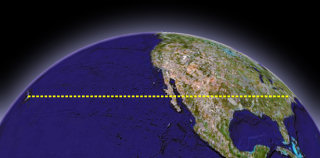
One interesting property of the Gravity Express is that its transit time would always be very, very close to forty-two minutes regardless of the distance travelled. In fact, if the Earth were a perfect sphere, the trip time would always be exactly forty-two minutes and twelve seconds. Greater distances would be traversed in the same amount of time as short ones because the train’s maximum speed would be increased enough to exactly make up the difference. Due to nature of gravity, this forty-two minute trip time would be consistent for any size of vehicle.
Begin tracing straight lines through the earth and find a problem? How deep is the deepest man has drilled down into the impossibly vast volume of the planet?
Here is a start:
http://geology.com/records/deepest-part-of-the-ocean.shtml
[size=+0]
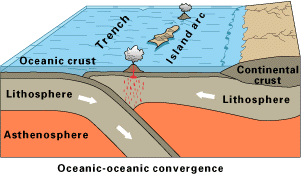
[size=+0]Challenger Deep in the Mariana Trench is the deepest point in Earth's oceans. The bottom there is 10,924 meters (35,840 feet) below sea level. If Mount Everest, the highest mountain on Earth, were placed at this location it would be covered by over one mile of water. The Challenger Deep is named after the British survey ship Challenger II, which discovered this deepest location in 1951. It was first explored by Nereus, a deep-sea robotic vehicle designed by scientists at the Woods Hole Oceanographic Institution in 2009.
http://www.damninteresting.com/the-deepest-hole
Today, the deepest hole ever created by humankind lies beneath the tower enclosing Kola’s drill. A number of boreholes split from the central branch, but the deepest is designated “SG-3,” a hole about nine inches wide which snakes over 12.262 kilometers (7.5 miles) into the Earth’s crust. The drill spent twenty-four years chewing its way to that depth, until its progress was finally halted in 1994, about 2.7 kilometers (1.7 miles) short of its 15,000-meter goal.
Even more surprisingly, this deep rock was found to be saturated in water which filled the cracks. Because free water should not be found at those depths, scientists theorize that the water is comprised of hydrogen and oxygen atoms which were squeezed out of the surrounding rocks due to the incredible pressure. The water was then prevented from rising to the surface because of the layer of impermeable rocks above it.
When drilling stopped in 1994, the hole was over seven miles deep (12,262 meters), making it by far the deepest hole ever drilled by humankind. The last of the cores to be plucked from from the borehole were dated to be about 2.7 billion years old, or roughly 32 million times older than Abe Vigoda. But even at that depth, the Kola project only penetrated into a fraction of the Earth’s continental crust, which ranges from twenty to eighty kilometers thick.
There, look at that math problem, if the deepest penetration into the vast volume of the planet Earth is about 7 miles, and if the viewer can imagine trying to travel straight through the earth on a Gravity Train, think with your brain now, how far could the straight line of the Gravity Train go if it could only go 7 miles deep?
What would be the longest distance the train could travel if it could only go 7 miles down into the Earth's vast volume? Suppose, for example, that your new Gravity Train started in New York City. Where could that Train travel too, how far could it go, if it could only travel down 7 miles, and the train travels through a straight line?
The idea here isn't to be precise with the calculation; the idea is to begin to see the relationship between surface area and volume on a planetary scale.
P.S.
http://www.slideshare.net/erostad/the-scarcity-myth
http://en.allexperts.com/e/n/ni/nikolai_kudryavtsev.htm
Kudryavtsev introduced a number of other relevant observations into the argument about the theory of abiogenic petroleum origin.
* Columns of flames have been seen during the eruptions of some volcanoes, sometimes reaching 500 meters in height, such as during the eruption of Mount Marapi in Sumatra in 1932. (There have been several other instances subsequently.)
* The eruptions of mud-volcanoes have liberated such large quantities of methane that even the most prolific gasfield underneath should have been exhausted long ago.
* The quantities of mud deposited in some cases would have required eruptions of much more gas than is known in any gasfield anywhere.
* The water in mud volcanoes in some instances carries such substances as iodine, bromine and boron that could not have been derived from local sediments, and that exceed the concentrations in seawater one hundred fold.
* Mud volcanoes are often associated with lava volcanoes, and the typical relationship is that where they are close, the mud volcanoes emit incombustible gases, while the ones further away emit methane.
* He knew of the occurrence of oil in basement rocks of the Kola Peninsula, and of the surface seeps of oil in the Siljan Ring formation of central Sweden. He noted as mentioned above that the enormous quantities of hydrocarbons in the Athabasca tar sands in Canada would have required vast amounts of source rocks for their generation in the conventional discussion, when in fact no source rocks have been found.
http://mjperry.blogspot.com/2008/07/oil-discovered-in-russia-drilling-to.html
MP: That seems like a pretty sensible drilling strategy: a Swedish company make a major discovery of oil in July, and it plans to start drilling in just TWO MONTHS. Compare that to the U.S. strategy - discover major deposits of crude oil in ANWR in 1987, and ban drilling for more than TWO DECADES.
http://www.the7thfire.com/Politics%20and%20History/peak_oil/drilling_developing_Dnieper-Donetsk.htm
The modern Russian-Ukrainian theory of deep, abiotic petroleum origins is by no means simply an academic proposition. After its first enunciation by N. A. Kudryavtsev in 1951, the modern theory was extensively debated and exhaustively tested. Significantly, the modern theory not only withstood all tests put to it, but also it settled many previously unresolved problems in petroleum science, such as that of the intrinsic component of optical activity observed in natural petroleum, and also it has demonstrated new patterns in petroleum, previously unrecognized, such as the paleonological and trace-element characteristics of reservoirs at different depths. Most importantly, the modern Russian-Ukrainian theory of deep, abiotic petroleum origins has played a central role in the transformation of Russia (then the U.S.S.R.) from being a "petroleum poor" entity in 1951 to the largest petroleum producing and exporting nation on Earth.