| Moderated by: Joe Kelley | ||
| Author | Post | |||||||||||
|---|---|---|---|---|---|---|---|---|---|---|---|---|
|
Joe Kelley Administrator
|
"Responsibility must be individual, or there is no responsibility at all." Equitable Commerce by Josiah Warren, 1852 http://www.theyliewedie.org/ressources/biblio/en/Warren_Josiah_-_EQUITABLE_COMMERCE.html Rothbard page 215-216 The Spooner-Tucker Distortion It should be remembered by radicals that, if they wanted to, all workers could refuse to work for wages and instead form their own producer's cooperatives and wait for years for their pay until the products are sold to the consumers; the fact that they do not do so, shows the enormous advantage of the capital investment, wage-paying system as a means of allowing workers to earn money far in advance of the sale of their products. Far from being exploitation of the workers, capital investment and the interest-profit system is an enormous boon to them and to all of society. http://mises.org/etexts/menger/two.asp ____________________________________ Here human self-interest finds an incentive to make itself felt, and where the available quantity does not suffice for all, every individual will attempt to secure his own requirements as completely as possible to the exclusion of others. ______________________________________ AND _______________________________________ We saw that economic goods are goods whose available quantities are smaller than the requirements for them. Wealth can therefore also be defined as the entire sum of goods at an economizing individual’s command, the quantities of which are smaller than the requirements for them. Hence, if there were a society where all goods were available in amounts exceeding the requirements for them, there would be no economic goods nor any “wealth.” _________________________________________ Archive Book links George Washington Tax Collector Every time one commands one obeys and one will disobey each time. <-me http://www.usa-the-republic.com/items%20of%20interest/trial_by_jury/trial03b.html#p86 The king, so far from being invested with arbitrary power, was only considered as the first among the citizens; his authority depended more on his personal qualities than on his station; he was even so far on a level with the people, that a stated price was fixed for his head, and a legal fine was levied upon his murderer, which though proportionate to his station, and superior to that paid for the life of a subject, was a sensible mark of his subordination to the community." - 1 Hume, Appendix, l. Samuel Butler's (1612-1680) 17th-century poem Hudibras. Part III, Canto iii, lines 547-550 read thus: http://teacher.sduhsd.net/tpsocialsciences/american_govt/antipapers/msmith.htm FRIDAY, June 20, 1788 Melancton Smith _______________ He was pleased that, thus early in debate, the honorable gentleman had himself shown that the intent of the Constitution was not a confederacy, but a reduction of all the states into a consolidated government. He hoped the gentleman would be complaisant enough to exchange names with those who disliked the Constitution, as it appeared from his own concessions, that they were federalists, and those who advocated it were anti-federalists. _______________ http://www.barefootsworld.net/trial01.html FOR more than six hundred years - that is, since Magna Carta, in 1215 - there has been no clearer principle of English or American constitutional law, than that, in criminal cases, it is not only the right and duty of juries to judge what are the facts, what is the law, and what was the moral intent of the accused; but that it is also their right, and their primary and paramount duty, to judge of the justice of the law, and to hold all laws invalid, that are, in their opinion, unjust or oppressive, and all persons guiltless in violating, or resisting the execution of, such laws. Unless such be the right and duty of jurors, it is plain that, instead of juries being a "palladium of liberty "- a barrier against the tyranny and oppression of the government - they are really mere tools in its hands, for carrying into execution any injustice and oppression it may desire to have executed. But for their right to judge of the law, and the justice of the law, juries would be no protection to an accused person, even as to matters of fact; for, if the government can dictate to a jury any law whatever, in a criminal case, it can certainly dictate to them the laws of evidence. That is, it can dictate what evidence is admissible, and what inadmissible, and also what force or weight is to be given to the evidence admitted. And if the government can thus dictate to a jury the laws of evidence, it can not only make it necessary for them to convict on a partial exhibition of the evidence rightfully pertaining to the case, but it can even require them to convict on any evidence whatever that it pleases to offer them. That the rights and duties of jurors must necessarily be such as are here claimed for them, will be evident when it is considered what the trial by jury is, and what is its object. "The trial by jury," then, is a "trial by the country" - that is, by the people - as distinguished from a trial by the government. It was anciently called "trial per pais" - that is, "trial by the country." And now, in every criminal trial, the jury are told that the accused "has, for trial, put himself upon the country; which country you (the jury) are." The object of this trial "by the country," or by the people, in preference to a trial by the government, is to guard against every species of oppression by the government. In order to effect this end, it is indispensable that the people, or "the country," judge of and determine their own liberties against the government; instead of the government's judging of and determining its own powers over the people. How is it possible that juries can do anything to protect the liberties of the people against the government, if they are not allowed to determine what those liberties are? Any government, that is its own judge of, and determines authoritatively for the people, what are its own powers over the people, is an absolute government of course. It has all the powers that it chooses to exercise. There is no other - or at least no more accurate - definition of a despotism than this. On the other hand, any people, that judge of, and determine authoritatively for the government, what are their own liberties against the government, of course retain all the liberties they wish to enjoy. And this is freedom. At least, it is freedom to them; because, although it may be theoretically imperfect, it, nevertheless, corresponds to their highest notions of freedom. To secure this right of the people to judge of their own liberties against the government, the jurors are taken, (or must be, to make them lawful jurors,} from the body of the people, by lot, or by some process that precludes any previous knowledge, choice, or selection of them, on the part of the government. This is done to prevent the government's constituting a jury of its own partisans or friends; in other words, to prevent the government's packing a jury, with a view to maintain its own laws, and accomplish its own purposes. It is supposed that, if twelve men be taken, by lot, from the mass of the people, without the possibility of any previous knowledge, choice, or selection of them, on the part of the government, the jury will be a fair epitome of "the country" at large, and not merely of the party or faction that sustain the measures of the government; that substantially all classes of opinions, prevailing among the people, will be represented in the jury; and especially that the opponents of the government, (if the government have any opponents,) will be represented there, as well as its friends; that the classes, who are oppressed by the laws of the government, (if any are thus oppressed,) will have their representatives in the jury, as well as those classes, who take sides with the oppressor - that is, with the government. It is fairly presumable that such a tribunal will agree to no conviction except such as substantially the whole country would agree to, if they were present, taking part in the trial. A trial by such a tribunal is, therefore, in effect, "a trial by the country." In its results it probably comes as near to a trial by the whole country, as any trial that it is practicable to have, without too great inconvenience and expense. And. as unanimity is required for a conviction, it follows that no one can be convicted, except for the violation of such laws as substantially the whole country wish to have maintained. The government can enforce none of its laws, (by punishing offenders, through the verdicts of juries,) except such as substantially the whole people wish to have enforced. The government, therefore, consistently with the trial by jury, can exercise no powers over the people, (or, what is the same thing, over the accused person, who represents the rights of the people,) except such as substantially the whole people of the country consent that it may exercise. In such a trial, therefore, "the country," or the people, judge of and determine their own liberties against the government, instead of the government's judging of and determining its own powers over the people. But all this "trial by the country" would be no trial at all "by the country," but only a trial by the government, if the government 'could either declare who may, and who may not, be jurors, or could dictate to the jury anything whatever, either of law or evidence, that is of the essence of the trial. If the government may decide who may, and who may not, be jurors, it will of course select only its partisans, and those friendly to its measures. It may not only prescribe who may, and who may not, be eligible to be drawn as jurors; but it may also question each person drawn as a juror, as to his sentiments in regard to the particular law involved in each trial, before suffering him to be sworn on the panel; and exclude him if he be found unfavorable to the maintenance of such a law. So, also, if the government may dictate to the jury what laws they are to enforce, it is no longer a " trial by the country," but a trial by the government; because the jury then try the accused, not by any standard of their own - not by their own judgments of their rightful liberties - but by a standard. dictated to them by the government. And the standard, thus dictated by the government, becomes the measure of the people's liberties. If the government dictate the standard of trial, it of course dictates the results of the trial. And such a trial is no trial by the country, but only a trial by the government; and in it the government determines what are its own powers over the people, instead of the people's determining what are their own liberties against the government. In short, if the jury have no right to judge of the justice of a law of the government, they plainly can do nothing to protect the people against the oppressions of the government; for there are no oppressions which the government may not authorize by law. The jury are also to judge whether the laws are rightly expounded to them by the court. Unless they judge on this point, they do nothing to protect their liberties against the oppressions that are capable of being practiced under cover of a corrupt exposition of the laws. If the judiciary can authoritatively dictate to a jury any exposition of the law, they can dictate to them the law itself, and such laws as they please; because laws are, in practice, one thing or another, according as they are expounded. The jury must also judge whether there really be any such law, (be it good or bad,) as the accused is charged with having transgressed. Unless they judge on this point, the people are liable to have their liberties taken from them by brute force, without any law at all. The jury must also judge of the laws of evidence. If the government can dictate to a jury the laws of evidence, it can not only shut out any evidence it pleases, tending to vindicate the accused, but it can require that any evidence whatever, that it pleases to offer, be held as conclusive proof of any offence whatever which the government chooses to allege. It is manifest, therefore, that the jury must judge of and try the whole case, and every part and parcel of the case, free of any dictation or authority on the part of the government. They must judge of the existence of the law; of the true exposition of the law; of the justice of the law; and of the admissibility and weight of all the evidence offered; otherwise the government will have everything its own way; the jury will be mere puppets in the hands of the government: and the trial will be, in reality, a trial by the government, and not a "trial by the country." By such trials the government will determine its own powers over the people, instead of the people's determining their own liberties against the government; and it will be an entire delusion to talk, as for centuries we have done, of the trial by jury, as a "palladium of liberty," or as any protection to the people against the oppression and tyranny of the government. The question, then, between trial by jury, as thus described, and trial by the government, is simply a question between liberty and despotism. The authority to judge what are the powers of the government, and what the liberties of the people, must necessarily be vested in one or the other of the parties themselves - the government, or the people; because there is no third party to whom it can be entrusted. If the authority be vested in the government, the government is absolute, and the people have no liberties except such as the government sees fit to indulge them with. If, on the other hand, that authority be vested in the people, then the people have all liberties, (as against the government,) except such as substantially the whole people (through a jury) choose to disclaim; and the government can exercise no power except such as substantially the whole people (through a jury) consent that it may exercise. __________________________________________ "There has, probably, never been a legal jury, nor a legal trial by jury, in a single court of the United States, since the adoption of the constitution. "These facts show how much reliance can be placed in written constitutions, to control the action of the government, and preserve the liberties of the people. "If the real trial by jury had been preserved in the courts of the United States - that is, if we had had legal juries, and the jurors had known their rights - it is hardly probable that one tenth of the past legislation of Congress would ever have been enacted, or, at least, that, if enacted, it could have been enforced." http://oll.libertyfund.org/titles/spooner-an-essay-on-the-trial-by-jury-1852 http://www.barefootsworld.net/trial06.html#p142 "Not only the opinion of the greatest men, and the experience of mankind, are against the idea of an extensive republic, but a variety of reasons may be drawn from the reason and nature of things, against it. In every government, the will of the sovereign is the law. In despotic governments, the supreme authority being lodged in one, his will is law, and can be as easily expressed to a large extensive territory as to a small one. In a pure democracy the people are the sovereign, and their will is declared by themselves; for this purpose they must all come together to deliberate, and decide. This kind of government cannot be exercised, therefore, over a country of any considerable extent; it must be confined to a single city, or at least limited to such bounds as that the people can conveniently assemble, be able to debate, understand the subject submitted to them, and declare their opinion concerning it." Brutus, 18 October, 1787, To the Citizens of the State of New-York. "Who can deny but the president general will be a king to all intents and purposes, and one of the most dangerous kind too; a king elected to command a standing army? Thus our laws are to be administered by this tyrant; for the whole, or at least the most important part of the executive department is put in his hands." Philadelphiensis IX February 06, 1788 http://teachingamericanhistory.org/library/document/philadelphiensis-ix/ "The question, then, between trial by jury, as thus described, and trial by the government, is simply a question between liberty and despotism. The authority to judge what are the powers of the government, and what the liberties of the people, must necessarily be vested in one or the other of the parties themselves - the government, or the people; because there is no third party to whom it can be entrusted. If the authority be vested in the government, the government is absolute, and the people have no liberties except such as the government sees fit to indulge them with. If, on the other hand, that authority be vested in the people, then the people have all liberties, (as against the government,) except such as substantially the whole people (through a jury) choose to disclaim; and the government can exercise no power except such as substantially the whole people (through a jury) consent that it may exercise." That is from an Essay on The Trial by Jury. Here too: "Congress have as much constitutional right to give over all the functions of the United States government into the hands of the state legislatures, to be exercised within each state in such manner as the legislature of such state shall please to exercise them, as they have to thus give up to these legislatures the selection of juries for the courts of the United States. There has, probably, never been a legal jury, nor a legal trial by jury, in a single court of the United States, since the adoption of the constitution. "These facts show how much reliance can be placed in written constitutions, to control the action of the government, and preserve the liberties of the people. "If the real trial by jury had been preserved in the courts of the United States—that is, if we had had legal juries, and the jurors had known their rights—it is hardly probable that one tenth of the past legislation of Congress would ever have been enacted, or, at least, that, if enacted, it could have been enforced." Abigail Adams to John Adams Braintree, Mass., March 31, 1776 "I have sometimes been ready to think that the passion for liberty cannot be equally strong in the breasts of those who have been accustomed to deprive their fellow creatures of theirs. Of this I am certain that it is not founded upon that generous and Christian principle of doing to others as we would that others should do unto us. . . . " John Adams to James Sullivan Philadelphia, May 26, 1776 "Depend upon it, sir, it is dangerous to open so fruitful a source of controversy and altercation, as would be opened by attempting to alter the qualifications of voters. There will be no end of it. New claims will arise. Women will demand a vote. Lads from 12 to 21 will think their rights not enough attended to, and every man, who has not a farthing, will demand an equal voice with any other in all acts of state. It tends to confound and destroy all distinctions, and prostrate all ranks, to one common level." Class warfare includes the employment of deception by individuals in the criminally aggressive class, targeting individuals in the targeted class. The targeted class are those who labor? Note the complete ignorance concerning the vote that matters out of the three boxes: Jury, ballot, cartridge. Notes of Major William Pierce (Georgia) in the Federal Convention of 1787 "As the word perpetual in the Articles of confederation gave occasion for several Members to insist upon the main principles of the confederacy, i e that the several States should meet in the general Council on a footing of compleat equality each claiming the right of sovereignty, Mr. Butler observed that the word perpetual in the confederation meant only the constant existence of our Union, and not the particular words which compose the Articles of the union." "Mr. Yates is said to be an able Judge. He is a Man of great legal abilities, but not distinguished as an Orator. Some of his Enemies say he is an anti- federal Man, but I discovered no such disposition in him. He is about 45 years old, and enjoys a great share of health." http://avalon.law.yale.edu/18th_century/pierce.asp Federal Farmer XV January 18, 1788 "It is an observation of an approved writer, that judicial power is of such a nature, that when we have ascertained and fixed its limits, with all the caution and precision we can, it will yet be formidable, somewhat arbitrary and despotic — that is, after all our cares, we must leave a vast deal to the discretion and interpretation — to the wisdom, integrity, and politics of the judges — These men, such is the state even of the best laws, may do wrong, perhaps, in a thousand cases, sometimes with, and sometimes without design, yet it may be impracticable to convict them of misconduct." "Add to these considerations, that particular circumstances exist at this time to increase our inattention to limiting properly the judicial powers, we may fairly conclude, we are more in danger of sowing the seeds of arbitrary government in this department than in any other." "By art. 3. sect. 1. the judicial power of the United States shall be vested in one supreme court, and in such inferior courts, as congress may, from time to time, ordain and establish — the judges of them to hold their offices during good behaviour, and to receive, at stated times, a compensation for their services, which shall not be diminished during their continuance in office; but which, I conceive, may be increased." "These clauses present to view the constitutional features of the federal judiciary: this has been called a monster by some of the opponents, and some, even of the able advocates, have confessed they do not comprehend it. " "The inferior federal courts are left by the constitution to be instituted and regulated altogether as the legislature shall judge best; and it is well provided, that the judges shall hold their offices during good behaviour." "This organization, so far as it would respect questions of law, inferior, superior, and a special supreme court, would resemble that of New-York in a considerable degree, and those of several other states. This, I imagine, we must adopt, or else the Massachusetts plan; that is, a number of inferior courts, and one superior or supreme court, consisting of three, or five, or seven judges, in which one supreme court all the business shall be immediately collected from the inferior ones. The decision of the inferior courts, on either plan, probably will not much be relied on; and on the latter plan, there must be a prodigious accumulation of powers and business in all cases touching law, equity and facts, and all kinds of causes in a few hands, for whose errors of ignorance or design, there will be no possible remedy. As the legislature may adopt either of these, or any other plan, I shall not dwell longer on this subject." Note in Federal Farmer 15 the lack of power (knowledge) of just how bad behavior (the opposite of good behavior) is remedied when summary justice judges are guilty in fact. Note also the feature of a federal system whereby systems of justice in each Nation State works as experiments in democracy. Note 2 the continued obfuscation of the meanings of words such as republic, democracy, federation, nation, justice, etc. And here is what I was looking for: "As the trial by jury is provided for in criminal causes, I shall confine my observations to civil causes — and in these, I hold it is the established right of the jury by the common law, and the fundamental laws of this country, to give a general verdict in all cases when they chuse to do it, to decide both as to law and fact, whenever blended together in the issue put to them. Their right to determine as to facts will not be disputed, and their right to give a general verdict has never been disputed, except by a few judges and lawyers, governed by despotic principles. Coke, Hale, Holt, Blackstone, De Lo[l]me, and almost every other legal or political writer, who has written on the subject, has uniformly asserted this essential and important right of the jury. Juries in Great-Britain and America have universally practised accordingly. Even Mansfield, with all his wishes about him, dare not directly avow the contrary. What fully confirms this point is, that there is no instance to be found, where a jury was ever punished for finding a general verdict, when a special one might, with propriety, have been found. The jury trial, especially politically considered, is by far the most important feature in the judicial department in a free country, and the right in question is far the most valuable part, and the last that ought to be yielded, of this trial. Juries are constantly and frequently drawn from the body of the people, and freemen of the country; and by holding the jury’s right to return a general verdict in all cases sacred, we secure to the people at large, their just and rightful controul in the judicial department. If the conduct of judges shall be severe and arbitrary, and tend to subvert the laws, and change the forms of government, the jury may check them, by deciding against their opinions and determinations, in similar cases. It is true, the freemen of a country are not always minutely skilled in the laws, but they have common sense in its purity, which seldom or never errs in making and applying laws to the condition of the people, or in determining judicial causes, when stated to them by the parties. The body of the people, principally, bear the burdens of the community; they of right ought to have a controul in its important concerns, both in making and executing the laws, otherwise they may, in a short time, be ruined. Nor is it merely this controul alone we are to attend to; the jury trial brings with it an open and public discussion of all causes, and excludes secret and arbitrary proceedings. This, and the democratic branch in the legislature, as was formerly observed, are the means by which the people are let into the knowledge of public affairs — are enabled to stand as the guardians of each others rights, and to restrain, by regular and legal measures, those who otherwise might infringe upon them. I am not unsupported in my opinion of the value of the trial by jury; not only British and American writers, but De Lo[l]me, and the most approved foreign writers, hold it to be the most valuable part of the British constitution, and indisputably the best mode of trial ever invented." "It was merely by the intrigues of the popish clergy, and of the Norman lawyers, that this mode of trial was not used in maritime, ecclesiastical, and military courts, and the civil law proceedings were introduced; and, I believe, it is more from custom and prejudice, than for any substantial reasons, that we do not in all the states establish the jury in our maritime as well as other courts. "In the civil law process the trial by jury is unknown; the consequence is, that a few judges and dependant officers, possess all the power in the judicial department. Instead of the open fair proceedings of the common law, where witnesses are examined in open court, and may be cross examined by the parties concerned — where council is allowed, &c. we see in the civil law process judges alone, who always, long previous to the trial, are known and often corrupted by ministerial influence, or by parties. Judges once influenced, soon become inclined to yield to temptations, and to decree for him who will pay the most for their partiality. It is, therefore, we find in the Roman, and almost all governments, where judges alone possess the judicial powers and try all cases, that bribery has prevailed. This, as well as the forms of the courts, naturally lead to secret and arbitrary proceedings — to taking evidence secretly– exparte, &c. to perplexing the cause — and to hasty decisions: — but, as to jurors, it is quite impracticable to bribe or influence them by any corrupt means; not only because they are untaught in such affairs, and possess the honest characters of the common freemen of a country; but because it is not, generally, known till the hour the cause comes on for trial, what persons are to form the jury." "But it is said, that no words could be found by which the states could agree to establish the jury-trial in civil causes. I can hardly believe men to be serious, who make observations to this effect. The states have all derived judicial proceedings principally from one source, the British system; from the same common source the American lawyers have almost universally drawn their legal information. All the states have agreed to establish the trial by jury, in civil as well as in criminal causes. The several states, in congress, found no difficulty in establishing it in the Western Territory, in the ordinance passed in July 1787. We find, that the several states in congress, in establishing government in that territory, agreed, that the inhabitants of it, should always be entitled to the benefit of the trial by jury. Thus, in a few words, the jury trial is established in its full extent; and the convention with as much ease, have established the jury trial in criminal cases. In making a constitution, we are substantially to fix principles. — If in one state, damages on default are assessed by a jury, and in another by the judges — if in one state jurors are drawn out of a box, and in another not — if there be other trifling variations, they can be of no importance in the great question. Further, when we examine the particular practices of the states, in little matters in judicial proceedings, I believe we shall find they differ near as much in criminal processes as in civil ones. Another thing worthy of notice in this place — the convention have used the word equity, and agreed to establish a chancery jurisdiction; about the meaning and extent of which, we all know, the several states disagree much more than about jury trials — in adopting the latter, they have very generally pursued the British plan; but as to the former, we see the states have varied, as their fears and opinions dictated." "By the common law, in Great Britain and America, there is no appeal from the verdict of the jury, as to facts, to any judges whatever — the jurisdiction of the jury is complete and final in this; and only errors in law are carried up to the house of lords, the special supreme court in Great Britain; or to the special supreme courts in Connecticut, New-York, New-Jersey, &c. Thus the juries are left masters as to facts: but, by the proposed constitution, directly the opposite principles is established. An appeal will lay in all appellate causes from the verdict of the jury, even as to mere facts, to the judges of the supreme court. Thus, in effect, we establish the civil law in this point; for if the jurisdiction of the jury be not final, as to facts, it is of little or no importance." Federal Farmer 15 (Richard Henry Lee) http://teachingamericanhistory.org/library/document/federal-farmer-xv/ Next is a description of the routine diversion of creating a Man of Straw, so as to then attack that fictional character, which is easy to accomplish since the fictional character created is weak, and this battle serves to distract from the facts that matter. Federal Farmer LETTER VI. DECEMBER 25, 1787. "Had the advocates left the constitution, as they ought to have done, to be adopted or rejected on account of its own merits or imperfections, I do not believe the gentlemen who framed it would ever have been even alluded to in the contest by the opposers. Instead of this, the ardent advocates begun by quoting names as incontestible authorities for the implicit adoption of the system, without any examination—treated all who opposed it as friends of anarchy; and with an indecent virulence addressed M—n G—y, L—e, and almost every man of weight they could find in the opposition by name. If they had been candid men they would have applauded the moderation of the opposers for not retaliating in this pointed manner, when so fair an opportunity was given them; but the opposers generally saw that it was no time to heat the passions; but, at the same time, they saw there was something more than mere zeal in many of their adversaries; they saw them attempting to mislead the people, and to precipitate their divisions, by the sound of names, and forced to do it, the opposers, in general terms, alledged those names were not of sufficient authority to justify the hasty adoption of the system contended for. The convention, as a body, was undoubtedly respectable; it was, generally, composed of members of the then and preceding Congresses: as a body of respectable men we ought to view it. To select individual names, is an invitation to personal attacks, and the advocates, for their own sake, ought to have known the abilities, politics, and situation of some of their favourite characters better, before they held them up to view in the manner they did, as men entitled to our implicit political belief: they ought to have known, whether all the men they so held up to view could, for their past conduct in public offices, be approved or not by the public records, and the honest part of the community. These ardent advocates seem now to be peevish and angry, because, by their own folly, they have led to an investigation of facts and of political characters, unfavourable to them, which they had not the discernment to foresee. They may well apprehend they have opened a door to some Junius, or to some man, after his manner, with his polite addresses to men by name, to state serious facts, and unfold the truth; but these advocates may rest assured, that cool men in the opposition, best acquainted with the affairs of the country, will not, in the critical passage of a people from one constitution to another, pursue inquiries, which, in other circumstances, will be deserving of the highest praise. I will say nothing further about political characters, but examine the constitution; and as a necessary and previous measure to a particular examination, I shall state a few general positions and principles, which receive a general assent, and briefly notice the leading features of the confederation, and several state conventions [i.e., constitutions], to which, through the whole investigation, we must frequently have recourse, to aid the mind in its determinations." Now another confusion concerning the meaning of the term national, as if the word was a synonym for federal, yet distinctions were elucidated in other works by this author, and others. National is explained as a connection to individuals, as exemplified by some form of tax upon individuals, while a federal tax is a demand for what amounts to an insurance policy premium, a payment to cover the costs of maintaining a voluntary mutual defense association. "Our territories are far too extensive for a limited monarchy, in which the representatives must frequently assemble, and the laws operate mildly and systematically. The most elligible system is a federal republic, that is, a system in which national concerns may be transacted in the centre, and local affairs in state or district governments." What exactly is meant in the following: "The people by Magna Charta, &c. did not acquire powers, or receive privileges from the king, they only ascertained and fixed those they were entitled to as Englishmen; the title used by the king “we grant,” was mere form. Representation, and the jury trial, are the best features of a free government ever as yet discovered, and the only means by which the body of the people can have their proper influence in the affairs of government." A confirmation of "equal protection," in other words: "Individual security consists in having free recourse to the laws—" Next are words describing the process often called "Mob Rule" or "democracy," and again this is a confounding of words, which causes confusion. Also on the following are words that describe the process known as "experiments in democracy," which can be described also as free market government services. "Popular instability" could mean an abuse of power accountable to any number of people having the power to abuse, but how can that happen more than once if those who are abusing power are held to account for that abuse of power? Only in despotic organizations, also known a involuntary associations, can any number of people gain enough power to abuse more than a few times. The check on abuse of power is supposed to be rule of law, or the capacity of any number of people to process anyone accused of wrongdoing (abuse of power), so that brings back the earlier quote concerning equal protection, or free access to rule of law. "Pennsylvania has lodged all her legislative powers in a single branch, and Georgia has done the same; the other eleven states have each in their legislatures a second or senatorial branch. In forming this they have combined various principles, and aimed at several checks and balances. It is amazing to see how ingenuity has worked in the several states to fix a barrier against popular instability." Next are references to something called "freehold," which could possibly mean allodial title. The following also lends more information to the concept of free market government (in a voluntary mutual defense association or federation), also known as "experiments in democracy." "In New-York the electors must each have a freehold worth 250 dollars, in North-Carolina a freehold of fifty acres of land; in the other states the electors of senators are qualified as electors of representatives are. In Massachusetts a senator must have a freehold in his own right worth 1000 dollars, or any estate worth 2000, in New Jersey any estate worth 2666, in South-Carolina worth 1300 dollars, in North-Carolina 300 acres of land in fee, &c. The numbers of senators in each state are from ten to thirty-one, about 160 in the eleven states, about one to 14000 inhabitants." Ending letter VI with another mention of trial by jury and the common law: "Each state has a judicial branch; each common law courts, superior and inferior; some chancery and admiralty courts: The courts in general sit in different places, in order to accommodate the citizens. The trial by jury is had in all the common law courts, and in some of the admiralty courts. The democratic freemen principally form the juries; men destitute of property, of character, or under age, are excluded as in elections. Some of the judges are during good behaviour, and some appointed for a year, and some for years; and all are dependant on the legislatures for their salaries-Particulars respecting this department are too many to be noticed here." LETTER VII. DECEMBER 31, 1787 In the words below there is missing the force of deception, which is odd because among the works of this Farmer are words eluding to the deceptions employed by the Nationalists to mislabel themselves as Federalists, and mislabel their opposition as Anti-Federalists. The power of deception includes the power to ignore that power. "Perhaps it is not possible for a government to be so despotic, as not to operate persuasively on some of its subjects; nor is it, in the nature of things, I conceive, for a government to be so free, or so supported by voluntary consent, as never to want force to compel obedience to the laws. In despotic governments one man, or a few men, independant of the people, generally make the laws, command obedience, and inforce it by the sword: one-fourth part of the people are armed, and obliged to endure the fatigues of soldiers, to oppress the others and keep them subject to the laws. In free governments the people, or their representatives, make the laws; their execution is principally the effect of voluntary consent and aid; the people respect the magistrate, follow their private pursuits, and enjoy the fruits of their labour with very small deductions for the public use." Next is a reference to confidence, and if deception is the rule, not the exception, then it is a confidence scheme: con job. "It being impracticable for the people to assemble to make laws, they must elect legislators, and assign men to the different departments of the government. In the representative branch we must expect chiefly to collect the confidence of the people, and in it to find almost entirely the force of persuasion. In forming this branch, therefore, several important considerations must be attended to. It must possess abilities to discern the situation of the people and of public affairs, a disposition to sympathize with the people, and a capacity and inclination to make laws congenial to their circumstances and condition: it must afford security against interested combinations, corruption and influence; it must possess the confidence, and have the voluntary support of the people." Next are words eluding to the Mob Rule (false democracy) scheme, having to do with the same process noted by the work on the Athenian Constitution, whereby electoral politics tends toward oligarchy. When, as stated earlier by Federal Farmer, the trial by jury (consent of the governed) process is in force, there is both determination to find the truth (a jury that is not criminally stacked toward falsehood), and there is a true representation of the country (nation?), as jurors are randomly selected as is done in science known as a "representative sample." So here, in fact (if facts matter), the proposed Mob Rule (so -called democracy) aspect of the Con Con Con Job is a representation of the oligarchy, not the "nation" (country: people as one), thereby a false "check" on the oligarchic Senate, and oligarchic King. "Where the people, or their representatives, make the laws, it is probable they will generally be fitted to the national character and circumstances, unless the representation be partial, and the imperfect substitute of the people." Further words on a the same Mob Rule (the people govern themselves) are again stated by Federal Farmer. Why is it assumed that a government will be corrupt, or involuntary? If trial by jury works, then there is no Mob Rule, no corruption (none that is out of the reach of the grand jurors, and trial jurors), and therefore whoever rules, no matter which portion of the whole people, a king, a senate, a mob, whatever, it is rule by voluntary association: consent. If it is assumed that it will be unconsentual rule, also known as crime, then why is it assumed, especially when it is at the same time assumed that trial by jury (common law) will be in force? The answer is obvious: trial by jury is thrown out, and replaced with summary justice. "However, the people may be electors, if the representation be so formed as to give one or more of the natural classes of men in the society an undue ascendency over the others, it is imperfect; the former will gradually become masters, and the latter slaves. It is the first of all among the political balances, to preserve in its proper station each of these classes." Naming "classes" rather than names, Federal Farmer explains who (which groups) are behind the corrupting of government, this is the same message offered in the Athenian Constitution work. If government is consensual (not corrupt), not slavery under the color of law (corrupt), it is maintained that way through trial by the country (nation? or the whole people as one: republic), as representation of the people is actual, not chimerical. "We talk of balances in the legislature, and among the departments of government; we ought to carry them to the body of the people. Since I advanced the idea of balancing the several orders of men in a community, in forming a genuine representation,s and seen that idea considered as chemerical, I have been sensibly struck with a sentence in the marquis Beccaria’,s treatise: this sentence was quoted by congress in 1774, and is as follows:—”In every society there is an effort continually tending to confer on one part the height of power and happiness, and to reduce the others to the extreme of weakness and misery; the intent of good laws is to oppose this effort, and to diffuse their influence universally and equally.” Add to this Montesquieu’s opinion, that “in a free state every man, who is supposed to be a free agent, ought to be concerned in his own government: therefore, the legislative should reside in the whole body of the people, or their representatives.” It is extremely clear that these writers had in view the several orders of men in society, which we call aristocratical, democratical, merchantile, mechanic, &c. and perceived the efforts they are constantly, from interested and ambitious views, disposed to make to elevate themselves and oppress others. Each order must have a share in the business of legislation actually and efficiently. It is deceiving a people to tell them they are electors, and can chuse their legislators, if they cannot, in the nature of things, chuse men from among themselves, and genuinely like themselves. " Next is a greater elaboration on the divisions between classes (in a voluntary association there is no corruption), with notations on who, and why, there are abuses, but if the government is voluntary (trial by jury), then abuses are not legal, and therefore abuses are a problem that can be solved by due process, which is the actual law, not statutes, whereby statutes are suggestions. "I wish you to take another idea along with you; we are not only to balance these natural efforts, but we are also to guard against accidental combinations; combinations founded in the connections of offices and private interests, both evils which are increased in proportion as the number of men, among which the elected must be, are decreased. To set this matter in a proper point of view, we must form some general ideas and descriptions of the different classes of men, as they may be divided by occupations and politically: the first class is the aristocratical. There are three kinds of aristocracy spoken of in this country—the first is a constitutional one, which does not exist in the United States in our common acceptation of the word. Montesquieu, it is true, observes, that where a part of the persons in a society, for want of property, age, or moral character, are excluded any share in the government, the others, who alone are the constitutional electors and elected, form this aristocracy; this according to him, exists in each of the United States, where a considerable number of persons, as all convicted of crimes, under age, or not possessed of certain property, are excluded any share in the government; the second is an aristocratic faction, a junto of unprincipled men, often distinguished for their wealth or abilities, who combine together and make their object their private interests and aggrandizement; the existence of this description is merely accidental, but particularly to be guarded against. The third is the natural aristocracy; this term we use to designate a respectable order of men, the line between whom and the natural democracy is in some degree arbitrary; we may place men on one side of this line, which others may place on the other, and in all disputes between the few and the many, a considerable number are wavering and uncertain themselves on which side they are, or ought to be. In my idea of our natural aristocracy in the United States, I include about four or five thousand men; and among these I reckon those who have been placed in the offices of governors, of members of Congress, and state senators generally, in the principal officers of Congress, of the army and militia, the superior judges, the most eminent professional men, &c. and men of large property—the other persons and orders in the community form the natural democracy; this includes in general the yeomanry, the subordinate officers, civil and military, the fishermen, mechanics and traders, many of the merchants and professional men. It is easy to perceive that men of these two classes, the aristocratical, and democratical, with views equally honest, have sentiments widely different, especially respecting public and private expences, salaries, taxes, &c. Men of the first class associate more extensively, have a high sense of honor, possess abilities, ambition, and general knowledge: men of the second class are not so much used to combining great objects; they possess less ambition, and a larger share of honesty: their dependence is principally on middling and small estates, industrious pursuits, and hard labour, while that of the former is principally on the emoluments of large estates, and of the chief offices of government. Not only the efforts of these two great parties are to be balanced, but other interests and parties also, which do not always oppress each other merely for want of power, and for fear of the consequences; though they, in fact, mutually depend on each other; yet such are their general views, that the merchants alone would never fail to make laws favourable to themselves and oppressive to the farmers, &c. the farmers alone would act on like principles; the former would tax the land, the latter the trade. The manufacturers are often disposed to contend for monopolies, buyers make every exertion to lower prices, and sellers to raise them; men who live by fees and salaries endeavour to raise them, and the part of the people who pay them, endeavour to lower them; the public creditors to augment the taxes, and the people at large to lessen them. Thus, in every period of society, and in all the transactions of men, we see parties verifying the observation made by the Marquis; and those classes which have not their centinels in the government, in proportion to what they have to gain or lose, must infallibly be ruined." Next is elaboration on the concept of "Mob Rule" as a creation of the enfranchised oligarchy (corrupt rulers) upon the disenfranchised slaves. "Efforts among parties are not merely confined to property; they contend for rank and distinctions; all their passions in turn are enlisted in political controversies—Men, elevated in society, are often disgusted with the changeableness of the democracy, and the latter are often agitated with the passions of jealousy and envy: the yeomanry possess a large share of property and strength, are nervous and firm in their opinions and habits—the mechanics of towns are ardent and changeable, honest and credulous, they are inconsiderable for numbers, weight and strength, not always sufficiently stable for the supporting free governments; the fishing interest partakes partly of the strength and stability of the landed, and partly of the changeableness of the mechanic interest. As to merchants and traders, they are our agents in almost all money transactions; give activity to government, and possess a considerable share of influence in it. It has been observed by an able writer, that frugal industrious merchants are generally advocates for liberty. It is an observation, I believe, well founded, that the schools produce but few advocates for republican forms of government; gentlemen of the law, divinity, physic, &c. probably form about a fourth part of the people; yet their political influence, perhaps, is equal to that of all the other descriptions of men; if we may judge from the appointments to Congress, the legal characters will often, in a small representation, be the majority; but the more the representatives are encreased, the more of the farmers, merchants, &c. will be found to be brought into the government." Again Federal Farmer elaborates on the scheme by which the angry mob is created by those against so-called democracy. "Could we get over all our difficulties respecting a balance of interests and party efforts, to raise some and oppress others, the want of sympathy, information and intercourse between the representatives and the people, an insuperable difficulty will still remain, I mean the constant liability of a small number of representatives to private combinations; the tyranny of the one, or the licentiousness of the multitude, are, in my mind, but small evils, compared with the factions of the few. It is a consideration well worth pursuing, how far this house of representatives will be liable to be formed into private juntos, how far influenced by expectations of appointments and offices, how far liable to be managed by the president and senate, and how far the people will have confidence in them. To obviate difficulties on this head, as well as objections to the representative branch, generally, several observations have been made—these I will now examine, and if they shall appear to be unfounded, the objections must stand unanswered." Next the Federal Farmer appears to have given license to the replacement of a Federal System of Independent Nations (states) joined voluntarily for mutual defense (which is in itself a benefit) - preplacing voluntary association - with involuntary association, or a Nation State (consolidating the states, which are then no longer experiments in democracy) with absolute power, since trial by jury is placed under the summary justice "Supreme" courts system of exortion. Note in the words following that had he been speaking about one Nation State (one of the states that constitute the federation), then any imperfections in that individual Nation State could be compared to imperfections in the other Nation States, as well as any perfections compared in those experiments in democracy. If one Nation State becomes mobbish, and another Nation State becomes tyrannical, which appears to be the opposite directions that Nation States may go when they become tyrannical, or involuntary, or criminal, and while seeing this in this light, would it also be noted that those states, having become tyrannical in either of those directions, would have had to usurp trial by jury? Note also the use of the "That..." beginning to each message. "That the state governments will form a part of, and a balance in the system. "That Congress will have only a few national objects to attend to, and the state governments many and local ones. That the new Congress will be more numerous than the present, and that any numerous body is unwieldy and mobbish. "That the states only are represented in the present Congress, and that the people will require a representation in the new one; that in fifty or an hundred years the representation will be numerous. "That congress will have no temptation to do wrong; and that no system to enslave the people is practicable. That as long as the people are free they will preserve free governments; and that when they shall become tired of freedom, arbitrary government must take place." LETTER VIII. JANUARY 3, 1788 "Before the Norman conquest the people of England enjoyed much of this liberty. The first of the Norman kings, aided by foreign mercenaries and foreign attendants, obnoxious to the English, immediately laid arbitrary taxes, and established arbitrary courts, and severely oppress[ed] all orders of people: The barons and people, who recollected their former liberties, were induced, by those oppressions, to unite their efforts in their common defence:" Note the routine of criminal gangs counterfeiting government by counterfeiting tax (real tax is voluntary: consented to by the taxed), counterfeiting courts, whereby the criminal gangs exist only so long as their slaves continue to fund the actions perpetrated by the criminal gangs. "It was in this united situation the people of England were for several centuries, enabled to combine their exertions, and by compacts, as Magna Charta, a bill of rights, &c. were able to limit, by degrees, the royal prerogatives, and establish their own liberties." A failure there is exposed in the contradiction of people having to "establish" something that already exists, something that existed before, and after, that something was established. I could be less contradictory, and less of a failure to explain that it was reestablished as a duty required of free people: to hold everyone, inlcuding governments, to account for their crimes: a deterent. That process of holding everyone, even government agents, to account is the work required by people to maintain liberty: due process of law, equal protection under the law, rule of law, trial by the country according to the common law, etc. In the work of Lysander Spooner, for example, the Saxons brought to England the concept of the people being the government with their trial by the country, that was done after the Roman Empire collapsed (all criminal organizations feed upon itself: consume itself) and could no longer afford to subject English people to Roman Extortion under the color of law. The English were thereby governing themselves as Anglo-Saxons, that was before the Norman Conquest. "In England, the people have been led uniformly, and systematically by their representatives to secure their rights by compact, and to abolish innovations upon the government: they successively obtained Magna Charta, the powers of taxation, the power to propose laws, the habeas corpus act, bill of rights, &c. they, in short, secured general and equal liberty, security to their persons and property; and, as an everlasting security and bulwark of their liberties, they fixed the democratic branch in the legislature, and jury trial in the execution of the laws, the freedom of the press, &c." There in those words are falsehoods, or half truths, as the English were, and still are, criminals who fund aggressive wars for profit, as exemplified in the aggressive attack upon America, so as to subsidize the enslavement of Americans, and any other slaves, such as the Irish, and Africans. And as to the English Magna Carta, that was a document that did not establish what already existed, which was trial by the country, or government by the people themselves, the document merely recorded a King's acknowlegment of that fact, and furthermore the same King rejected the document when he sold the English (and Americans) out to the Roman Pope. Look up The papal bull annulling Magna Carta, and the criminal in the case is ironically named Pope Innocent III. Next are words from Federal Farmer explaining more of the same half truth concerning how the people represent the government. In the following words he explains that the Con of 1789 will under-represent the people, and over-represent the aristocracy. Why is it that the aristocracy has any more say than the laborers, or the Indians, or the African slaves, or the Irish indentured servants? Why isn't Congress divided into all those parts, why is it that the aristocracy are somehow given (actually they take, by criminal means) special priviledges in government? The answer is clearly such that they buy (bribe) their way into power, after they steal their way into power, by fraud, threat of aggressive violence, and aggressive violence. " The whole community, probably, not more than two-fifths more numerous than we now are, were represented by seven or eight hundred men; the barons stipulated with the common people, and the king with the whole. Had the legal distinction between lords and commons been broken down, and the people of that island been called upon to elect forty-five senators, and one hundred and twenty representatives, about the proportion we propose to establish, their whole legislature evidently would have been of the natural aristocracy, and the body of the people would not have had scarcely a single sincere advocate; their interests would have been neglected, general and equal liberty forgot, and the balance lost; contests and conciliations, as in most other countries, would have been merely among the few, and as it might have been necessary to serve their purposes, the people at large would have been flattered or threatened, and probably not a single stipulation made in their favour." Next is a general contradiction that confesses something worth known: many seeking power during the power grab (filling a vacuum) after the Revolutionary War claimed that governments ought to be resisted from time to time (having just resisted the British Empire, to say otherwise would be contradictory), and yet the resistance in Massachusetts (so-called Shays's Rebellion) was claimed as the reason to get rid of the Federation, and turn the Federation (where resistance is legal) into a Nation State (where crushing resistance, and making the resistors pay for crushing the resistance, is "legal"). So there is the confession, those who may claim that resistance is necessary (when they do it, see Generalissimo Washington), are those who crush resistance when resistors refuse to pay for their own demise. "We are not like the people of England, one people compactly settled on a small island, with a great city filled with frugal merchants, serving as a common centre of liberty and union: we are dispersed, and it is impracticable for any but the few to assemble in one place: the few must be watched, checked, and often resisted—tyranny has ever shewn a prediliction to be in close amity with them, or the one man. Drive it from kings and it flies to senators, to dicemvirs, to dictators, to tribunes, to popular leaders, to military chiefs, &c." And finally in Letter 8: "De Lome well observes, that in societies, laws which were to be equal to all are soon warped to the private interests of the administrators, and made to defend the usurpations of a few. The English, who had tasted the sweets of equal laws, were aware of this, and though they restored their king, they carefully delegated to parliament the advocates of freedom. "I have often lately heard it observed, that it will do very well for a people to make a constitution, and ordain, that at stated periods they will chuse, in a certain manner, a first magistrate, a given number of senators and representatives, and let them have all power to do as they please. This doctrine, however it may do for a small republic, as Connecticut, for instance, where the people may chuse so many senators and representatives to assemble in the legislature, in an eminent degree, the interests, the views, feelings, and genuine sentiments of the people themselves, can never be admitted in an extensive country; and when this power is lodged in the hands of a few, not to limit the few, is but one step short of giving absolute power to one man—in a numerous representation the abuse of power is a common injury, and has no temptation—among the few, the abuse of power may often operate to the private emolument of those who abuse it." LETTER VIII. JANUARY 4, 1788 Continued: http://www.power-independence.com/forum/view_topic.php?id=1360&forum_id=2&jump_to=7864#p7864 "The true idea is, so to open and enlarge the representation as to let in a due proportion of the third class with those of the first." Above is a small portion of the effort to expose the anti-democratic (not Mob Rule democracy, but rule by the whole people, so anti-demoratic means rule by the few, which is absolute rule, which corrupts everyone as a rule) nature of the proposed "Constitution" intended to replace the existing Constitution. Note the reference to more democratic military government compared to a less democratic "Constitution," which is counterfeit as explained with the reference to aristocracy ruling the lower classes: without consent. Consent is facilitated with trial by jury. See the Athenian example of democracy, and see the work by Rothbard titled Generalissimo Washington on the differences between bottom up, democracy, or rule by the peole themselves, versus rule by a so-called "elite." Federal Farmer: An Additional Number of Letters to the Republican http://teachingamericanhistory.org/library/document/federal-farmer-an-additional-number-of-letters-to-the-republican/ The Conviction Factory, The Collapse of America's Criminal Courts, by Roger Roots Page 40 Private Prosecutors "For decades |
|||||||||||
|
Joe Kelley Administrator
|
Hamilton' s confessions quoted "But Hamilton wanted to go farther than debt assumption. He believed a funded national debt would assist in establishing public credit. By funding national debt, Hamilton envisioned the Congress setting aside a portion of tax revenues to pay each year's interest without an annual appropriation. Redemption of the principal would be left to the government's discretion. At the time Hamilton gave his Report on Public Credit, the national debt was $80 million. Though such a large figure shocked many Republicans who saw debt as a menace to be avoided, Hamilton perceived debt's benefits. "In countries in which the national debt is properly funded, and the object of established confidence," explained Hamilton, "it assumes most of the purposes of money." Federal stock would be issued in exchange for state and national debt certificates, with interest on the stock running about 4.5 percent. To Republicans the debt proposals were heresy. The farmers and planters of the South, who were predominantly Republican, owed enormous sums to British creditors and thus had firsthand knowledge of the misery wrought by debt. Debt, as Hamilton himself noted, must be paid or credit is ruined. High levels of taxation, Republicans prognosticated, would be necessary just to pay the interest on the perpetual debt. Believing that this tax burden would fall on the yeoman farmers and eventually rise to European levels, Republicans opposed Hamilton's debt program. "To help pay the interest on the debt, Hamilton convinced the Congress to pass an excise on whiskey. In Federalist N. 12, Hamilton noted that because "[t]he genius of the people will ill brook the inquisitive and peremptory spirit of excise law," such taxes would be little used by the national government. In power, the Secretary of the Treasury soon changed his mind and the tax on the production of whiskey rankled Americans living on the frontier. Cash was scarce in the West and the Frontiersmen used whiskey as an item of barter." Reclaiming the American Revolution: The Kentucky and Virginia Resolutions and their Legacy by William Watkins https://www.amazon.com/Reclaiming-American-Revolution-Kentucky-Resolutions/dp/1403963037 From: Reclaiming Revolution Alexander Hamilton: The Worst of the Worst? https://blog.tenthamendmentcenter.com/2022/10/alexander-hamilton-the-worst-of-the-worst/?fbclid=IwAR1ZbcwccsYNRogMskWspiLi-cMrHzvKmzw-F7__ktxWbpHTDbjx9R0C0k In Convention, Richmond, Monday, June 9, 1788 Patrick Henry "A number of characters, of the greatest eminence in this country, object to this government for its consolidating tendency. This is not imaginary. It is a formidable reality. If consolidation proves to be as mischievous to this country as it has been to other countries, what will the poor inhabitants of this country do? This government will operate like an ambuscade. It will destroy the state governments, and swallow the liberties of the people, without giving previous notice. If gentlemen are willing to run the hazard, let them run it; but I shall exculpate myself by my opposition and monitory warnings within these walls. But then comes paper money. We are at peace on this subject. Though this is a thing which that mighty federal Convention had no business with, yet I acknowledge that paper money would be the bane of this country. I detest it. Nothing can justify a people in resorting to it but extreme necessity. It is at rest, however, in this commonwealth. It is no longer solicited or advocated." Look up Day by Day Virginia Ratification and the word ambuscade To Alexander Hamilton from Robert Morris, 26 May 1781 "The Capital proposed falls far Short of your Idea and indeed far Short of what it ought to be, but I am Confident if this is once Accomplished the Capital may afterward be encreased to almost any Amount, to propose a large Sum in the Outsett, and fail in the Attempt to Raise it might prove Fatal, to begin with what is Clearly in our power to accomplish, and on that beginning to establish the Credit that will Meritably Command the future encrease of Capital Seems the most Certain Road to Success. I have thought much about Interweaving a Land Security with the Capital of this Bank, but am apprehensive it would Convey to the Publick Mind an Idea of Paper being Circulated on that Credit and that the Bank of Consequence must fail in its Payments in Case of any Considerable Run on it; and we must expect, that its Ruin will be attempted by External and Internal Foes." https://founders.archives.gov/documents/Hamilton/01-02-02-1176 PUBLIC LETTER TO J[OHN] BAUSKETT AND OTHERS, EDGEFIELD DISTRICT, S.C. John C. Calhoun, November 3, 1837 "Of all the interests in the community, the banking is by far the most influential and formidable—the most active; and the most concentrating and pervading; and of all the points, within the immense circle of this interest, there is none, in relation to which the banks[484] are more sensitive and tenacious, than their union with the political power of the country. This is the source of a vast amount of their profits, and of a still larger portion of their respectability and influence." https://oll.libertyfund.org/titles/calhoun-union-and-liberty-the-political-philosophy-of-john-c-calhoun |
|||||||||||
|
Joe Kelley Administrator
|
True Civilization True Civilization Josiah Warren 123. Now are heard the wails of distress from all quarters. The papers are filled with accounts of brutal violence on both sides -- villages burning -- men hanging -- ferocity let loose in every horrid shape and form. The heated passions on both sides become more and more ferocious, -- a curious way to promote "Union"! A frenzy of rage sweeps over the land while I write. The last step of despotism has been taken by both governments. Freedom of action and speech are annihilated in "the land of the free and the home of the brave." Even these written words may prove the death-warrant of the writer. Nothing but the clamor of war and the fear of prisons and violent deaths, smother, for the moment, the low moan from desolated hearths and broken hearts from the depths of the hell we are in! http://dwardmac.pitzer.edu/Anarchist_Archives/bright/warren/3.html The Science of Society, Stephen Pearl Andrews (1888) "Protestantism, Democracy, and Socialism are identical in the assertion of the Supremacy of the Individual, - a dogma essentially contumacious, revolutionary, and antagonistic to the basic principles of all the older institutions of society, and to Society respectively. Not only is this supremacy or SOVEREIGNTY OF THE INDIVIDUAL a common element of all three of these great modern movements, but I will make the still more sweeping assertion that it is substantially the whole of those movements. It is not merely a feature, as I have denominated it, but the living soul itself, the vital energy, the integral essence or being of them all." Protestants and Protestant churches may differ in relation to every other article of their creed, and do so differ, without ceasing to be Protestants, so long as they assert the paramount right of private or individual judgment in matters of conscience. It is that, and that only, which makes them Protestants, and distinguishes them from the Catholic world, which asserts, on the contrary, the supreme authority of the church, of the priesthood, or of some dignitary or institution other than the Individual whose judgment and whose conscience is in question. In like manner, Democrats and Democratic governments and institutions may differ from each other, and may very infinitely at different periods of time, and still remain Democratic, so long as they maintain the one essential principle and condition of Democracy, - namely, that all governmental powers reside in, are only delegated by, and can be, at any moment, resumed by the people, - that is, by the individuals, who are first Individuals, and who then, by virtue only of the act of delegating such powers, become a people, - that is, a combined mass of Individulas. It is this dogma, and this alone, which makes the Democrat, and which distinguishes him from Despotist, or defender of the divine right of kings. Again, Socialism assumes every shade and variety of opinion respecting the modes of realizing its own aspirations, and, indeed, upon every other point, except one, which, when investigated, will be found to be the paramount rights of the Individual over the social institutions, and the consequent demand that all existing social institutions shall be so modified that the Individual shall be in no manner subjected to them. This, then, is the identical principle of Protestantism and Democracy carried into its application in another sphere. The celebrated formula of Fourier that “destinies are proportioned to attractions,” means, when translated into less technical phraseology, that society must be so reorganized that every man may be a law unto himself, paramount to all other human laws, and the sole judge for himself of the divine law and of the requisitions of his own Individual nature and organization. This is equally the fundamental principle of all the social theories, except in the case of the Shakers, the Rappites, etc., which are based upon rlegiouis whims, demanding submission, as a matter of duty, to a despotic rule, and which embody, in another form the readoption of the pops or conservative principle. They, therefore, while they live in a form of society similar in some respects to those which have been proposed by the various schools of Socialists, are, in fact, neither Protestants nor Democrats, and consequently, not Socialists in the sense in which I am now defining Socialism. The forms of society proposed by Socialism are the mere shell of the Doctrine, - means to the end, - a platform upon which to place the Individual, in order that he may be enabled freely to exercise his own Individuality, which is the end and aim of all. We have seen that the shell is one which may be inhabited by despotism. Possibly it is unfit for the habitation of any thing else than despotism which the Socialist hopes, by ensconcing himself therein, to escape. It is possible, even, that Socialism may have mistaken its measures altogether, and that the whole system of Association and combined interests and combined responsibilities proposed by it may be essentially antagonistic to the very ends proposed. All this however, if it be so, is merely incidental. It belongs to the shell, and not the substance, - to the means, and not the end. The whole programme of Socialism may yet be abandoned or reversed, and yet Socialism remain in substance the same thing. What Socialism demands is the emancipation of the Individual from social bondage, by whatsoever means will effect that design, in the same manner as Protestantism demands the emancipation of the Individual from ecclesiastical bondage, and Democracy from political. Whosoever makes that demand, or labors to that end, is a Socialist. Any particular views he may entertain, distinguishing him from other Socialists, regarding practical measures, or the ultimate forms of society, are mere specific differences, like those which divide the Protestant sects of Christendom. "What Socialism demands is the emancipation of the Individual from social bondage, by whatsoever means will effect that design, in the same manner as Protestantism demands the emancipation of the Individual from ecclesiastical bondage, and Democracy from political. Whosoever makes that demand, or labors to that end, is a Socialist. Any particular views he may entertain, distinguishing him from other Socialists, regarding practical measures, or the ultimate forms of society, are the mere specific differences, like those which divide the Protestant sects of Christendom. The definition of Socialism may surprise some into the discover of the fact that they have been Socialists all along, unawares. Some, on the other hand, who have called themselves Socialist my not at once be inclined to accept the definition. They may not perceive clearly that it is the emancipation of the Individual for which they are laboring, and affirm that it is, on the other hand, the freedom and happiness of the race. They will not however, deny that it is both; and a very little reflection will show that the freedom and happiness of each individual will be the freedom and happiness of the race, and that is freedom and happiness of the race can not exist so long as there is any individual of the race who is not happy and free. So the Protestant and Democrat may not always have a clear intellectual perception of the distinctive principle of their creeds. He may be attached to it from an instinctive sentiment, which he has never thoroughly analyzed, or even from the mere accidents of education and birth. Protestantism proclaims that the individual has an inalienable right to judge for himself in all matters of conscience. Democracy proclaims that the Individual has an inalienable right to life, liberty, and the pursuit of happiness. Socialism proclaims that the Individual has an inalienable right to that social position which his powers and natural organization qualify him, and which his tastes incline him to fill, and consequently, to that constitution or arrangement of the property relations, and other relations of society, whatsoever that may be, which will enable him to enjoy and exercise that right,- to adaptation of social conditions to the wants of each Individual, with all his peculiarities and fluctuations of taste, instead of the mounding of the Individual into conformity with the rigid requirements of a preconcerted social organization. If this be a correct statement of the essential nature of Protestantism, Democracy, and Socialism, then Protestantism, Democracy, and Socialism are not actuated by three distinct principles at all. They are simply three partial announcements of one generic principle, which lies beneath all these movements, and of which they are the legitimate outgrowths or developments, modified only by the fact of different application of the same principle. This great generic principle, which underlies every manifestation of that universal unrest and revolution which is known technically in this age as "Progress," is nothing more nor less than "THE SOVEREIGNTY OF THE INDIVIDUAL." It is that which is the central idea and vital principle of Protestantism; it is that which is the central idea and vital principle of Democracy, and it is that which is the central idea nd vital principle of Socialism. This being so, it is high time that the mutual affinity of these movements should be intelligently perceived and recognized by both the friend and the enemies of the movements themselves. It is high time that the scene of the battle-field should be shifted from the right or wrong of any or all of the partial developments of the principle to the right or wrong of the principle itself. The true issue is not whether Protestantism be good or evil, whether Democracy be good or evil, nor whether Socialism be good or evil, but whether the naked, bald, unlimited principle of the Sovereignty of the Individual, in human government and the administration of human affairs, be essentially good and true or essentially pernicious and false. This is the issue now up for trial before the world, and the definitive decision of which must be had before the final destiny of mankind upon earth can be even rough-hewn by the most vivid imagination, and certainly before any thing approximating scientific deduction respecting in can be had. Break Finally, this indestructibe and all-pervading Individuality furnishes, itself, the law, and the only true law, of order and harmony. Governments have hitherto been established, and have apologized for the unseemly fact that their existence, from the necessity of establishing and maintaining order; but order has never yet been maintained, revolutions and violent outbreaks have never yet been ended, public peace and harmony have never yet been secured, for the precise reason that the organic, essential, and indestructible natures of the objects which it was attempted to reduce to order have always been constricted and infringed by every such attempt. Just in proportion as the effort is less and less made to reduce men to order, just in that proportion they become more orderly, as witness the difference in the state of society in Austria and the United States. Plant an army of one hundred thousand soldiers in New York, as at Paris, to preserve the peace, and we should have a bloody revolution in a week; and be assured that the only remedy for what little of turbulence remains among us, as compared with European societies, will be found to be more liberty. When there remain positively no external restrictions, there will be positively no disturbance, provided always certain regulating principles of justice, to which I shall advert presently, are accepted and enter into the public mind, serving as substitutes for every species of repressive laws. http://dwardmac.pitzer.edu/Anarchist_Archives/bright/andrews/scienceofsociety.pdf |
|||||||||||
|
Joe Kelley Administrator
|
Con Con http://archive.org/stream/secretproceedin00convgoog#page/n14/mode/2up Secret proceedings and debates of the convention assembled at Philadelphia, in the year 1787, Page 13 Luther Martin One party, whose object and wish it was to abolish and annihilate all State governments, and to bring forward one general government, over this extensive continent, of monarchical nature, under certain restrictions and limitations. Those who openly avowed this sentiment were, it is true, but few; yet it is equally true, Sir, that there were a considerable number, who did not openly avow it, who were by myself, and many others of the convention, considered as being in reality favorers of that sentiment; and, acting upon those principles, covertly endeavoring to carry into effect what they well knew openly and avowedly could not be accomplished. |
|||||||||||
|
Joe Kelley Administrator
|
Reclaiming the American Revolution: The Kentucky and Virginia Resolutions and Their Legacy by William Watkins "Second, federalism permits the states to operate as laboratories of democracy-to experiment with various policies and Programs. For example, if Tennessee wanted to provide a state-run health system for its citizens, the other 49 states could observe the effects of this venture on Tennessee's economy, the quality of care provided, and the overall cost of health care. If the plan proved to be efficacious other states might choose to emulate it, or adopt a plan taking into account any problems surfacing in Tennessee. If the plan proved to be a disastrous intervention, the other 49 could decide to leave the provision of medical care to the private sector. With national plans and programs, the national officials simply roll the dice for all 284 million people of the United States and hope they get things right. "Experimentation in policymaking also encourages a healthy competition among units of government and allows the people to vote with their feet should they find a law of policy detrimental to their interests. Using again the state-run health system as an example, if a citizen of Tennessee was unhappy with Tennessee's meddling with the provisions of health care, the citizen could move to a neighboring state. Reallocation to a state like North Carolina, with a similar culture and climate, would not be a dramatic shift and would be a viable option. Moreover, if enough citizens exercised this option, Tennessee would be pressured to abandon its foray into socialized medicine, or else lose much of its tax base. To escape a national health system, a citizen would have to emigrate to a foreign country, an option far less appealing and less likely to be exercised than moving to a neighboring state. Without competition from other units of government, the national government would have much less incentive than Tennessee would to modify the objectionable policy. Clearly, the absence of experimentation and competition hampers the creation of effective programs and makes the modification of failed national programs less likely." http://www.amazon.com/Reclaiming-American-Revolution-Kentucky-Resolutions/sim/1403963037/2?o=9 St. George Tucker on Confederation This idea of a confederate, or federal, republic, was probably borrowed from Montesquieu, who treats of it as an expedient for extending the sphere of popular government, and reconciling internal freedom with external security, as hath been mentioned elsewhere. The experience of the practicability and benefit of such a system, was recent in the memory of every American, from the success of the revolutionary war, concluded but a few years before; during the continuance of which the states entered into a perpetual alliance and confederacy with each other. Large concessions of the rights of sovereignty were thereby made to congress; but the system was defective in not providing adequate means, for a certain, and regular revenue; congress being altogether dependent upon the legislatures of the several states for supplies, although the latter, by the terms of compact, were bound to furnish, whatever the former should deem it necessary to require. At the close of the war, it was found that congress had contracted debts, without a revenue to discharge them; that they had entered into treaties, which they had not power to fulfil; that the several states possessed sources of an extensive commerce, for which they could not find any vent. These evils were ascribed to the defects of the existing confederation; and it was said that the principles of the proposed constitution were to be considered less as absolutely new, than as the expansion of the principles contained in the articles of confederation: that in the latter those principles were so feeble and confined, as to justify all the charges of inefficiency which had been urged against it; that in the new government, as in the old, the general powers are limited, and that the states, in all unenumerated cases, are left in the enjoyment of their sovereign and independent jurisdictions. This construction has since been fully confirmed by the twelfth article of amendments,3 which declares, “that the powers not delegated to the United States by the constitution, nor prohibited by it to the states, are reserved to the states respectively, or to the people.” This article was added “to prevent misconstruction or abuse” of the powers granted by the constitution,4 rather than supposed necessary to explain and secure the rights of the states, or of the people. The powers delegated to the federal government being all positive, and enumerated, according to the ordinary rules of construction, whatever is not enumerated is retained; for, expressum facit tacere tacitum is a maxim in all cases of construction: it is likewise a maxim of political law, that sovereign states cannot be deprived of any of their rights by implication; nor in any manner whatever by their own voluntary consent, or by submission to a conqueror. The Reconstruction Amendments Kurt Lash https://www.cato.org/events/reconstruction-amendments-essential-documents Page 4 Luther Martin "The members of the convention from the States, came there under different powers; the greatest number, I believe, under powers nearly the same as those of the delegates of this State. Some came to the convention under the former appointment, authorizing the meeting of delegates merely to regulate trade. Those of the Delaware were expressly instructed to agree to no system, which should take away from the States that equality of suffrage secured by the original articles of confederation. Before I arrived, a number of rules had been adopted to regulate the proceedings of the convention, by one of which was to affect the whole Union. By another, the doors were to be shut, and the whole proceedings were to be kept secret; and so far did this rule extend, that we were thereby prevented from corresponding with gentlemen in the different States upon the subjects under our discussion; a circumstance, Sir, which, I confess, I greatly regretted. I had no idea, that all the wisdom, integrity, and virtue of this State, or of the others, were centered in the convention. I wished to have corresponded freely and confidentially with eminent political characters in my own and other States; not implicitly to be dictated to by them, but to give their sentiments due weight and consideration. So extremely solicitous were they, that their proceedings should not transpire, that the members were prohibited even from taking copies of resolutions, on which the convention were deliberating, or extracts of any kind from the journals, without formally moving for, and obtaining permission, by vote of the convention for that purpose. "But, Sir, it was to no purpose that the futility of their objections were shown, when driven from the pretense, that the equality of suffrage had been originally agreed to on principles of expediency and necessity; the representatives of the large States persisting in a declaration, that they would never agree to admit the smaller States to an equality of suffrage. In answer to this, they were informed, and informed in terms that most strong, and energetic that could possibly be used, that we never would agree to a system giving them the undue influence and superiority they proposed. That we would risk every possible consequence. That from anarchy and confusion, order might arise. That slavery was the worst that could ensue, and we considered the system proposed to be the most complete, most abject system of slavery that the wit of man ever devised, under pretense of forming a government for free States. That we never would submit tamely and servilely, to a present certain evil, in dread of a future, which might be imaginary; that we were sensible the eyes of our country and the world were upon us. That we would not labor under the imputation of being unwilling to form a strong and energetic federal government; but we would publish the system which we approved, and also that which we opposed, and leave it to our country, and the world at large, to judge between us, who best understood the rights of free men and free States, and who best advocated them; and to the same tribunal we could submit, who ought to be answerable for all the consequences, which might arise to the Union from the convention breaking up, without proposing any system to their constituents. During this debate we were threatened, that if we did not agree to the system proposed, we never should have an opportunity of meeting in convention to deliberate on another, and this was frequently urged. In answer, we called upon them to show what was to prevent it, and from what quarter was our danger to proceed; was it from a foreign enemy? Our distance from Europe, and the political situation of that country, left us but little to fear. Was there any ambitious State or States, who, in violation of every sacred obligation, was preparing to enslave the other States, and raise itself to consequence on the ruin of the others? Or was there any such ambitious individual? We did not apprehend it to be the case; but suppose it to be true, it rendered it the more necessary, that we should sacredly guard against a system, which might enable all those ambitious views to be carried into effect, even under the sanction of the constitution and government. In fine, Sir, all those threats were treated with contempt, and they were told, that we apprehended but one reason to prevent the States meeting again in convention; that, when they discovered the part this convention had acted, and how much its members were abusing the trust reposed in them, the States would never trust another convention." https://archive.org/details/secretproceedin00convgoog/page/n38/mode/2up?view=theater https://www.amazon.com/Secret-Proceedings-Debates-Constitutional-Convention/dp/1410203638 Con Con |
|||||||||||
|
Joe Kelley Administrator
|
Menger on Capitalism: Carl Menger Here human self-interest finds an incentive to make itself felt, and where the available quantity does not suffice for all, every individual will attempt to secure his own requirements as completely as possible to the exclusion of others. We saw that economic goods are goods whose available quantities are smaller than the requirements for them. Wealth can therefore also be defined as the entire sum of goods at an economizing individual’s command, the quantities of which are smaller than the requirements for them. Hence, if there were a society where all goods were available in amounts exceeding the requirements for them, there would be no economic goods nor any “wealth.” |
|||||||||||
|
Joe Kelley Administrator
|
William Black Spells it Out Almost spells it out, so...what did he say when he said something that sounds like Agressums Dynamics? Time 12:55 The U.S. financial system is sick and we still have this fundamental dynamic, and the fundamental dynamic is the regulatory race to the bottom, and so this is the biggest banks put us in competition, particularity with the City of London, to who will have the weakest regulation, and then they move their operations to wherever they will have the weakest regulation, and the place that won the competition in laxity was the City of London. No obviously you can't win a competition that is a race to the bottom so "win" should be in quotation marks. If you get rid of the cops on the beat, then cheaters prosper, and we call it aggressums dynamic, in economics and criminology, and in regulation, in which bad ethics drives good ethics out of the market place. aggressums dynamic What is that, is it spelled right? It sounds a lot like Legal Crime to me. |
|||||||||||
|
Joe Kelley Administrator
|
Lost this one, found again. June 4th George Mason George Mason Speech Virginia Ratifying Convention June 04, 1788 Mr. Chairman—Whether the Constitution be good or bad, the present clause clearly discovers, that it is a National Government, and no longer a confederation. I mean that clause which gives the first hint of the General Government laying direct taxes. The assumption of this power of laying direct taxes, does of itself, entirely change the confederation of the States into one consolidated Government. This power being at discretion, unconfined, and without any kind of controul, must carry every thing before it. The very idea of converting what was formerly confederation, to a consolidated Government, is totally subversive of every principle which has hitherto governed us. This power is calculated to annihilate totally the State Governments. Will the people of this great community submit to be individually taxed by two different and distinct powers? Will they suffer themselves to be doubly harrassed? These two concurrent powers cannot exist long together; the one will destroy the other: The General Government being paramount to, and in every respect more powerful than, the State governments, the latter must give way to the former. |
|||||||||||
|
Joe Kelley Administrator
|
Sam Peace From the day on which an accommodation takes place between England and America, on any other terms than as independent States, I shall date the ruin of this country. a politic minister will study to lull us into security by granting us the full extent of our petitions. The warm sunshine of influence would melt down the virtue which the violence of the storm rendered more firm and unyielding. In a state of tranquillity, wealth, and luxury, our descendants would forget the arts of war and the noble activity and zeal which made their ancestors invincible. Every art of corruption would be employed to loosen the bond of union which renders our resistance formidable. When the spirit of liberty, which now animates our hearts and gives success to our arms, is extinct, our numbers will accelerate our ruin and render us easier victims to tyranny. Ye abandoned minions of an infatuated ministry, if peradventure any should yet remain among us, remember that a Warren and Montgomery are numbered among the dead. Contemplate the mangled bodies of your countrymen, and then say, What should be the reward of such sacrifices? Bid us and our posterity bow the knee, supplicate the friendship, and plow, and sow, and reap, to glut the avarice of the men who have let loose on us the dogs of war to riot in our blood and hunt us from the face of the earth? If ye love wealth better than liberty, the tranquillity of servitude than the animating contest of freedom--go from us in peace. We ask not your counsels or arms. Crouch down and lick the hands which feed you. May your chains sit lightly upon you, and may posterity forget that ye were our countrymen! |
|||||||||||
|
Joe Kelley Administrator
|
True Civilization. Warren, Josiah (1863) Boston, Mass. 496. Constitutions, statutes, rules, axioms, and all verbal formulas are subject to various and conflicting interpretations, all growing out of the inherent and indestructible Individuality of different minds. A compact between parties who do not understand it alike is null and void, because they have not consented to the same thing, even if they have signed it! What is to be done with this fact? We can do nothing with it but accept it as an irrefutable truth, and provide means of dispensing with whatever conflicts with it. http://dwardmac.pitzer.edu/Anarchist_Archives/bright/warren/conclusion.html |
|||||||||||
|
Joe Kelley Administrator
|
Ben Franklin: That, as we enjoy great advan-tages from the inventions of others, we should be glad of an opportunity to serve others by any invention of ours; and this we should do freely and generously. Auto Page 108 |
|||||||||||
|
Joe Kelley Administrator
|
Patrick Henry Transformed into Beasts Mr. President it is natural to man to indulge in the illusions of hope. We are apt to shut our eyes against a painful truth - and listen to the song of the siren till she transforms us into beasts. Is this the part of wise men engaged in a great and arduous struggle for liberty? Are we disposed to be of the number of those who, having eyes, see not, and having ears, hear not, the things which so nearly concern their temporal salvation? For my part, whatever anguish of spirit it may cost, I am willing to know the whole truth; to know the worst and to provide for it. |
|||||||||||
|
Joe Kelley Administrator
|
From history after Wild Cat Banking and during The so called Civil War: "First in the importance of its evil influence they considered the money monopoly, which consists of the privilege given by the government to certain individuals, or to individuals holding certain kinds of property, of issuing the circulating medium, a privilege which is now enforced in this country by a national tax of ten per cent., upon all other persons who attempt to furnish a circulating medium, and by State laws making it a criminal offense to issue notes as currency. "It is claimed that the holders of this privilege control the rate of interest, the rate of rent of houses and buildings, and the prices of goods, – the first directly, and the second and third indirectly. For, say Proudhon and Warren, if the business of banking were made free to all, more and more persons would enter into it until the competition should become sharp enough to reduce the price of lending money to the labor cost, which statistics show to be less than three-fourths of once per cent. In that case the thousands of people who are now deterred from going into business by the ruinously high rates which they must pay for capital with which to start and carry on business will find their difficulties removed. If they have property which they do not desire to convert into money by sale, a bank will take it as collateral for a loan of a certain proportion of its market value at less than one per cent. discount. "If they have no property, but are industrious, honest, and capable, they will generally be able to get their individual notes endorsed by a sufficient number of known and solvent parties; and on such business paper they will be able to get a loan at a bank on similarly favorable terms. Thus interest will fall at a blow. The banks will really not be lending capital at all, but will be doing business on the capital of their customers, the business consisting in an exchange of the known and widely available credits of the banks for the unknown and unavailable, but equality good, credits of the customers and a charge therefore of less than one per cent., not as interest for the use of capital, but as pay for the labor of running the banks. "This facility of acquiring capital will give an unheard of impetus to business, and consequently create an unprecedented demand for labor, – a demand which will always be in excess of the supply, directly to the contrary of the present condition of the labor market. Then will be seen an exemplification of the words of Richard Cobden that, when two laborers are after one employer, wages fall, but when two employers are after one laborer, wages rise. Labor will then be in a position to dictate its wages, and will thus secure its natural wage, its entire product. "Thus the same blow that strikes interest down will send wages up. But this is not all. Down will go profits also. For merchants, instead of buying at high prices on credit, will borrow money of the banks at less than one per cent., buy at low prices for cash, and correspondingly reduce the prices of their goods to their customers. And with the rest will go house-rent. For no one who can borrow capital at one per cent. with which to build a house of his own will consent to pay rent to a landlord at a higher rate than that. Such is the vast claim made by Proudhon and Warren as to the results of the simple abolition of the money monopoly. Benjamin Tucker, State Socialism and Anarchism: HOW FAR THEY AGREE, AND WHEREIN THEY DIFFER (1888) http://praxeology.net/BT-SSA.htm Quote:_______________________________ A Parasite City. Suppose 5,000 men to own $30,000 each; suppose these men to move, with their families, to some desolate place in the state, where there is no opportunity for the profitable pursuit of the occupations either of commerce, agriculture, or manufacturing! The united capital of these 5,000 men would be $150,000,000. Suppose, now, this capital to be safely invested in different parts of the state; suppose these men to be, each of them, heads of families, comprising, on an average, five persons each this would give us, in all, 25,000 individuals. A servant to each family would give us 5,000 persons more, and these added to the above number would give us 30,000 in all. Suppose, now, that 5,000 mechanics—shoemakers, bakers, butchers, etc.—should settle with their families in the neighborhood of these capitalists, in order to avail themselves of their custom. Allowing five to a family, as before, we have 25,000 to add to the above number. We have, therefore, in all, a city of 55,000 individuals, established in the most desolate part of the state. The people in the rest of the state would have to pay to the capitalists of this city six per cent on $150,000,000 every year; for these capitalists have, by the supposition, this amount out at interest on bond and mortgage, or other wise. The yearly interest on $150,000,000, at six per cent, is- $9,000,000. These wealthy individuals may do no useful work whatever, and, nevertheless, they levy a tax of $9,000,000 per annum on the industry of the state. The tax would be paid in this way. Some money would be brought to the new city, and much produce; the produce would be sold for money to the capitalists, and with the money thus obtained, added to the other, the debtors would pay the interest due the capitalists would have their choice of the best the state produces, and the mechanics of the city, who receive money from the capitalists, the next choice. Now, how would all this be looked upon by the people of the commonwealth? There would be a general rejoicing over the excellent market for produce which had grown up in so unexpected a place, and the people would suppose the existence of this city of financial horse-leeches to be one of the main pillars of the prosperity of the state. Each of these capitalists would receive yearly $1,800, the interest on $ 30,000, on which to live. Suppose he lives on $900, the half of his income, and lays the other half by to portion off his children as they come to marriageable age, that they may start also with $30,000 capital, even as he did. This $900 which he lays by every year would have to be invested. The men of business, the men of talent, in the state, would see it well invested for him. Some intelligent man would discover that a new railroad, canal, or other public work was needed; he would survey the ground, draw a plan' of the work, and make an estimate of the expenses; then he would go to this new city and interest the capitalists in the matter. The capitalists would furnish money, the people of the state would furnish labor; the people would dig the dirt, hew the wood, and draw the water. The intelligent man who devised the plan would receive a salary for superintending the work, the people would receive day's wages, and the capitalists would own the whole; for did they not furnish the money that paid for the construction? Taking a scientific view of the matter, we may suppose the capitalists not to work at all; for the mere fact of their controlling the money would insure all the results. We suppose them, therefore, not to work at all; we suppose them to receive, each of them, $1,800 a year; we suppose them to live on one-half of this, or $900, and to lay up the other half for their children. We suppose new-married couples to spring up, in their proper season, out of these families, and that these new couples start, also, each with a capital of $30,000. We ask now, is there no danger of this new city's absorbing unto itself the greater portion of the wealth of the state? There is no city in this commonwealth that comes fully up to this ideal of a fainéant and parasite city; but there is no city in the state in which this ideal is not more or less completely embodied. Greene, William Batchelder, l8l9-l878. Mutual banking. _____________________________________ http://www.the-portal.org/mutual_banking.htm#4 |
|||||||||||
|
Joe Kelley Administrator
|
Tinyurl version: https://tinyurl.com/mqmp66k Broken one following: http://dwardmac.pitzer.edu/anarchist_archives/bright/andrews/1876-tucker-andrews.pdf Proudhon and his Translator The Index July 23, 1876, Steven Pearl Andrews "Another of Proudhon's startling paradoxes, seemingly so at least, and I think we shall see really so, is the use of the term anarchy, to denote not chaos and confusion, but the basis of order in the freedom of the individual from the control of others. Etymologically, this use of the term has a show of reason as it merely means absence of government, and a writer has the right, if he choose so to revert to etymological origins; and frequently there is a great advantage in so doing. There is a loss it is true in the temporary obfuscation of the mind of the reader, but, it may be, a more than compensating advantage in arousing deeper thought, or in furnishing a securer technicality. But in this ease the disadvantage is certainly incurred; and neither advantage is secured. There are two very different things covered by the term government: personal government by arbitrium, and the government of inherent laws and principles. Proudhon is denying the rightfulness of the former, and affirming the latter. Now the Greek arche meant both of these things; but if either more peculiarly than the other, it meant the government of laws and principles, whence the negation of such rule by the prefix an has meant, and rightly means, chaos. Proudhon undertakes to make the Greek word mean exclusively the other idea, whereby he spoils one excellent technicality without getting for his other purpose a secure and good one in place of it." |
|||||||||||
|
Joe Kelley Administrator
|
The Heart of Darkness http://www.gutenberg.org/cache/epub/526/pg526.html You know I hate, detest, and can't bear a lie, not because I am straighter than the rest of us, but simply because it appalls me. There is a taint of death, a flavor of mortality in lies,—which is exactly what I hate and detest in the world—what I want to forget. It makes me miserable and sick, like biting something rotten would do. Temperament, I suppose. It occurs to me to write a comment finding its way to me while reading Heart of Darkness, and glancing back over to one of the 13 original American Constitutions. http://avalon.law.yale.edu/18th_century/nc07.asp "VIII. That no freeman shall be put to answer any criminal charge, but by indictment, presentment, or impeachment" How does one tell another one is a freeman? My thought was: The freeman will defend the innocent. |
|||||||||||
|
Joe Kelley Administrator
|
Worthy of something http://www.dailypaul.com/comment/reply/321443#comment-form 1. Stop being a judgmental creep and try being nice to people. |
|||||||||||
|
Joe Kelley Administrator
|
Josiah Warren and True Civilization http://dwardmac.pitzer.edu/Anarchist_Archives/bright/warren/truecivtoc.html 24. Theorize as we may about the interpretation of "the Constitution," every individual does unavoidably measure it and all other words by his own peculiar understanding or conceits, whether he understands himself or not, and should, like General Jackson, recognize the fact, "take the responsibility of it," and qualify himself to meet its consequences. The full appreciation of this simple but almost unknown fact will neutralize the war element in all verbal controversies, and the binding power of all indefinite words, and place conformity thereto on the voluntary basis! Did any institution-makers (except the signers of the "Declaration") ever think of this? |
|||||||||||
|
Joe Kelley Administrator
|
"I was a gangbanger my whole life until i joined the military, then i became the President's gangbanger." Anonymous |
|||||||||||
|
Joe Kelley Administrator
|
Age of Reason, Thomas Paine All national institutions of churches, whether Jewish, Christian or Turkish, appear to me no other than human inventions, set up to terrify and enslave mankind, and monopolize power and profit. |
|||||||||||
|
Joe Kelley Administrator
|
"This unfortunate difference of colour, and perhaps of faculty, is a powerful obstacle to the emancipation of these people. Many of their advocates, while they wish to vindicate the liberty of human nature, are anxious also to preserve its dignity and beauty. Some of these, embarrassed by the question `What further is to be done with them?' join themselves in opposition with those who are actuated by sordid avarice only. Among the Romans emancipation required but one effort. The slave, when made free, might mix with, without staining the blood of his master. But with us a second is necessary, unknown to history. When freed, he is to be removed beyond the reach of mixture." http://xroads.virginia.edu/~hyper/JEFFERSON/ch14.html The above is offered to a candid world. If there is no such thing as a candid world, then who is to blame for that error in judgment? There was an effort to end slavery, to say otherwise is to speak falsely. It is as accurate to acknowledge that there was - uncontroversial - an effort to gain at the expense of slaves, and to institutionalize that type of heinous criminality. From Facebook Topic on 5G my comments All polluters allowed to continue indicates the absence of due process of law, not credit accrediting the willfully fraudulent, such as evidence proving culpability beyond reasonable doubt, refusing to even acknowledge that the matter even exists, or ever has existed, or ever will exist, accurate efforts to determine the precise line between fact and fiction. I just discovered, by routine accident seeking, a very interesting old English word: Outlawry Here is my find: “outlawry, act of putting a person beyond the protection of the law for his refusal to become amenable to the court having legal jurisdiction. ... Under English law outlawry can now be invoked only for one accused of criminal charges.” Google Search result for: outlawry Polluting the body known as The people with a false narrative as to what is or is not the law, as those making that claim are busy disregarding the rules that they say are their rules giving them authority to do precisely opposite what they are in fact doing – polluting society – so often proving the self-evident fact of a Treasonous Fraud Guilty of Polluting the very source of the Treasonous Frauds Counterfeit Authority, which irrefutably is: Treasonous Fraud. Do you see it? In common law an out-law is someone volunteering to step outside the natural laws governing human beings. If any one of The People are deceiving so as to profit from other people, that one proves his guilt in the act of performing the crime known as fraud, which would be that guilty one doing to another that which he himself would defend against were others to dare to do the same to them. We, in common law, are on the Golden Rule, or Natural Law, path to defend each other from frauds. The Golden Rule side, or The Natural Law side, is the moral side as tested with a moral experiment such as an attempt to deceive someone else for the purposes of disarming someone else for the purpose of consuming someone else, by some accurate measure, including the burning of calories. That may sound absurd to those preferring not to look, but to those who are looking the next layer up the Treasonous Fraud Pyramid is more hidden and more evil. That fact that matters ought to suggest a need to at least look for possible existence of an evil, cooperative, force larger than one individual alone in the deepest, darkest, web of deception, seeking that muffled warning shot, the enemies of life are near and approaching. One might be deceived into mistaking Conspiracy Theory with Reasonable Doubt. IDW response on Polish House of Representatives v Mr. Global presented by Reiner Füllmich, my comments follow: Looking good so far, which is far from actual law as proven by delays put in place for the purpose of delaying due process of law, which is itself a confession if actual law is moral, to delay the process merely for the purpose of delaying it, and despite evidence suggesting that further delay - as a rule - constitutes injustice by default. Self-evidently, one imposing rules that one does not himself follow, is a confession of distrust, found in the disagreement between law and un-law, or between law and outlawry, one is based upon facts and the other counterfeits facts with false narratives. Not yet knowing what exactly is behind the Curtain hiding the Wizard of Oz, the closer it is to the Top of either Law or Outlawry, is either much better or much worse for the divisions caused by those choosing self-evident deception. Reiner dares to move one more level above the lower level in The Pyramid Scheme, the self-confessing deceivers employing Treasonous Fraud in fact. Rule by deception is not a new thing for those who know it for what it is in fact. |
|||||||||||
|
Joe Kelley Administrator
|
http://pzacad.pitzer.edu/Anarchist_Archives/bright/warren/equcom.pdf Quote:______________________________________ To what purpose, O legislators, do ye say, “thou shalt not steal?” To what end are all your horrid inventions for punishment! Stealing still goes on, and ye only repeat “thou shalt not steal,” and still punish, even though you said at first that punishment was a remedy! Ye have no remedy! but only inflict tenfold more evils by your abortive attempts to over come effects without consulting causes, or opening your eyes and ears to explanations! Our security against fire and gunpowder is in our knowledge of their natures and their incalculable modes of action, which knowledge raises us above their dangers, and renders them useful and comparatively harmless. Our remedies and securities against social evils are in our knowledge of our own natures, our inevitable modes of action, our true positions with regard to each other, and to our institutions. Even man-made laws, rules, precepts, dogmas, counsel, advice, may all be rendered comparatively harmless and useful by not allowing them to rise above the higher law, the highest utility, the SOVEREIGNTY of the INDIVIDUAL. We are liable to be deceived and disappointed in ourselves, as well as in others, until we are aware of this liability, which raises us above the danger; and we are subject, not only to constant changes, but to actions and temporary reactions, over which (at the time) we have no control whatever. The intrinsic philosophy of reactions may be beyond our reach, but the facts are notorious, that the reaction of fatigue of mind or body is rest; that the reaction of intense friendship is intense enmity; the reaction of intense love is indifference, a temporary or intense hatred; the reaction of great benevolence is temporary malevolence; the reaction of philanthropy is misanthropy; the reaction of great hope or expectations is temporary or great despair; the reaction of great popularity is sudden unpopularity; and it is well known that the greatest benefactors of the race, from high popularity, have often suddenly fallen victims to an unaccountable public hatred. It is also notorious, that all of us are liable to strange inconsistencies of character, and that no effort on our part can prevent it; that the most reasonable are sometimes very unreasonable; the most accurate observers are very often under mistake; the most consistent are sometimes inconsistent; the most wise are sometimes foolish; the most rational sometimes insane! How unreasonable, then, how inconsistent, how unwise, how absurd, to promise for ourselves, or to demand of others, always to be reasonable, correct, consistent, and wise! under all these changes, and actions, and reactions, and inconsistencies of character, over which (at the time) we have no control whatever. How difficult to regulate our-selves! How impossible to govern others! Add to all these unavoidable idiosyncrasies of character, the nice and peculiar influences of the conditions of the vital organs, the circulation of the blood, the influence of intangible agents, all combining and acting differently, perhaps, on every different constitution, and like the changes of the kaleidoscope, seldom or never twice alike, even upon the same individual! Add these again to what has been said in the foregoing pages, and to all that passes in our daily experience, bearing directly upon the point under consideration, and we shall then get only a glimpse of Individuality; then consider on what foundation rest all customs laws, and institutions which demand conformity! They are all directly opposed to this inevitable individuality, and are therefore FALSE!!! and the great problem must be solved with the broadest admission of the ABSOLUTE RIGHT OF SUPREME INDIVIDUALITY. The exercise of this right being impracticable in combined or amalgamated interests and responsibilities, universal harmony demands that those be universally disintegrated, INDIVIDUALIZED. _________________________ The Conviction Factory, The Collapse of America's Criminal Courts, by Roger Roots Page 40 Private Prosecutors "For decades before and after the Revolution, the adjudication of criminals in America was governed primarily by the rule of private prosecution: (1) victims of serious crimes approached a community grand jury, (2) the grand jury investigated the matter and issued an indictment only if it concluded that a crime should be charged, and (3) the victim himself or his representative (generally an attorney but sometimes a state attorney general) prosecuted the defendant before a petit jury of twelve men. Criminal actions were only a step away from civil actions - the only material difference being that criminal claims ostensibly involved an interest of the public at large as well as the victim. Private prosecutors acted under authority of the people and in the name of the state - but for their own vindication. The very term "prosecutor" meant criminal plaintiff and implied a private person. A government prosecutor was referred to as an attorney general and was a rare phenomenon in criminal cases at the time of the nation's founding. When a private individual prosecuted an action in the name of the state, the attorney general was required to allow the prosecutor to use his name - even if the attorney general himself did not approve of the action. Private prosecution meant that criminal cases were for the most part limited by the need of crime victims for vindication. Crime victims held the keys to a potential defendant's fate and often negotiated the settlement of criminal cases. After a case was initiated in the name of the people, however, private prosecutors were prohibited from withdrawing the action pursuant to private agreement with the defendant. Court intervention was occasionally required to compel injured crime victims to appear against offenders in court and "not to make bargains to allow [defendants] to escape conviction, if they...repair the injury." Page 42 Law Enforcement as a Universal Duty "Law enforcement in the Founders' time was a duty of every citizen. Citizens were expected to be armed and equipped to chase suspects on foot, on horse, or with wagon whenever summoned. And when called upon to enforce the laws of the state, citizens were to respond "not faintly and with lagging steps, but honestly and bravely and with whatever implements and facilities [were] convenient and at hand. Any person could act in the capacity of a constable without being one, and when summoned by a law enforcement officer, a private person became a temporary member of the police department. The law also presumed that any person acting in his public capacity as an officer was rightfully appointed." Restore, redeem, remedy, reunite, retribution |
|||||||||||
|
Joe Kelley Administrator
|
The first sign in my opinion is the first claim (false) of exception under (the color of) law. This happens once, then twice, then four times, then sixteen times, and as deception required ever expanding numbers of lies to cover the first one, and as aggressive violence requires exponentially expanding aggressive violence, this first claim of exception is that first step down that almost vertical, and slippery, slope where the bottom, once reached, is a familiar enough hell on earth. |
|||||||||||
|
Joe Kelley Administrator
|
http://www.constitution.org/rc/rat_va_13.htm http://press-pubs.uchicago.edu/founders/documents/a1_8_17s6.html http://press-pubs.uchicago.edu/founders/print_documents/a1_8_17s6.html http://teachingamericanhistory.org/ratification/elliot/vol3/june16/ Debate in Virginia Ratifying Convention 1788 Elliot 3:89, 430--36, 439--42 [6 June] George Mason: Among the enumerated powers, Congress are to lay and collect taxes, duties, imposts, and excises, and to pay the debts, and to provide for the general welfare and common defence; and by that clause (so often called the sweeping clause) they are to make all laws necessary to execute those laws. Now, suppose oppressions should arise under this government, and any writer should dare to stand forth, and expose to the community at large the abuses of those powers; could not Congress, under the idea of providing for the general welfare, and under their own construction, say that this was destroying the general peace, encouraging sedition, and poisoning the minds of the people? And could they not, in order to provide against this, lay a dangerous restriction On the press? Might they not even bring the trial of this restriction within the ten miles square, when there is no prohibition against it? Might they not thus destroy the trial by jury? http://www.let.rug.nl/usa/documents/1786-1800/the-anti-federalist-papers/speech-of-patrick-henry-(june-5-1788).php' Patrick Henry: "Here is a revolution as radical as that which separated us from Great Britain. It is radical in this transition; our rights and privileges are endangered, and the sovereignty of the states will be relinquished: And cannot we plainly see that this is actually the case? The rights of conscience, trial by jury, liberty of the press, all your immunities and franchises, all pretensions to human rights and privileges, are rendered insecure, if not lost, by this change, so loudly talked of by some, and inconsiderately by others." AND "Is it necessary for your liberty that you should abandon those great rights by the adoption of this system? Is the relinquishment of the trial by jury and the liberty of the press necessary for your liberty?" AND: "Consider what you are about to do before you part with this Government. Take longer time in reckoning things: Revolutions like this have happened in almost every country in Europe: Similar examples are to be found in ancient Greece and ancient Rome: Instances of the people losing their liberty by their carelessness and the ambition of a few. We are cautioned by the Honorable Gentleman who presides, against faction and turbulence: I acknowledge that licentiousness is dangerous, and that it ought to be provided against: I acknowledge also the new form of Government may effectually prevent it: Yet, there is another thing it will as effectually do: it will oppress and ruin the people. There are sufficient guards placed against sedition and licentiousness: For when power is given to this Government to suppress these, or, for any other purpose, the language it assumes is clear, express, and unequivocal; but when this Constitution speaks of privileges, there is an ambiguity," http://www.constitution.org/rc/rat_va_12.htm June 14, 1788 Patrick Henry: Mr. Chairman, it is now confessed that this is a national government. There is not a single federal feature in it. It has been alleged, within these walls, during the debates, to be national and federal, as it suited the arguments of gentlemen. But now, when we have heard the definition of it, it is purely national. June 17, 1788 George Mason: Mr. Chairman, this is a fatal section, which has created more dangers than any other. The first clause allows the importation of slaves for twenty years. Under the royal government, this evil was looked upon as a great oppression, and many attempts were made to prevent it; but the interest of the African merchants prevented its prohibition. No sooner did the revolution take place, than it was thought of. It was one of the great causes of our separation from Great Britain. Its exclusion has been a principal object of this state, and most of the states in the Union. The augmentation of slaves weakens the states; and such a trade is diabolical in itself, and disgraceful to mankind; yet, by this Constitution, it is continued for twenty years. As much as I value a union of all the states, I would not admit the Southern States into the Union unless they agree to the discontinuance of this disgraceful trade, because it would bring weakness, and not strength, to the Union. http://teachingamericanhistory.org/ratification/elliot/vol3/june17/ "A number of characters, of the greatest eminence in this country, object to this government for its consolidating tendency. This is not imaginary. It is a formidable reality. If consolidation proves to be as mischievous to this country as it has been to other countries, what will the poor inhabitants of this country do? This government will operate like an ambuscade. It will destroy the state governments, and swallow the liberties of the people, without giving previous notice. If gentlemen are willing to run the hazard, let them run it; but I shall exculpate myself by my opposition and monitory warnings within these walls. But then comes paper money. We are at peace on this subject. Though this is a thing which that mighty federal Convention had no business with, yet I acknowledge that paper money would be the bane of this country. I detest it. Nothing can justify a people in resorting to it but extreme necessity. It is at rest, however, in this commonwealth. It is no longer solicited or advocated." Patrick Henry, Monday, June 9, 1788 http://teachingamericanhistory.org/ratification/elliot/vol3/june9/ Robert Yates, Brutus I, October 18, 1787: "The judicial power of the United States is to be vested in a supreme court, and in such inferior courts as Congress may from time to time ordain and establish. The powers of these courts are very extensive; their jurisdiction comprehends all civil causes, except such as arise between citizens of the same state; and it extends to all cases in law and equity arising under the constitution. One inferior court must be established, I presume, in each state at least, with the necessary executive officers appendant thereto. It is easy to see, that in the common course of things, these courts will eclipse the dignity, and take away from the respectability, of the state courts. These courts will be, in themselves, totally independent of the states, deriving their authority from the United States, and receiving from them fixed salaries; and in the course of human events it is to be expected, that they will swallow up all the powers of the courts in the respective states." http://teachingamericanhistory.org/files/2018/09/Documents-and-Debates-in-American-History-and-Government-Vol.-1-and-Vol.-2.pdf Page 102 "The judiciary of the United States is so constructed and extended, as to absorb and destroy the judiciaries of the several states; thereby rendering laws as tedious, intricate, and expensive, and justice as unattainable by a great part of the community, as in England; and enabling the rich to oppress and ruin the poor." George Mason, 1787 https://www.archives.gov/files/legislative/resources/education/bill-of-rights/images/mason.pdf 2. The Plan proposed-The 1st. Propn. withdrawn (15)-it was incompatible with the 2d. The Principles were gradually unfolded- The 1 Propn. accords with the Spirit of the Constn. Each State is sovereign, free, and independt. etc. Sovereignty includes Equality- If then the States in Union are as States still to con tinue in Union, they must be considered as Equals- 13 sovereign and independent States can never constitute one Nation, and at the same Time be States-they may by Treaty make one confederated Body- Mr. Randolph-We ought to be one Nation-etc. The States as States must be cut up, and destroyed- This is the way to form us into a Nation (16)-It has Equality-it will not break in upon the Rights of any Citizen-it will destroy State Politicks and Attachmts. Will it be acceded to, etc. G. Morris-Every Citizen should enjoy a rateable Proportion of Sovereignty- The Mind of Man is fond of Power- Enlarge his Prospects, you increase his Desires- Proportion of Votes-State- Politicks, State-Attachments, State-Influence, State-Passions-Districts- Great Britain and America-Suppose Representn. from the latter before the Revolutn. according to the Quantum of Property or Number of Souls-Wt. the Consequence- 3 Article (17)-Com. Defence, Security of Liberty, mutual and general Welfare. A national Govt. to operate individually upon the People in the first Instance, and not upon the States- and therefore a Representation from the People at large and not from the States- Will the Operation of the natl. Govt. depend upon the Mode of Representn. - No-it depends upon the Quantum of Power lodged in the leg. ex. and judy. Departments-it will operate individually in the one Case as well as in the other- Why not operate upon the States-if they are coerced they will in Turn coerce each individual- Let the People elect the State-Legr. -The State-Legr. elect the federal Legr. -assign to the State Legr. its Duty-the same to the federal-they will be Checks upon each other, and the best Checks that can be formed-Cong. the Sun of our political System- Why a Representation from the People at large-to equalize Representn. Majr. Butler-Representn. -Property-People- The Consent of Rhode-Island will be necessary on the Jersey-Plan- Views-to amend the Confedn. if not amendable, then to propose a new Governmt.- . Whether the Articles of the Confedn. can be so reformed as to answer the Purposes of a national Governmt.- No Usurpation of Power in this Convention. The Spirit of the People in Favour of the Plan from Virginia- Powers pursued; if Powers wanting. we should do what is right. Our Debts remain unpaid while the federal Govt. remains as it is- The 13th. Article-provides for the alteration of the Articles, then of course for the Alteration of the 5th. Article. Powers in a deliberate Assembly-ridiculous-We are only to compare Sentiments- Disdain Danger, and do what is necessary to our political Salvation-We must avail ourselves of the present Moment. His Constituents will applaud, when he has done every Thing in his Power to relieve America- No Provision agt. foreign Powers or Invasions. no Mony nor Men-Militia not sufficient- No Provision agt. internal Insurrections. nor for the Maintenance of Treaties- Coercion two Ways-1. as to Trade-2. as to an Army- Legislation affecting Individuals the only Remedy. This Power too great to lodge in one Body- Congress possess both Legislation and Execution- The Variety of Interests (38) in the several States require a national Legislation; or else there may be a Combination of States- No Provision made or Power in Congress for the Suppression of Rebellion-no Troops can be raised-Congress ought not to have the Power of raising Troops. June 28th Mr. Martin resumed his argument. The Genl. Govt. is not to regulate the rights of Individuals, but that of States. The Genl. Govt. is to Govern Sovereignties. then where the propriety of the several Branches-they cannot exist-there can be no such checks. Amphictyonick Council of Greece represented by two from each town-who were notwithsg. the dispn. of the Towns equal-Rollins Ancient Hist. 4 Vol. pa. 79. All the Ancient and Modern Confedns. and Leagues were as equals notwithstanding the vast disproportions in size and wealth. If the large States, who have got a Majority, will adhere to their plan, we cannot help it, but we will publish to the world our plan and our principles, and leave it to judge. Have we seen the Great Powers of Europe combining to oppress the small- (44) Yes-the division of Poland. They talk in vague Terms of the great States combining etc. (45) Wants to know how it is possible that the large States can oppress the small (46) The rule to tax the States according to their numbers would be cruel and unjust-it would Create a war. If you form the present Government, the States will be satisfied-and they will divide and sub-divide so as to become nearly equal- Notes of William Paterson in the Federal Convention of 1787 http://avalon.law.yale.edu/18th_century/patterson.asp Below is a quote from Papers of Dr. James McHenry on the Federal Convention of 1787. Governor Randolph...in the notes by McHenry is pushing for dictatorship, seeking "benefits" from everyone capable of producing "benefits" in every state, so as then to have the power to keep the "benefits" flowing to the dictatorship. This criminal tells some very outrageous lies. It might be worth noting that those at the convention were either lured by lies, extorted, or were in agreement to get rid of the voluntary mutual defense association, so as to recreate a military dictatorship capable of extracting by criminal force their coveted "benefits." "5. Inferior to State constitutions. State constitutions formed at an early period of the war, and by persons elected by the people for that purpose. These in general with one or two exceptions established about 1786 [sic]. The confederation was formed long after this, and had its ratification not by any special appointment from the people, but from the several assemblies. No judge will say that the confederation is paramount to a State consti[tu]tion." That shows how the criminals were set on establishing summary justice courts, thereby over-powering rule of law, and trial by jury, which is the mechanism by which the people consent to - or do not consent to- government. More from the dictator: "Thus we see that the confederation is incompetent to any one object for which it was instituted. The framers of it wise and great men; but human rights were the chief knowle[d]ge of the times when it was framed so far as they applied to oppose Great Britain. Requisitions for men and money had never offered their form to our assemblies. None of those vices that have since discovered themselves were apprehended. Its defects therefore no reflextion [sic] on its contrivers. Having pointed out its defects, let us not be affraid to view with a steady eye the perils with which we are surrounded. Look at the public countenance from New Hampshire to Georgia. Are we not on the eve of war, which is only prevented by the hopes from this convention. Our chief danger arises from the democratic parts of our constitutions. It is a maxim which I hold incontrovertible, that the powers of government exercised by the people swallows [sic] up the other branches. None of the constitutions have provided sufficient checks against the democracy. The feeble Senate of Virginia is a phantom. Maryland has a more powerful senate, but the late distractions in that State, have discovered that it is not powerful enough. The check established in the constitution of New York and Massachusets is yet a stronger barrier against democracy, but they all seem insufficient." Whistle blowing among the dictators (aristocratic souls): "Gen. Pinkney-Thinks agreeing to the resolve is declaring that the convention does not act under the authority of the recommendation of Congress." Next in the notes from McHenry are words that confess the fraud: to avoid admitting the fact that these criminals were usurping their authority given to them, and by this fraud they take absolute power. "Mr. E. Gerry. Does not rise to speak to the merits of the question before the Committee but to the mode. A distinction has been made between a federal and national government. We ought not to determine that there is this distinction for if we do, it is questionable not only whether this convention can propose an government totally different or whether Congress itself would have a right to pass such a resolution as that before the house. The commission from Massachusets empowers the deputies to proceed agreeably to the recommendation of Congress. This the foundation of the convention. If we have a right to pass this resolution we have a right to annihilate the confederation." Next is the dictator (criminal covered in the color of law) named Morris re-defines the meaning of a federal agreement: "Governeur Morris. Not yet ripe for a decision, because men seem to have affixed different explanations to the terms before the house. 1. We are not now under a foederal gover[n]ment. 2. There is no such thing. A foederal government is that which has a right to compel every part to do its duty. The foederal gov. has no such compelling capacities, whether considered in their legislative, judicial or Executive qualities." See the first congress explanation of a federation and compare that to this opposite meaning. The original meaning of federation is a voluntary association, and now this new meaning is a "right" to "compel ever part to do its duty." The concept of equal footing, equality under the law, liberty, freedom, voluntary association, accurate accountability through equal protection "under" the law, is thrown out and replaced with a new meaning for federation, whereby the new meaning is that everyone will be "under" a "federal" government. Morris: "We are not now under a foederal gover[n]ment." Meaning we are not now suffering under a despotic criminal organization covered under the color of law. But these criminals will do whatever is needed to place everyone under that criminal power. http://avalon.law.yale.edu/18th_century/mchenry.asp Switching gears here, so as to recheck a familiar characteristic of certain people whose actions confess their mindset. Those who are criminals, which include those who are dictators, set about in the minds to enforce any command that they dream up, and issue, to whomever they choose to command in time and place. Do this, they say, or else, they say, and then they follow up with action. Above are characters in American history that represent these despotic, criminal, types. Now look at some words offered by the one who is attributed to be the author of the Articles of Confederation: John Dickinson: "The matter being thus stated, the assembly of New York either had, or had not, a right to refuse submission to that act. If they had, and I imagine no American will say they had not, then the parliament had no right to compel them to execute it. If they had not this right, they had no right to punish them for not executing it; and therefore no right to suspend their legislation, which is a punishment. In fact, if the people of New York cannot be legally taxed but by their own representatives, they cannot be legally deprived of the privilege of legislation, only for insisting on that exclusive privilege of taxation. If they may be legally deprived in such a case, of the privilege of legislation, why may they not, with equal reason, be deprived of every other privilege? Or why may not every colony be treated in the same manner, when any of them shall dare to deny their assent to any impositions, that shall be directed? Or what signifies the repeal of the Stamp Act, if these colonies are to lose their other privileges, by not tamely surrendering that of taxation?" http://oll.libertyfund.org/titles/dickinson-empire-and-nation-letters-from-a-farmer Type A personality is normal, this live and let live, free people, free in Liberty. Type B hates Type A, and therefore Type B enslaves by any means, not limited to deception, threat of aggressive violence, nor aggressive violence upon the innocent. Richard Henry Lee (not present at the Con Con) answers the false claims made by the despotic false federalists: "But what do we mean by a federal republic and what by a consolidated government? To erect a federal republic, we must first make a number of states on republican principles; each state with a government organized for the internal management of its affairs: The states, as such, must unite under a federal head, and delegate to it powers to make and execute laws in certain enumerated cases, under certain restrictions; this head may be a single assembly, like the present congress, or the Amphictionic council; or it may consist of a legislature, with one or more branches; of an executive, and of a judiciary. To form a consolidated, or one entire government, there[163] must be no state, or local governments, but all things, persons and property, must be subject to the laws of one legislature alone; to one executive, and one judiciary. Each state government, as the government of New Jersey etc., is a consolidated, or one entire government, as it respects the counties, towns, citizens, and property within the limits of the state. The state governments are the basis, the pillar on which the federal head is placed, and the whole together, when formed on elective principles, constitutes a federal republic. A federal republic in itself supposes state or local governments to exist, as the body or props, on which the federal head rests, and that it cannot remain a moment after they cease. In erecting the federal government, and always in its councils, each state must be known as a sovereign body; but in erecting this government, I conceive, the legislature of the state, by the expressed or implied assent of the people, or the people of the state, under the direction of the government of it, may accede to the federal compact: Nor do I conceive it to be necessarily a part of a confederacy of states, that each have an equal voice in the general councils. A confederated republic being organized, each state must retain powers for managing its internal police, and all delegate to the union power to mange general concerns: The quantity of power the union must possess is one thing, the mode of exercising the powers given, is quite a different consideration; and it is the mode of exercising them, that makes one of the essential distinctions between one entire or consolidated government, and a federal republic; that is, however the government may be organized, if the laws of the union, in most important concerns, as in levying and collecting taxes, raising troops, etc. operate immediately upon the persons and property of individuals, and not on states, extend to organizing the militia, etc. the government, as to its administration, as to making and executing laws, is not federal, but consolidated. To illustrate my idea—the union makes a requisition, and assigns to each state its quota of men or monies wanted; each state, by its own laws and officers, in its own way, furnishes its quota: here the state governments stand between the union and individuals; the laws of the union operate only on states, as such, and federally: Here nothing can be done without the meetings of the state legislatures—but in the other case the union, though[164] the state legislatures should not meet for years together, proceeds immediately, by its own laws and officers, to levy and collect monies of individuals, to enlist men, form armies, etc. Here the laws of the union operate immediately on the body of the people, on persons and property; in the same manner the laws of one entire consolidated government operate—These two modes are very distinct, and in their operation and consequences have directly opposite tendencies: The first makes the existence of the state governments indispensable, and throws all the detail business of levying and collecting the taxes, etc. into the hands of those governments, and into the hands, of course, of many thousand officers solely created by and dependent on the state. The last entirely excludes the agency of the respective states, and throws the whole business of levying and collecting taxes, etc. into the hands of many thousand officers solely created by, and dependent upon the union, and makes the existence of the state government of no consequence in the case. It is true, congress in raising any given sum in direct taxes, must by the constitution, raise so much of it in one state, and so much in another, by a fixed rule, which most of the states some time since agreed to: But this does not affect the principle in question, it only secures each state against any arbitrary proportions. The federal mode is perfectly safe and eligible, founded in the true spirit of a confederated republic; there could be no possible exception to it, did we not find by experience, that the states will sometimes neglect to comply with the reasonable requisitions of the union. It being according to the fundamental principles of federal republics, to raise men and monies by requisitions, and for the states individually to organize and train the militia, I conceive, there can be no reason whatever for departing from them, except this, that the states sometimes neglect to comply with reasonable requisitions, and that it is dangerous to attempt to compel a delinquent state by force, as it may often produce a war. We ought, therefore, to inquire attentively, how extensive the evils to be guarded against are, and cautiously limit the remedies to the extent of the evils. I am not about to defend the confederation, or to charge the proposed constitution with imperfections not in it; but we ought to examine facts, and strip them of the false colorings often given them[165] by incautious observations, by unthinking or designing men. We ought to premise, that laws for raising men and monies, even in consolidated governments, are not often punctually complied with. Historians, except in extraordinary cases, very seldom take notice of the detail collection of taxes; but these facts we have fully proved, and well attested; that the most energetic governments have relinquished taxes frequently, which were of many years standing. These facts amply prove, that taxes assessed, have remained many years uncollected. I agree there have been instances in the republics of Greece, Holland, etc. in the course of several centuries, of states neglecting to pay their quotas of requisitions; but it is a circumstance certainly deserving of attention, whether these nations which have depended on requisitions principally for their defense, have not raised men and monies nearly as punctually as entire governments, which have taxed directly; whether we have not found the latter as often distressed for the want of troops and monies, as the former. It has been said that the Amphictionic council, and the Germanic head, have not possessed sufficient powers to control the members of the republic in a proper manner. Is this, if true, to be imputed to requisitions? Is it not principally to be imputed to the unequal powers of those members, connected with this important circumstance, that each member possessed power to league itself with foreign powers, and powerful neighbors, without the consent of the head? After all, has not the Germanic body a government as good as its neighbors in general? And did not the Grecian republic remain united several centuries, and form the theater of human greatness? No government in Europe has commanded monies more plentifully than the government of Holland. As to the United States, the separate states lay taxes directly, and the union calls for taxes by way of requisitions; and is it a fact, that more monies are due in proportion on requisitions in the United States, than on the state taxes directly laid? It is only about ten years since congress began to make requisitions, and in that time, the monies, etc. required, and the bounties given for men required of the states, have amounted, specie value, to about 36 million dollars, about 24 millions of dollars of which have been actually paid; and a very considerable part of the 12 millions not paid, remains so[166] not so much from the neglect of the states, as from the sudden changes in paper money, etc. which in a great measure rendered payments of no service, and which often induced the union indirectly to relinquish one demand, by making another in a different form. Before we totally condemn requisitions, we ought to consider what immense bounties the states gave, and what prodigious exertions they made in the war, in order to comply with the requisitions of congress; and if since the peace they have been delinquent, ought we not carefully to inquire, whether that delinquency is to be imputed solely to the nature of requisitions? Ought it not in part to be imputed to two other causes? I mean first, an opinion, that has extensively prevailed, that the requisitions for domestic interest have not been founded on just principles; and secondly, the circumstance, that the government itself, by proposing imposts, etc. has departed virtually from the constitutional system; which proposed changes, like all changes proposed in government, produce an inattention and negligence in the execution of the government in being." Richard Henry Lee, 1787 http://oll.libertyfund.org/titles/dickinson-empire-and-nation-letters-from-a-farmer |
|||||||||||
|
Joe Kelley Administrator
|
http://one-heaven.org/canons/sovereign_law/article/161.htmlThe deliberate modification of English to being not only a commercial language but the primary language of occult knowledge and usage was confirmed by the massive undertaking in the creation of the “Authorized Version” of the Bible also known as the King James Version and the KJB or KJV. A further one thousand (1,000) words were introduced into the English language out of approximately eight thousand (8,000) word forms used in the text. Most significantly, the use of the Persian word God / Gad as the public name for Sabaoth, also known as Satan was introduced to replace Yehovah (YHVH) of the Catholic Church since the 8th Century as the primary deity worshipped, making the Church of England the reformed Aryan (Persian) religion of Menes, later known as Judaism. |
|||||||||||
|
Joe Kelley Administrator
|
Production exceeding consumption is surplus which is potentially savings, investment, or consumption. Private savings is an increase in purchasing power for the individual. Collective savings is a decrease in prices of consumables. That is true reasonably. If maximum collective savings is achieved then, reasonably, prices of consumables reach zero. The opposite reasons out too, as the collective consumption exceeds production to a maximum, every consumable is priceless, or beyond an individual power to purchase. |
|||||||||||
|
Joe Kelley Administrator
|
http://www.power-independence.com/forum/attachment.php?id=30 "Plaintiff admitted that it, in combination with the Federal Reserve Bank of Minneapolis, which are for all practical purposes, because of their interlocking activity and practices, and both being Banking Institutions Incorporated under the Laws of the United States, are in the Law to be treated as one and the same Bank, did create the entire 14,000.00 in money or credit upon its own books by bookkeeping entry. That this was the Consideration used to support the Note dated May 8, 1964 and the Mortgage of the same date. The money and credit first came into existence when they created it. Mr. Morgan admitted that no United States Law or Statute existed which gave him the right to do this. A lawful consideration must exist and be tendered to support the Note. See Anheuser-Bush Brewing co. V. Emma Mason, 44 Minn. 318. The Jury found there was no lawful consideration and I agree. Only God can create something of value out of nothing." STATE OF MINNESOTA COUNTY OF SCOTT First National Bank of Montgomery, Plaintiff vs Jerome Daly, Defendant. December 9, 1968 "There is no question of the general doctrine that fraud vitiates the most solemn contracts, documents, and even judgments" (United States v. Throckmorton, 98 US 61(1878). https://www.supremecourt.gov/DocketPDF/17/17-6553/36473/20180223165921038_00000001.pdf Cause No. 17-6553 Ron Glick, Plaintiff/Appellant/Petitioner, v Angela J Townsend, Andrew Wies, The Forlorned LLC Good Outlaw Studios, Clean Teen Publishing, Inc, and Does One through Twenty, Defendant/Appellee/Respondent “It is to be regretted that the rich and powerful too often bend the acts of government to their selfish purposes. Distinctions in society will always exist under every just government. Equality of talents, of education, or of wealth can not be produced by human institutions. In the full enjoyment of the gifts of Heaven and the fruits of superior industry, economy, and virtue, every man is equally entitled to protection by law; but when the laws undertake to add to these natural and just advantages artificial distinctions, to grant titles, gratuities, and exclusive privileges, to make the rich richer and the potent more powerful, the humble members of society–the farmers, mechanics, and laborers–who have neither the time nor the means of securing like favors to themselves, have a right to complain of the injustice of their Government. There are no necessary evils in government. Its evils exist only in its abuses. If it would confine itself to equal protection, and, as Heaven does its rains, shower its favors alike on the high and the low, the rich and the poor, it would be an unqualified blessing. In the act before me there seems to be a wide and unnecessary departure from these just principles…” https://billofrightsinstitute.org/essays/andrew-jacksons-veto-of-the-national-bank Jackson The Central Bank Fraud Killer https://www.ucl.ac.uk/USHistory/Building/docs/Jackson%20on%20the%20Bank.htm |
|||||||||||
|
Joe Kelley Administrator
|
_______________________________________ Q. Let me ask you finally -- this has been a long road -- how you regard -- what is your explanation for the fact that there has been such little national media coverage of these -- of this trial and this evidence and this event here in this Memphis courtroom, which is the first trial ever to be able to produce evidence on this assassination -- what has happened here that Mighty Wurlitzer is not sounding but is in fact totally silent -- almost totally silent? A. Oh, but -- as we know, silence can be deafening. Disinformation is not only getting certain things to appear in print, it's also getting certain things not to appear in print. I mean, the first -- the first thing I would say as a way of explanation is the incredibly powerful effect of disinformation over a long period of time that I mentioned before. For 30 years the official line has been that James Earl Ray killed Martin Luther King and he did it all by himself. That's 30 years, not -- nothing like the short period when the line was that the Cubans raped the Angolan women. But for 30 years it's James Earl Ray killed Dr. King, did it all by himself. And when that is imprinted in the minds of the general public for 30 years, if somebody stood up and confessed and said: I did it. Ray didn't do it, I did it. Here's a movie. Here's a video showing me do it. 99 percent of the people wouldn't believe him because it just -- it just wouldn't click in the mind. It would just go right to -- it couldn't be. It's just a powerful psychological effect over 30 years of disinformation that's been imprinted on the brains of the -- the public. Something to the country couldn't -- couldn't be. _____________________________ https://ratical.org/ratville/JFK/MLKACT/MLKACTtoc.html https://thekingcenter.org/wp-content/uploads/2018/12/King_Family_Trial_Transcript.pdf |
|||||||||||
|
Joe Kelley Administrator
|
To the citizens of the United States by Thomas Paine November 15, 1802 "But a faction, acting in disguise, was rising in America; they had lost sight of first principles. They were beginning to contemplate government as a profitable monopoly, and the people as hereditary property. It is, therefore, no wonder that the "Rights of Man" was attacked by that faction, and its author continually abused. But let them go on; give them rope enough and they will put an end to their own insignificance. There is too much common sense and independence in America to be long the dupe of any faction, foreign or domestic. "But, in the midst of the freedom we enjoy, the licentiousness of the papers called Federal (and I know not why they are called so, for they are in their principles anti-federal and despotic), is a dishonor to the character of the country, and an injury to its reputation and importance abroad. They represent the whole people of America as destitute of public principle and private manners. "As to any injury they can do at home to those whom they abuse, or service they can render to those who employ them, it is to be set down to the account of noisy nothingness. It is on themselves the disgrace recoils, for the reflection easily presents itself to every thinking mind, that those who abuse liberty when they possess it would abuse power could they obtain it; and, therefore, they may as well take as a general motto, for all such papers, we and our patrons are not fit to be trusted with power. "There is in America, more than in any other country, a large body of people who attend quietly to their farms, or follow their several occupations; who pay no regard to the clamors of anonymous scribblers, who think for themselves, and judge of government, not by the fury of newspaper writers, but by the prudent frugality of its measures, and the encouragement it gives to the improvement and prosperity of the country; and who, acting on their own judgment, never come forward in an election but on some important occasion. "When this body moves, all the little barkings of scribbling and witless curs pass for nothing. To say to this independent description of men, "You must turn out such and such persons at the next election, for they have taken off a great many taxes, and lessened the expenses of government, they have dismissed my son, or my brother, or myself, from a lucrative office, in which there was nothing to do"-is to show the cloven foot of faction, and preach the language of ill-disguised mortification. "In every part of the Union, this faction is in the agonies of death, and in proportion as its fate approaches, gnashes its teeth and struggles. My arrival has struck it as with an hydrophobia, it is like the sight of water to canine madness." AND "When the plan of the Federal Government, formed by this convention, was proposed and submitted to the consideration of the several States, it was strongly objected to in each of them. But the objections were not on anti-Federal grounds, but on constitutional points. Many were shocked at the idea of placing what is called executive power in the hands of a single individual. To them it had too much the form and appearance of a military government, or a despotic one. "Others objected that the powers given to a President were too great, and that in the hands of an ambitious and designing man it might grow into tyranny as it did in England under Oliver Cromwell, and as it has since done in France. A republic must not only be so in its principles, but in its forms. "The executive part of the Federal Government was made for a man, and those who consented, against their judgment, to place executive power in the hands of a single individual, reposed more on the supposed moderation of the person they had in view, than on the wisdom of the measure itself. "Two considerations, however, overcame all objections. The one was the absolute necessity of a Federal Government. The other, the rational reflections, that as government in America is founded on the representative system any error in the first essay could be reformed by the same quiet and rational process by which the Constitution was formed, and that either by the generation then living, or by those who were to succeed. "If ever America lose sight of this principle, she will no longer be the land of liberty. The father will become the assassin of the rights of the son, and his descendants be a race of slaves. "As many thousands who were minors are grown up to manhood since the name of Federalist began, it became necessary, for their information, to go back and show the origin of the name, which is now no longer what it originally was; but it was the more necessary to do this, in order to bring forward, in the open face of day, the apostasy of those who first called themselves Federalists. "To them it served as a cloak for treason, a mask for tyranny. Scarcely were they placed in the seat of power and office, than federalism was to be destroyed, and the representative system of government, the pride and glory of America, and the palladium of her liberties, was to be over- thrown and abolished. The next generation was not to be free. The son was to bend his neck beneath the father's foot, and live, deprived of his rights, under hereditary control. "Among the men of this apostate description, is to be ranked the ex-President John Adams. It has been the political career of this man to begin with hypocrisy, proceed with arrogance, and finish in contempt. May such be the fate of all such characters. http://thomaspaine.org/major-works/to-the-citizens-of-the-united-states.html https://www.google.com/url?sa=t&rct=j&q=&esrc=s&source=web&cd=2&ved=0ahUKEwjdpt_m9KHSAhVJ8WMKHbHvDk8QFgggMAE&url=http%3A%2F%2Fsocserv2.socsci.mcmaster.ca%2Fecon%2Fugcm%2F3ll3%2Fpaine%2Fvolume10%2F094-171%2520Thomas%2520Paine%2520to%2520the%2520Citizens%2520of%2520the%2520United%2520States.rtf&usg=AFQjCNFbmn8KqwBN5kr036zjrObGj1hr5w&bvm=bv.147448319,d.cGc |
|||||||||||
|
Joe Kelley Administrator
|
https://thewordfoundation.org/pdf/Thinking-and-Destiny-by-Harold-W-Percival-fourteenth-printing.pdfA consideration of feeling and desire introduces one of the most important and far reaching subjects put forth in this book. It's significance and value cannot be overestimated. The understanding and use of feeling and desire may mean the turning point in the progress of the individual and of Humanity; it can liberate doers from false thinking, false beliefs, false goals, by which they have kept themselves in darkness. It disproves a false belief that has long been blindly accepted; a belief that is now so deeply rooted in the thinking of human beings that apparently no one has thought of questioning it. |
|||||||||||
|
Joe Kelley Administrator
|
On Federation and other voluntary mutual defense agreements: 1. Previous to the American Common Law (Voluntary Agreement for Mutual Defense) example is offered by Lysander Spooner in Trial by Jury: ________________________________ Hallam says, "The relation established between a lord and his vassal by the feudal tenure, far from containing principles of any servile and implicit obedience, permitted the compact to be dissolved in case of its violation by either party. This extended as much to the sovereign as to inferior lords. If a vassal was aggrieved, and if justice was denied him, he sent a defiance, that is, a renunciation of fealty to the king, and was entitled to enforce redress at the point of his sword. It then became a contest of strength as between two independent potentates, and was terminated by treaty, advantageous or otherwise, according to the fortune of war. There remained the original principle, that allegiance depended conditionally upon good treatment, and that an appeal might be lawfully made to arms against an oppressive government. Nor was this, we may be sure, left for extreme necessity, or thought to require a long-enduring forbearance. In modern times, a king, compelled by his subjects' swords to abandon any pretension, would be supposed to have ceased to reign; and the express recognition of such a right as that of insurrection has been justly deemed inconsistent with the majesty of law. But ruder ages had ruder sentiments. Force was necessary to repel force; and men accustomed to see the king's authority defied by a private riot, were not much shocked when it was resisted in defence of public freedom." - 3 Middle Age, 240-2. _______________________________________ 2. First Congress of the United States of America in Congress Assembled (Federal government recently federated: voluntarily joined for mutual defense against British criminals perpetrating War of Aggression): http://teachingamericanhistory.org/ratification/elliot/vol1/approaches/ __________________________________ "That the question was not whether, by a declaration of independence, we should make ourselves what we are not; but whether we should declare a fact which already exists: That, as to the people or Parliament of England, we had always been independent of them, their restraints on our trade deriving efficacy from our acquiescence only, and not from any rights they possessed of imposing them; and that, so far, our connection had been federal only, and was now dissolved by the commencement of hostilities: That, as to the king, we had been bound to him by allegiance, but that this bond was now dissolved by his assent to the late act of Parliament, by which he declares us out of his protection, and by his levying war on us a fact which had long ago proved us out of his protection, it being a certain position in law, that allegiance and protection are reciprocal, the one ceasing when the other is withdrawn:" _________________________________ 3. Falsely labeled "anti" federalist papers: http://www.barefootsworld.net/antifederalist.html#afp03 _____________________________________ There are but two modes by which men are connected in society, the one which operates on individuals, this always has been, and ought still to be called, national government; the other which binds States and governments together (not corporations, for there is no considerable nation on earth, despotic, monarchical, or republican, that does not contain many subordinate corporations with various constitutions) this last has heretofore been denominated a league or confederacy. The term federalists is therefore improperly applied to themselves, by the friends and supporters of the proposed constitution. This abuse of language does not help the cause; every degree of imposition serves only to irritate, but can never convince. They are national men, and their opponents, or at least a great majority of them, are federal, in the only true and strict sense of the word. _________________________ 4. Bonding Code http://www.1215.org/lawnotes/work-in-progress/bonding-code.htm ____________________________________ 9.2 - Escalation Further: A law enforcement officer will lose his bond if he oppresses a citizen to the point of civil. rebellion when that citizen attempts to obtain redress of grievances (U.S. constitutional 1st so-called amendment). When a state, by and through its officials and agents, deprives a citizen of all of his remedies by the due process of law and deprives the citizen of the equal protection of the law, the state commits an act of mixed war against the citizen, and, by its behavior, the state declares war on the citizen. The citizen has the right to recognize this act by the publication of a solemn recognition of mixed war. This writing has the same force as the Declaration of Independence. It invokes the citizen's U.S. constitutional 9th and 10th so-called amend guarantees of the right to create an effective remedy where otherwise none exists. ___________________________________ _________________________________________ "I found this insight on the UBC to be very perspicuous and most useful to the Patriot movement, but like all laws, it is useful only to the one(s) who use it and enforce it." Remember the etymon at the tine of law's creation and The Federalist Papers. (Read and discern until it's perspicuous.) "Prior law governs always." "Prior etymons govern always." "To act in pro se fashion in a court of law or equity is to profess in law, thus, casting yourself to drift away from logic and into the arms of a fool." Study the UBC, file your "criminal complaints" in timely fashion, take their money or their hides for future parchment. MAXIM; (Universal Axiom of Law) All persons know that the foundation of law and the legal system exists in the telling of the truth, the whole truth, and nothing but the truth, generally by testimony, deposition, and/or by affidavit. Therefore, every honorable judge requires those who appear before him to be sworn to tell the truth, the whole truth, and nothing but the truth, and is compelled by the high principles of his profession to protect that truth and do nothing to tamper with that truth, either directly or indirectly, either in person or by proxy, or by subornation of the affiant or other person (subornation/extortion of perjury). This instrument is an Affidavit of Obligation, also known as a Claim of Lien. This affidavit of obligation is a commercial instrument arising from a private or public contract, either express, constructive, and/or implied, which exists by the express, constructive, and/or implied consent of the Lien Debtor. Therefore, this Affidavit of obligation is a consensual commercial lien. This lien arises from the necessity to guarantee specific performance (oath) of the Lien Debtor. Therefore, this Affidavit of obligation is also a z-just compensation commercial lien. The Lien Claimant's Claim of Lien is expressed as this Affidavit. A mere unsworn declaration is not sufficient grounds for a Claim of Lien because it does not attach commercial liability to the person making the claim of obligation upon a debtor. The person making the claim (the Lien Claimant) must assume the commercial liability for making a claim against the debtor (the Lien debtor) by issuing a sworn statement known as an Affidavit of Obligation which is given to the best of the claimant's knowledge and belief to be the truth, the whole truth, and nothing but the truth, for which the claimant stands personally commercially responsible. A declaration of obligation does not become a lien unless it is sworn to, in which case it is known by the stronger term, "Affidavit of Obligation." A mere declaration of obligation is not a lien. A "distress," which essentially compels instant specific performance, being severe because of its instant effect, must be bonded. On the other hand, a lien, having a traditional three month grace period, allows ample time for a response, hence is regarded as commercially moderate, and, therefore, does not have to be bonded beyond the personal liability which it automatically imposes upon the Lien Claimant/Affiant. (The three day, three week, three month, and three year grace periods in American Law arise from the traditional numerology of ancient Hebrew and Jewish law. See Holy Bible, Old Testament.) _____________________________________ 5. THE COMMERCIAL LIEN RIGHT AND THE MILITARY LIEN RIGHT http://sicknesshope.com/node/2033 https://scannedretina.com/2013/05/09/the-commercial-lien-right-and-the-military-lien-right/ _________________________________________ In American history, the Declaration of Independence served the legal purpose of making a Solemn Recognition of Mixed War, which is a Notice of Military Lien Right, a warning of No Trespass, an assertion that any killing or taking of human life necessary for the protection of the legal remedies of the common citizen is being done, in the immediate situation described in the Solemn Recognition or Notice, not as murder, but as lethal self-defense of the commercial and social remedy against the cited domestic enemy or enemies. The Declaration of Independence is the legal model or format for the construction of the Solemn Recognition of Mixed War and the Notice of Military Lien Right. ________________________________ Victims of deception can be explained as those who are convinced in their own minds that they must, without question, replace their own conscience with order issued to them from an authority other than their own conscience. With the above in mind there is a question that can be offered to potential jurors during voir dire that is in opposition to questions by tyrannical government agents asking for blind obedience to falsehood without question. Defendant representative to juror: "Do you place your own moral conscience, your innate, power of judgment between right and wrong, above, or below the power of judgment offered to you by someone else, such as an authorized agent of government?" Example of "jury stacking" provided by Lysander Spooner in Trial by Jury: http://www.barefootsworld.net/trial01.html#p5 To show that this supposition is not an extravagant one, it may be mentioned that courts have repeatedly questioned jurors to ascertain whether they were prejudiced against the government - that is, whether they were in favor of, or opposed to, such laws of the government as were to be put in issue in the then pending trial. This was done (in 1851) in the United States District Court for the District of Massachusetts, by Peleg Sprague, the United States district judge, in empanelling three several juries for the trials of Scott, Hayden, and Morris, charged with having aided in the rescue of a fugitive slave from the custody of the United States deputy marshal. This judge caused the following question to be propounded to all the jurors separately; and those who answered unfavorably for the purposes of the government, were excluded from the panel. "Do you hold any opinions upon the subject of the Fugitive Slave Law, so called, which will induce you to refuse to convict a person indicted under it, if the facts set forth, in the indictment, and constituting the offence, are proved against him, and the court direct you that the law is constitutional?" The reason of this question was, that "the Fugitive Slave Law, so called," was so obnoxious to a large portion of the people, as to render a conviction under it hopeless, if the jurors were taken indiscriminately from among the people. Here is another link to Commercial and Military Lien Rights: |
|||||||||||
|
Joe Kelley Administrator
|
434 ___________________________________ Then when they had the plea-bargaining business, I said to myself, here is this justice system, the most important American perhaps other than the President of the United States has been killed, and they are going to have a plea-bargaining instead of a full-scale trial so that a court of law can tell us, can give us a full transcript of what that murder is about. Reverend Jim Lawson ____________________________________ 441 ___________________________________ America has never been able to deal with the issue of slavery, never been able to deal with the issue of the oppression of women, never been able to deal with the issue of the notion that even today many huge business people have mainly that a lot of people ought to work and not make living wages. Reverend Jim Lawson ______________________________________ 442 _____________________________________ The movement was aimed at reversing that. King's motto was, the SCLC motto, it was not civil rights, it was redeem the soul of America. That was our motto. So you see right away that that is much larger than getting a hamburger at a lunch counter. Reverend Jim Lawson _____________________________________ 1374 ______________________________________ One of the most sacred rights in our judicial system is that right to subpoena witnesses on one's behalf. _____________________________________ 1603 ___________________________________________ Judge Battle: "Do you understand that you are waiving, which means `giving up,' a formal trial by your Plea of Guilty although the laws of this State require the prosecution to present certain evidence to a jury in all cases of Pleas of Guilty to Murder in the First Degree?" _________________________________________ Page THE COURT: Let me ask you, do all of you agree with this verdict? THE JURY: Yes (In unison). THE COURT: In answer to the question did Loyd Jowers participate in a conspiracy to do harm to Dr. Martin Luther King, your answer is yes. Do you also find that others, including governmental agencies, were parties to this conspiracy as alleged by the defendant? Your answer to that one is also yes. And the total amount of damages you find for the plaintiffs entitled to is one hundred dollars. Is that your verdict? THE JURY: Yes (In unison). https://ratical.org/ratville/JFK/MLKACT/MLKACTtoc.html https://thekingcenter.org/wp-content/uploads/2018/12/King_Family_Trial_Transcript.pdf |
|||||||||||
|
Joe Kelley Administrator
|
"We ask your attention to the injuries inflicted upon you and your children, by an institution which lives by your sufferance, and will die at your mandate. Slavery is maintained by you whom it impoverishes and degrades, not by those upon whom it confers wealth and influence. These assertions will be received by you and others with surprise and incredulity. Before you condemn them, ponder the following considerations and statistics." https://archive.org/details/addresstononslav00lcamer |
|||||||||||
|
Joe Kelley Administrator
|
"It was a principle of the Common Law, as it is of the law of nature, and of common sense, that no man can be taxed without his personal consent. The Common Law knew nothing of that system, which now prevails in England, of assuming a man’s own consent to be taxed, because some pretended representative, whom he never authorized to act for him, has taken it upon himself to consent that he may be taxed. That is one of the many frauds on the Common Law, and the English constitution, which have been introduced since Magna Carta. Having finally established itself in England, it has been stupidly and servilely copied and submitted to in the United States. "If the trial by jury were reëstablished, the Common Law principle of taxation would be reëstablished with it; for it is not to be supposed that juries would enforce a tax upon an individual which he had never agreed to pay. Taxation without consent is as plainly robbery, when enforced against one man, as when enforced against millions; and it is not to be imagined that juries could be blind to so self-evident a principle. Taking a man’s money without his consent, is also as much robbery, when it is done by millions of men, acting in concert, and calling themselves a government, as when it is done by a single individual, acting on his own responsibility, and calling himself a highwayman. Neither the numbers engaged in the act, nor the different characters they assume as a cover for the act, alter the nature of the act itself. "If the government can take a man’s money without his consent, there is no limit to the additional tyranny it may practise upon him; for, with his money, it can hire soldiers to stand over him, keep him in subjection, plunder him at discretion, and kill him if he resists. And governments always will do this, as they everywhere and always have done it, except where the Common Law principle has been established. It is therefore a first principle, a very sine qua non of political freedom, that a man can be taxed only by his personal consent. And the establishment of this principle, with trial by jury, insures freedom of course; because: "1. No man would pay his money unless he had first contracted for such a government as he was willing to support; and, "2. Unless the government then kept itself within the terms of its contract, juries would not enforce the payment of the tax. Besides, the agreement to be taxed would probably be entered into but for a year at a time. If, in that year, the government proved itself either inefficient or tyrannical, to any serious degree, the contract would not be renewed. "The dissatisfied parties, if sufficiently numerous for a new organization, would form themselves into a separate association for mutual protection. If not sufficiently numerous for that purpose, those who were conscientious would forego all governmental protection, rather than contribute to the support of a government which they deemed unjust. "All legitimate government is a mutual insurance company, voluntarily agreed upon by the parties to it, for the protection of their rights against wrong-doers. In its voluntary character it is precisely similar to an association for mutual protection against fire or shipwreck. Before a man will join an association for these latter purposes, and pay the premium for being insured, he will, if he be a man of sense, look at the articles of the association; see what the company promises to do; what it is likely to do; and what are the rates of insurance. If he be satisfied on all these points, he will become a member, pay his premium for a year, and then hold the company to its contract. If the conduct of the company prove unsatisfactory, he will let his policy expire at the end of the year for which he has paid; will decline to pay any further premiums, and either seek insurance elsewhere, or take his own risk without any insurance. And as men act in the insurance of their ships and dwellings, they would act in the insurance of their properties, liberties and lives, in the political association, or government. "The political insurance company, or government, have no more right, in nature or reason, to assume a man’s consent to be protected by them, and to be taxed for that protection, when he has given no actual consent, than a fire or marine insurance company have to assume a man’s consent to be protected by them, and to pay the premium, when his actual consent has never been given. To take a man’s property without his consent is robbery; and to assume his consent, where no actual consent is given, makes the taking none the less robbery. If it did, the highwayman has the same right to assume a man’s consent to part with his purse, that any other man, or body of men, can have. And his assumption would afford as much moral justification for his robbery as does a like assumption, on the part of the government, for taking a man’s property without his consent. The government’s pretence of protecting him, as an equivalent for the taxation, affords no justification. It is for himself to decide whether he desires such protection as the government offers him. If he do not desire it, or do not bargain for it, the government has no more right than any other insurance company to impose it upon him, or make him pay for it. "Trial by the country, and no taxation without consent, were the two pillars of English liberty, (when England had any liberty,) and the first principles of the Common Law. They mutually sustain each other; and neither can stand without the other. Without both, no people have any guaranty for their freedom; with both, no people can be otherwise than free." Lysander Spooner, Essay on The Trial by Jury http://oll.libertyfund.org/titles/spooner-an-essay-on-the-trial-by-jury-1852 A Disquisition on Government John C. Calhoun "The necessary consequence of taking the sense of the community by the concurrent majority is, as has been explained, to give to each interest or portion of the community a negative on the others. It is this mutual negative among its various conflicting interests, which invests each with the power of protecting itself—and places the rights and safety of each, where only they can be securely placed, under its own guardianship. Without this there can be no systematic, peaceful, or effective resistance to the natural tendency of each to come into conflict with the others: and without this there can be no constitution." https://oll.libertyfund.org/titles/calhoun-union-and-liberty-the-political-philosophy-of-john-c-calhoun http://www.barefootsworld.net/trial12.html#p222 "In June of 1775, George Washington was appointed Major General and elected by Congress to be commander in chief of the American revolutionary forces. Although he took up his tasks energetically, Washington accomplished nothing militarily for the remainder of the year and more, nor did he try. His only campaign in 1775 was internal rather than external; it was directed against the American army as he found it, and was designed to extirpate the spirit of liberty pervading this unusually individualistic and democratic army of militiamen. In short, Washington set out to transform a people's army, uniquely suited for a libertarian revolution, into another orthodox and despotically ruled statist force after the familiar European model. "His primary aim was to crush the individualistic and democratic spirit of the American forces. For one thing, the officers of the militia were elected by their own men, and the discipline of repeated elections kept the officers from forming an aristocratic ruling caste typical of European armies of the period. The officers often drew little more pay than their men, and there were no hierarchical distinctions of rank imposed between officers and men. As a consequence, officers could not enforce their wills coercively on the soldiery. This New England equality horrified Washington's conservative and highly aristocratic soul. "To introduce a hierarchy of ruling caste, Washington insisted on distinctive decorations of dress in accordance with minute gradations of rank. As one observer phrased it: "New lords, new laws. … The strictest government is taking place, and great distinction is made between officers and soldier. Everyone is made to know his place and keep it." Despite the great expense involved, he also tried to stamp out individuality in the army by forcing uniforms upon them; but the scarcity of cloth made this plan unfeasible. "At least as important as distinctions in decoration was the introduction of extensive inequality in pay. Led by Washington and the other aristocratic southern delegates, and over the objections of Massachusetts, the Congress insisted on fixing a pay scale for generals and other officers considerably higher than that of the rank and file. "In addition to imposing a web of hierarchy on the Continental Army, Washington crushed liberty within by replacing individual responsibility by iron despotism and coercion. Severe and brutal punishments were imposed upon those soldiers whose sense of altruism failed to override their instinct for self-preservation. Furloughs were curtailed and girlfriends of soldiers were expelled from camp; above all, lengthy floggings were introduced for all practices that Washington considered esthetically or morally offensive. He even had the temerity to urge Congress to raise the maximum number of strikes of the lash from 39 to the enormous number of 500; fortunately, Congress refused. "In a few short months, Washington had succeeded in extirpating a zealous, happy, individualistic people's army, and transforming it into yet another statist army, filled with bored, resentful, and even mutinous soldiery. The only thing he could not do was force the troops to continue in camp after their terms of enlistment were up at the end of the year, and by now the soldiers were longing for home. In addition to all other factors, Americans were not geared — nor should they have been — for a lengthy conflict of position and attrition; they were not professional soldiers, and they were needed at their homes and jobs and on their farms. Had they been a frankly guerrilla army, there would have been no conflict between these roles." https://mises.org/library/generalissimo-washington-how-he-crushed-spirit-liberty 4 Areas of study or worthy of time and effort by existing people so as to pass on the findings in these 4 areas to posterity: so posterity does not make the same mistakes. 1. If Voluntary Assocaition for Mutual Defense, with trial by jury, had been preserved after the Revolutionary War, what would be different in American now, because the African Slave trade would have remained unlawful, and therefore criminal slave traders would have been held to an accurate accounting, and that criminal activity would no longer pay well, so it would have ended in 1787. 2. If Voluntary Association for Mutual Defense, with trial by jury, had been preserved after the Revolutionary War, what would be different in American now, because the common law principle of allodial land title would have remained lawful, and therefore criminal stealing of lands occupied by the Indian (Nations), would have been prosecuted as crimes, and those crimes would not pay, and that criminal activity would have ended. This defense against stealing of land applies to everyone who homesteads too, no matter which individual takes allodial possession of land. 3. If Voluntary Association for Mutual Defense, with trial by jury, had been preserved after the Revolutionary War, what would be different in American now, without any color of law false justification of War of Aggression for Profit, which includes such criminal acts as the Indian Wars, the Mexican War, the Civil War, and every single War of Aggression for Profit since 1789? Without FAKE government "justifying" the crimes that the Nazi's were hung for, those crimes would not pay, and they would end, and America would be without all those Wars of Aggression charged as crimes to American posterity, just as Germans living today have their War of Aggression for profit hanging over their heads. Look into who financed World War II, to fully understand the significance of this specific necessity of study, to know better, so as not to repeat, over, and over, again, and again, the same stupid, and servile, mistakes. 4. If Voluntary Association for Mutual Defense, with trial by jury, had been preserved after the Revolutionary War, what would be different in American now, as a direct result of productive investments by economic pioneers (entrepreneurs), in competitive products and services that raise the standard of living and reduce the cost of living, for all, if instead of consuming posterity with Wars of Aggression for the Profit of a few (at the expense of all), all that productive wealth was invested wisely instead of consumed stupidly, and servilely? Look into the crime of central banking fraud in order to understand how those Wars of Aggression for Profit are financed criminally: under the color of law. Those are just 4 areas of study that ought to awaken posterity to reality, but there are other falsehoods created by deceivers that ought to be known by the victims, rather than the victims remaining perpetually ignorant. The Unconstitutionality of Criminal Jury Selection Brittany L. Deitch "Currently, the prosecution and defense share equal control over jury selection. Looking to the literal text of the Sixth Amendment, the landmark case on the right to a jury trial, and the Federal Rules of Criminal Procedure for guidance, this Article explains that jury selection procedures undermine the defendant-protection rationale for the Sixth Amendment right to a jury trial. Because the Sixth Amendment grants this right personally to the defendant and the Supreme Court has construed this right as intending to protect the defendant from governmental overreach, the prosecution should not be entitled to select the very jury that is supposed to serve as a check against its power. After concluding that symmetrical power in jury selection undermines the constitutional purpose of the jury trial, this Article proposes two possible remedies." https://scholarship.law.wm.edu/cgi/viewcontent.cgi?article=1859&context=wmborj |
|||||||||||
|
Joe Kelley Administrator
|
14th of October, 1774 "On the same day, Congress unanimously resolved, “that the respective colonies are entitled to the common law of England, and more especially to the great and inestimable privilege of being tried by their peers of the vicinage according to the course of that law.” They further resolved, “that they were entitled to the benefit of such of the English statutes as existed at the time of their colonization, and which they have, by experience, respectively found to be applicable to their several and local circumstances.” They also resolved, that their ancestors, at the time of their immigration, were “entitled to all the rights, liberties, and immunities, of free and natural-born subjects within the realms of England.” On the 20th day of October 1774 This agreement contained a clause to discontinue the slave trade, and a provision not to import East India tea from any part of the world. In the article respecting non-exportations, the sending of rice to Europe was excepted." On the 1st of April, 1775 "On this occasion, the importation of slaves was expressly prohibited." "On the 21st of March, Congress recommended to the several provincial assemblies to exert their utmost endeavors to promote the culture of hemp, flax, and cotton, and the growth of wool, in the United Colonies; to take the earliest measures for erecting and establishing, in each colony, a society for the improvement of agriculture, arts, manufactures, and commerce; and forthwith to consider of the ways and means of introducing and improving the manufactures of duck, sail-cloth, and steel." https://teachingamericanhistory.org/resource/elliot/vol1/approaches/ ______________________________ In the Writings of Thomas Jefferson, Vol. I. p. 10 "The clause, too, reprobating the enslaving the inhabitants of Africa, was struck out in complaisance to South Carolina and Georgia, who had never attempted to restrain the importation of slaves, and who, on the contrary, still wished to continue it. Our northern brethren also, I believe felt a little tender under those censures; for, though their people had very few slaves themselves, yet they had been pretty considerable carriers of them to others." http://teachingamericanhistory.org/ratification/elliot/vol1/approaches/ Thomas Jefferson Declaration of Independence "he has waged cruel war against human nature itself, violating it's most sacred rights of life & liberty in the persons of a distant people who never offended him, captivating & carrying them into slavery in another hemisphere, or to incur miserable death in their transportation thither. this piratical warfare, the opprobrium of infidel powers, is the warfare of the CHRISTIAN king of Great Britain. determined to keep open a market where MEN should be bought & sold, he has prostituted his negative for suppressing every legislative attempt to prohibit or to restrain this execrable commerce: and that this assemblage of horrors might want no fact of distinguished die, he is now exciting those very people to rise in arms among us, and to purchase that liberty of which he has deprived them, & murdering the people upon whom he also obtruded them; thus paying off former crimes committed against the liberties of one people, with crimes which he urges them to commit against the lives of another." https://www.loc.gov/exhibits/declara/ruffdrft.html |
|||||||||||
|
Joe Kelley Administrator
|
"With you rests the power of perpetuating or destroying slavery. It lives by your sufferance, it dies at your mandate. We are well aware that these assertions will be received by you and others with surprise and incredulity. But we ask your attention to the following considerations and statistics." Address to the Non-Slaveholders of the South, on the Social and Political Evils of Slavery, Tappan, Lewis, 1788-1873 https://archive.org/details/addresstononslav00lcamer "To emancipate all slaves born after passing the act. The bill reported by the revisors does not itself contain this proposition; but an amendment containing it was prepared, to be offered to the legislature whenever the bill should be taken up, and further directing, that they should continue with their parents to a certain age, then be brought up, at the public expence, to tillage, arts or sciences, according to their geniusses, till the females should be eighteen, and the males twenty-one years of age, when they should be colonized to such place as the circumstances of the time should render most proper, sending them out with arms, implements of houshold and of the handicraft arts, feeds, pairs of the useful domestic animals, &c. to declare them a free and independant people, and extend to them our alliance and protection, till they shall have acquired strength; and to send vessels at the same time to other parts of the world for an equal number of white inhabitants; to induce whom to migrate hither, proper encouragements were to be proposed. It will probably be asked, Why not retain and incorporate the blacks into the state, and thus save the expence of supplying, by importation of white settlers, the vacancies they will leave? Deep rooted prejudices entertained by the whites; ten thousand recollections, by the blacks, of the injuries they have sustained; new provocations; the real distinctions which nature has made; and many other circumstances, will divide us into parties, and produce convulsions which will probably never end but in the extermination of the one or the other race." Notes on the State of Virginia by Thomas Jefferson, 1781 http://avalon.law.yale.edu/18th_century/jeffvir.asp |
|||||||||||
|
Joe Kelley Administrator
|
Joe facebook post 7-19-2017 One more note while I am at the iron while it (appears to be) hot. The name "consuming posterity" is an inventive name, it intends to convey meaning with few words: efficiently. The idea is to understand what is the opposite of effective, moral, right, lawful, legal, mutual defense of posterity, which is something that inspired people to fight against the largest criminal army of sociopaths, psychopaths, and their minions of dupes, know collectively as the Revolutionary War (in America). The idea was, is, and can still be the idea that inspires people to do something, anything, to prevent what you can label yourself, or you can borrow a competitive label: consuming posterity. Consuming posterity is the alteration of natural human thought, and natural human action, whereby people naturally think, and act, so as to create, maintain, and improve the next generation of human beings, to pervert that natural idea, that natural ideal, and to replace that natural idea with a counterfeit version, whereby the counterfeit version is the opposite of the natural version. The counterfeit idea is summed up on the label: consume posterity. So these people are suspected of very serious crimes, of harvesting living babies, taking from living babies the power of life, such as blood, bone marrow, etc., even while the babies are still alive, and using that life power to gain power, do then repeat that type of crime, and to repeat all that is require to repeat that type of crime with IMPUNITY. |
|||||||||||
|
Joe Kelley Administrator
|
Rights of Man Page 52. "A government on the principles on which constitutional governments arising out of society are established, cannot have the right of altering itself. If it had, it would be arbitrary. It might make itself what it pleased; and wherever such a right is set up, it shows there is no constitution." Thomas Paine Rights of Man Chapter III Page 176 "Mr. Burke is so little acquainted with constituent principles of government, that he confounds democracy and representation together. Representation was a thing unknown in the ancient democracies. In those the mass of the people met and enacted laws (grammatically speaking) in the first person. Simple democracy was no other than the common hall of the ancients. It signifies the form, as well as the public principle of the government. As those democracies increased in population, and the territory extended, the simple democratical form became unwieldy and impracticable; and as the system of representation was not known, the consequence was, they either degenerated convulsively into monarchies, or became absorbed into such as then existed. Had the system of representation been then understood, as it now is, there is no reason to believe that those forms of government, now called monarchical or aristocratical, would ever have taken place. It was the want of some method to consolidate the parts of society, after it became too populous, and too extensive for the simple democratical form, and also the lax and solitary condition of shepherds and herdsmen in other parts of the world, that afforded opportunities to those unnatural modes of government to begin. "As it is necessary to clear away the rubbish of errors, into which the subject of government has been thrown, I will proceed to remark on some others. "It has always been the political craft of courtiers and courtgovernments, to abuse something which they called republicanism; but what republicanism was, or is, they never attempt to explain. let us examine a little into this case. "The only forms of government are the democratical, the aristocratical, the monarchical, and what is now called the representative. "What is called a republic is not any particular form of government. It is wholly characteristical of the purport, matter or object for which government ought to be instituted, and on which it is to be employed, Res-Publica, the public affairs, or the public good; or, literally translated, the public thing. It is a word of a good original, referring to what ought to be the character and business of government; and in this sense it is naturally opposed to the word monarchy, which has a base original signification. It means arbitrary power in an individual person; in the exercise of which, himself, and not the res-publica, is the object. "Every government that does not act on the principle of a Republic, or in other words, that does not make the res-publica its whole and sole object, is not a good government. Republican government is no other than government established and conducted for the interest of the public, as well individually as collectively. It is not necessarily connected with any particular form, but it most naturally associates with the representative form, as being best calculated to secure the end for which a nation is at the expense of supporting it. "Various forms of government have affected to style themselves a republic. Poland calls itself a republic, which is an hereditary aristocracy, with what is called an elective monarchy. Holland calls itself a republic, which is chiefly aristocratical, with an hereditary stadtholdership. But the government of America, which is wholly on the system of representation, is the only real Republic, in character and in practice, that now exists. Its government has no other object than the public business of the nation, and therefore it is properly a republic; and the Americans have taken care that this, and no other, shall always be the object of their government, by their rejecting everything hereditary, and establishing governments on the system of representation only. Those who have said that a republic is not a form of government calculated for countries of great extent, mistook, in the first place, the business of a government, for a form of government; for the res-publica equally appertains to every extent of territory and population. And, in the second place, if they meant anything with respect to form, it was the simple democratical form, such as was the mode of government in the ancient democracies, in which there was no representation. The case, therefore, is not, that a republic cannot be extensive, but that it cannot be extensive on the simple democratical form; and the question naturally presents itself, What is the best form of government for conducting the Res-Publica, or the Public Business of a nation, after it becomes too extensive and populous for the simple democratical form? It cannot be monarchy, because monarchy is subject to an objection of the same amount to which the simple democratical form was subject. "It is possible that an individual may lay down a system of principles, on which government shall be constitutionally established to any extent of territory. This is no more than an operation of the mind, acting by its own powers. But the practice upon those principles, as applying to the various and numerous circumstances of a nation, its agriculture, manufacture, trade, commerce, etc., etc., a knowledge of a different kind, and which can be had only from the various parts of society. It is an assemblage of practical knowledge, which no individual can possess; and therefore the monarchical form is as much limited, in useful practice, from the incompetency of knowledge, as was the democratical form, from the multiplicity of population. The one degenerates, by extension, into confusion; the other, into ignorance and incapacity, of which all the great monarchies are an evidence. The monarchical form, therefore, could not be a substitute for the democratical, because it has equal inconveniences. "Much less could it when made hereditary. This is the most effectual of all forms to preclude knowledge. Neither could the high democratical mind have voluntarily yielded itself to be governed by children and idiots, and all the motley insignificance of character, which attends such a mere animal system, the disgrace and the reproach of reason and of man. "As to the aristocratical form, it has the same vices and defects with the monarchical, except that the chance of abilities is better from the proportion of numbers, but there is still no security for the right use and application of them. "Referring them to the original simple democracy, it affords the true data from which government on a large scale can begin. It is incapable of extension, not from its principle, but from the inconvenience of its form; and monarchy and aristocracy, from their incapacity. Retaining, then, democracy as the ground, and rejecting the corrupt systems of monarchy and aristocracy, the representative system naturally presents itself; remedying at once the defects of the simple democracy as to form, and the incapacity of the other two with respect to knowledge. "Simple democracy was society governing itself without the aid of secondary means. By ingrafting representation upon democracy, we arrive at a system of government capable of embracing and confederating all the various interests and every extent of territory and population; and that also with advantages as much superior to hereditary government, as the republic of letters is to hereditary literature. "It is on this system that the American government is founded. It is representation ingrafted upon democracy. It has fixed the form by a scale parallel in all cases to the extent of the principle. What Athens was in miniature America will be in magnitude. The one was the wonder of the ancient world; the other is becoming the admiration of the present. It is the easiest of all the forms of government to be understood and the most eligible in practice; and excludes at once the ignorance and insecurity of the hereditary mode, and the inconvenience of the simple democracy. "It is impossible to conceive a system of government capable of acting over such an extent of territory, and such a circle of interests, as is immediately produced by the operation of representation. France, great and populous as it is, is but a spot in the capaciousness of the system. It is preferable to simple democracy even in small territories. Athens, by representation, would have outrivalled her own democracy. "That which is called government, or rather that which we ought to conceive government to be, is no more than some common center in which all the parts of society unite. This cannot be accomplished by any method so conducive to the various interests of the community, as by the representative system. It concentrates the knowledge necessary to the interest of the parts, and of the whole. It places government in a state of constant maturity. It is, as has already been observed, never young, never old. It is subject neither to nonage, nor dotage. It is never in the cradle, nor on crutches. It admits not of a separation between knowledge and power, and is superior, as government always ought to be, to all the accidents of individual man, and is therefore superior to what is called monarchy." https://www.ucc.ie/archive/hdsp/Paine_Rights_of_Man.pdf ________________________________________ The Athenian Constitution: Government by Jury and Referendum by Roderick T. Long "The practice of selecting government officials randomly (and the Athenians developed some fairly sophisticated mechanical gadgets to ensure that the selection really was random, and to make cheating extremely difficult) is one of the most distinctive features of the Athenian constitution. We think of electoral politics as the hallmark of democracy; but elections were almost unknown at Athens, because they were considered paradigmatically anti-democratic. Proposals to replace sortition with election were always condemned as moves in the direction of oligarchy. "Why? Well, as the Athenians saw it, under an electoral system no one can obtain political office unless he is already famous: this gives prominent politicians an unfair advantage over the average person. Elections, they thought, favor those wealthy enough to bribe the voters, powerful enough to intimidate the voters, flashy enough to impress the voters, or clever enough to deceive the voters. The most influential political leaders were usually Horsemen anyway, thanks to their social prominence and the political following they could obtain by dispensing largesse among the masses. (One politician, Kimon, won the loyalty of the poor by leaving his fields and orchards unfenced, inviting anyone who was hungry to take whatever he needed.) If seats on the Council had been filled by popular vote, the Horsemen would have disproportionately dominated it — just as, today, Congress is dominated by those who can afford expensive campaigns, either through their own resources or through wealthy cronies. Or, to take a similar example, in the United States women have had the vote for over half a century, and yet, despite being a majority of the population, they represent only a tiny minority of elected officials. Obviously, the persistence of male dominance in the economic and social sphere has translated into women mostly voting for male candidates. The Athenians guessed, probably rightly, that the analogous prestige of the upper classes would lead to commoners mostly voting for aristocrats. "That is why the Athenians saw elections as an oligarchical rather than a democratic phenomenon. Above all, the Athenians feared the prospect of government officials forming a privileged class with separate interests of their own. Through reliance on sortition, random selection by lot, the Council could be guaranteed to represent a fair cross-section of the Athenian people — a kind of proportional representation, as it were. Random selection ensured that those selected would be representatives of the people as a whole, whereas selection by vote made those selected into mere representatives of the majority." http://www.freenation.org/a/f41l1.html |
|||||||||||
|
Joe Kelley Administrator
|
http://virtualology.com/thomas-jefferson.org/RichardHenryLee.org/ Extreme shyness prevented his taking any part in the debates for some time in House of Burgess. His first speech was on a motion: "to lay so heavy a duty on the importation of slaves as effectually to put an end to that iniquitous and disgraceful traffic within the colony of Virginia." On this occasion, his hatred of slavery overcame his timidity and he made a powerful speech supplying the proofs of principal points of view used by the northern Abolitionists through the 1860s. |
|||||||||||
|
Joe Kelley Administrator
|
_____________________________quote: For more than six hundred years—that is, since Magna Carta, in 1215—there has been no clearer principle of English or American constitutional law, than that, in criminal cases, it is not only the right and duty of juries to judge what are the facts, what is the law, and what was the moral intent of the accused; but that it is also their right, and their primary and paramount duty, to judge of the justice of the law, and to hold all laws invalid, that are, in their opinion, unjust or oppressive, and all persons guiltless in violating, or resisting the execution of, such laws. Unless such be the right and duty of jurors, it is plain that, instead of juries being a “palladium of liberty”—a barrier against the tyranny and oppression of the government—they are really mere tools in its hands, for carrying into execution any injustice and oppression it may desire to have executed. But for their right to judge of the law, and the justice of the law, juries would be no protection to an accused person, even as to matters of fact; for, if the government can dictate to a jury any law whatever, in a criminal case, it can certainly dictate to them the laws of evidence. That is, it can dictate what evidence is admissible, and what inadmissible, and also what force or weight is to be given to the evidence admitted. And if the government can thus dictate to a jury the laws of evidence, it can not only make it necessary for them to convict on a partial exhibition of the evidence rightfully pertaining to the case, but it can even require them [6] to convict on any evidence whatever that it pleases to offer them. That the rights and duties of jurors must necessarily be such as are here claimed for them, will be evident when it is considered what the trial by jury is, and what is its object. “The trial by jury,” then, is a “trial by the country”—that is, by the people—as distinguished from a trial by the government. _________________________________________ ________________________________________ It was anciently called “trial per pais”—that is “trial by the country.” And now, in every criminal trial, the jury are told that the accused “has, for trial, put himself upon the country; which country you (the jury) are.” The object of this trial “by the country,” or by the people, in preference to a trial by the government, is to guard against every species of oppression by the government. In order to effect this end, it is indispensable that the people, or “the country,” judge of and determine their own liberties against the government; instead of the government’s judging of and determining its own powers over the people. How is it possible that juries can do anything to protect the liberties of the people against the government, if they are not allowed to determine what those liberties are? Any government, that is its own judge of, and determines authoritatively for the people, what are its own powers over the people, is an absolute government of course. It has all the powers that it chooses to exercise. There is no other—or at least no more accurate—definition of a despotism than this. On the other hand, any people, that judge of, and determine authoritatively for the government, what are their own liberties against the government, of course retain all the liberties they wish to enjoy. And this is freedom. At least, it is freedom to them; because, although it may be theoretically imperfect, it, nevertheless, corresponds to their highest notions of freedom. To secure this right of the people to judge of their own liberties against the government, the jurors are taken, (or must be, to make them lawful jurors,) from the body of the people, by lot, or by some process that precludes any previous knowledge, choice, or selection of them, on the part of the government. [7] This is done to prevent the government’s constituting a jury of its own partisans or friends; in other words, to prevent the government’s packing a jury, with a view to maintain its own laws, and accomplish its own purposes. It is supposed that, if twelve men be taken, by lot, from the mass of the people, without the possibility of any previous knowledge, choice, or selection of them, on the part of the government, the jury will be a fair epitome of “the country” at large, and not merely of the party or faction that sustain the measures of the government; that substantially all classes of opinions, prevailing among the people, will be represented in the jury; and especially that the opponents of the government, (if the government have any opponents,) will be represented there, as well as its friends; that the classes, who are oppressed by the laws of the government, (if any are thus oppressed,) will have their representatives in the jury, as well as those classes, who take sides with the oppressor—that is, with the government. It is fairly presumable that such a tribunal will agree to no conviction except such as substantially the whole country would agree to, if they were present, taking part in the trial. A trial by such a tribunal is, therefore, in effect, “a trial by the country.” In its results it probably comes as near to a trial by the whole country, as any trial that it is practicable to have, without too great inconvenience and expense. And as unanimity is required for a conviction, it follows that no one can be convicted, except for the violation of such laws as substantially the whole country wish to have maintained. The government can enforce none of its laws, (by punishing offenders, through the verdicts of juries,) except such as substantially the whole people wish to have enforced. The government, therefore, consistently with the trial by jury, can exercise no powers over the people, (or, what is the same thing, over the accused person, who represents the rights of the people,) except such as substantially the whole people of the country consent that it may exercise. In such a trial, therefore, “the country,” or the people, judge of and determine their own liberties against the government, instead of the [8] government’s judging of and determining its own powers over the people. But all this “trial by the country” would be no trial at all “by the country,” but only a trial by the government, if the government could either declare who may, and who may not, be jurors, or could dictate to the jury anything whatever, either of law or evidence, that is of the essence of the trial. If the government may decide who may, and who may not, be jurors, it will of course select only its partisans, and those friendly to its measures. It may not only prescribe who may, and who may not, be eligible to be drawn as jurors; but it may also question each person drawn as a juror, as to his sentiments in regard to the particular law involved in each trial, before suffering him to be sworn on the panel; and exclude him if he be found unfavorable to the maintenance of such a law. ___________________________ http://oll.libertyfund.org/titles/spooner-an-essay-on-the-trial-by-jury-1852 |
|||||||||||
|
Joe Kelley Administrator
|
https://www.archives.gov/publications/prologue/2000/winter/garrisons-constitution-1.html https://www.archives.gov/publications/prologue/2000/winter/garrisons-constitution-2.html An advertisement for runaway slaves. C. C. Pinckney of South Carolina recognized that the adoption of the fugitive slave clause in the Constitution handed slaveholding states a new right—"to recover our slaves in whatever part of America they may take refuge." One of the compromises made by the Constitutional Convention was to close the African slave trade in 1808. This manifest from the schooner Gustavus shows the increased value of slaves in the domestic market after that date. (Records of the U.S. Customs Service, RG 36) 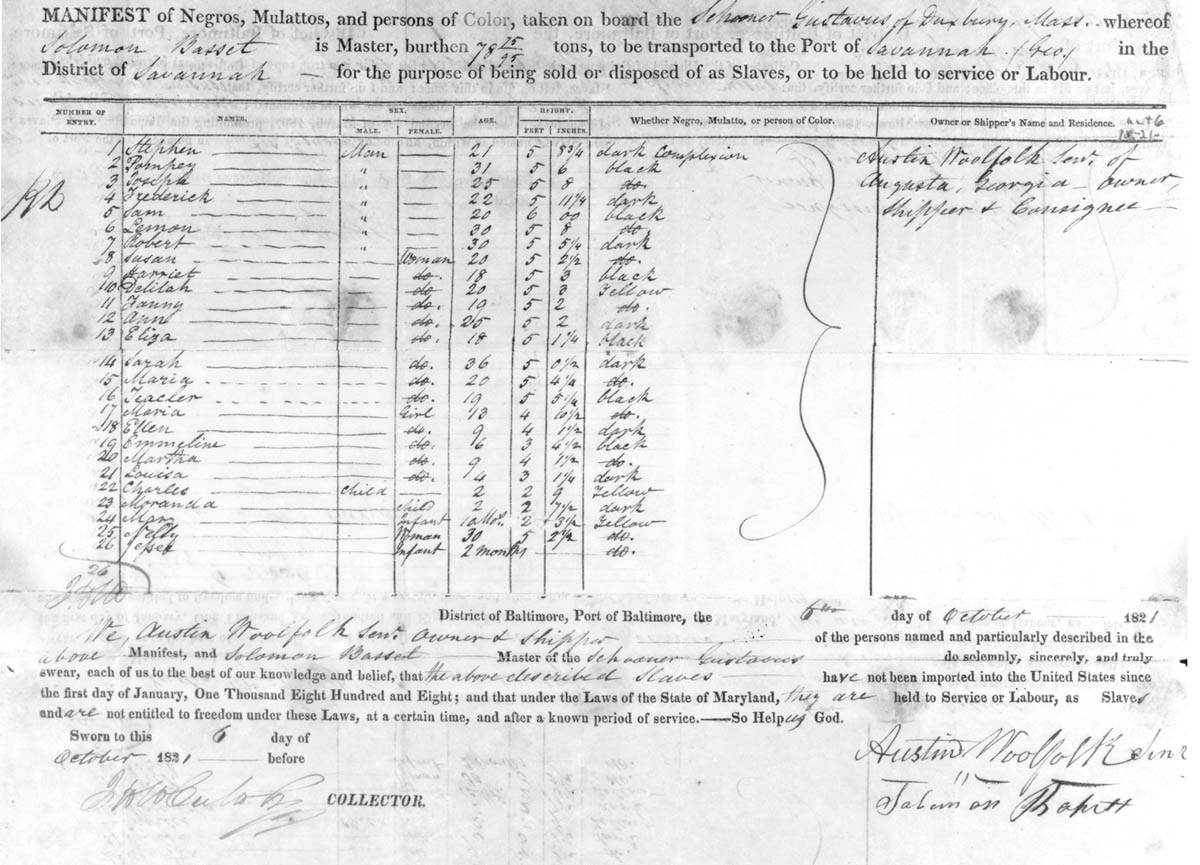 ________________________________ The abolitionist William Lloyd Garrison thought the U.S. Constitution was the result of a terrible bargain between freedom and slavery. Calling the Constitution a "covenant with death" and "an agreement with Hell," he refused to participate in American electoral politics because to do so meant supporting "the pro-slavery, war sanctioning Constitution of the United States." Instead, under the slogan "No Union with Slaveholders," the Garrisonians repeatedly argued for a dissolution of the Union. Part of Garrison's opposition to continuing the Union stemmed from a desire to avoid the corruption that came from participating in a government created by the proslavery Constitution. But this position was also at least theoretically pragmatic. The Garrisonians were convinced that the legal protection of slavery in the Constitution made political activity futile, while support for the Constitution merely strengthened the stranglehold slavery had on America. In 1845 Wendell Phillips pointed out that in the years since the adoption of the Constitution, Americans had witnessed "the slaves trebling in numbers—slaveholders monopolizing the offices and dictating the policy of the Government-prostituting the strength and influence of the Nation to the support of slavery here and elsewhere—trampling on the rights of the free States, and making the courts of the country their tools." Phillips argued that this experience proved "that it is impossible for free and slave States to unite on any terms, without all becoming partners in the guilt and responsible for the sin of slavery." Garrison's Constitution The Covenant with Death and How It Was Made By Paul Finkelman, 2000 https://www.archives.gov/publications/prologue/2000/winter/garrisons-constitution-1.html Thomas Jefferson, A Summary View of the Rights of British America, August 1774 "For the most trifling reasons, and sometimes for no conceivable reason at all, his majesty has rejected laws of the most salutary tendency. The abolition of domestic slavery is the great object of desire in those colonies, where it was unhappily introduced in their infant state. But previous to the enfranchisement of the slaves we have, it is necessary to exclude all further importations from Africa; yet our repeated attempts to effect this by prohibitions, and by imposing duties which might amount to a prohibition, have been hitherto defeated by his majesty’s negative: Thus preferring the immediate advantages of a few African corsairs to the lasting interests of the American states, and to the rights of human nature, deeply wounded by this infamous practice. Nay, the single interposition of an interested individual against a law was scarcely ever known to fail of success, though in the opposite scale were placed the interests of a whole country. That this is so shameful an abuse of a power trusted with his majesty for other purposes, as if not reformed, would call for some legal restrictions. . . " http://teachingamericanhistory.org/files/2018/09/Documents-and-Debates-in-American-History-and-Government-Vol.-1-and-Vol.-2.pdf Conceived in Liberty, by Murray Rothbard Chapter 18 Slavery in Virginia Page 584 "The prevalent practice of fornication by the masters with the female slaves was regarded as “a pleasant method to secure slaves at a cheap rate.” |
|||||||||||
|
Joe Kelley Administrator
|
http://teachingamericanhistory.org/ratification/elliot/vol1/approaches/ 14th October, 1775 ___________________________ On the same day, Congress unanimously resolved, “that the respective colonies are entitled to the common law of England, and more especially to the great and inestimable privilege of being tried by their peers of the vicinage according to the course of that law.” They further resolved, “that they were entitled to the benefit of such of the English statutes as existed at the time of their colonization, and which they have, by experience, respectively found to be applicable to their several and local circumstances.” They also resolved, that their ancestors, at the time of their immigration, were “entitled to all the rights, liberties, and immunities, of free and natural-born subjects within the realms of England.” ____________________________________ http://avalon.law.yale.edu/18th_century/jeffvir.asp _________________________________________ Laws The state is divided into counties. In every county are appointed magistrates, called justices of the peace, usually from eight to thirty or forty in number, in proportion to the size of the county, of the most discreet and honest inhabitants. They are nominated by their fellows, but commissioned by the governor, and act without reward. These magistrates have jurisdiction both criminal and civil. If the question before them be a question of law only, they decide on it themselves: but if it be of fact, or of fact and law combined, it must be referred to a jury. In the latter case, of a combination of law and fact, it is usual for the jurors to decide the fact, and to refer the law arising on it to the decision of the judges. But this division of the subject lies with their discretion only. And if the question relate to any point of public liberty, or if it be one of those in which the judges may be suspected of bias, the jury undertake to decide both law and fact. If they be mistaken, a decision against right, which is casual only, is less dangerous to the state, and less afflicting to the loser, than one which makes part of a regular and uniform system. In truth, it is better to toss up cross and pile in a cause, than to refer it to a judge whose mind is warped by any motive whatever, in that particular case. But the common sense of twelve honest men gives still a better chance of just decision, than the hazard of cross and pile. These judges execute their process by the sheriff or coroner of the county, or by constables of their own appointment. If any free person commit an offence against the commonwealth, if it be below the degree of felony, he is bound by a justice to appear before their court, to answer it on indictment or information. If it amount to felony, he is committed to jail, a court of these justices is called; if they on examination think him guilty, they send him to the jail of the general court, before which court he is to be tried first by a grand jury of 24, of whom 13 must concur in opinion: if they find him guilty, he is then tried by a jury of 12 men of the county where the offence was committed, and by their verdict, which must be unanimous, he is acquitted or condemned without appeal. _____________________________________________ https://supreme.justia.com/cases/federal/us/1/236/ ___________________________________________ It is a matter well known, and well understood, that by the laws of our country, every question which affects a man's life, reputation, or property, must be tried by twelve of his peers; and that their unanimous verdict is, alone, competent to determine the fact in issue. If then, you undertake to enquire, not only upon what foundation the charge is made, but, likewise, upon what foundation it is denied, you will, in effect, usurp the jurisdiction of the Petty Jury, you will supercede the legal authority of the court, in judging of the competency and admissibility of witnesses, and, having thus undertaken to try the question, that question may be determined by a bare majority, or by a much greater number of your body, than the twelve peers prescribed by the law of the land. This point has, I believe, excited some doubts upon former occasions but those doubts have never arisen in the mind of any lawyer, and they may easily be removed by a proper consideration of the subject. For, the bills, or presentments, found by a grand Jury, amount to nothing more than an official accusation, in order to put the party accused upon his trial: 'till the bill is returned, there is, therefore, no charge from which he can be required to exculpate himself; and we know that many persons, against whom bills were returned, have been afterwards acquitted by a verdict of their country. Here then, is the just line of discrimination: It is the duty of the Grand Jury to enquire into the nature and probable grounds of the charge; but it is the exclusive province of the Petty Jury, to hear and determine, with the assistance, and under the direction of the court, upon points of law, whether the Defendant is, or is not guilty, on the whole evidence, for, as well as against, him. You will therefore, readily perceive, that if you examine the witnesses on both sides, you do not confine your consideration to the probable grounds of charge, but engage completely in the trial of the cause; and your return must, consequently, be tantamount to a verdict of acquital, or condemnation. But this would involve us in another difficulty; for, by the law it is declared that no man shall be twice put in jeopardy for the same offence: and, yet, it is certain that the enquiry, now proposed by the Grand Jury, would necessarily introduce the oppression of a double trial. Nor is it merely upon maxims of law, but, I think, likewise, upon principles of humanity, that this innovation should be opposed. __________________________________________________ http://teachingamericanhistory.org/ratification/elliot/vol1/approaches/ ____________________________________________ That the question was not whether, by a declaration of independence, we should make ourselves what we are not; but whether we should declare a fact which already exists: That, as to the people or Parliament of England, we had always been independent of them, their restraints on our trade deriving efficacy from our acquiescence only, and not from any rights they possessed of imposing them; and that, so far, our connection had been federal only, and was now dissolved by the commencement of hostilities: That, as to the king, we had been bound to him by allegiance, but that this bond was now dissolved by his assent to the late act of Parliament, by which he declares us out of his protection, and by his levying war on us a fact which had long ago proved us out of his protection, it being a certain position in law, that allegiance and protection are reciprocal, the one ceasing when the other is withdrawn: June 8, 1776 _________________________________ https://founders.archives.gov/documents/Jefferson/01-01-02-0160 |
|||||||||||
|
Joe Kelley Administrator
|
http://unionstatesassembly.info/journals/summaries/A%20Brief%20History%20of%20the%20ONLY%20Lawful%20Government.pdf Quote_________________________________ Here are the exact words for the approval of the Convention proposal (Constitution for the United States): “Resolved, That the proceeding Constitution be laid before the United States in Congress assembled, that is should afterwards be submitted to a Convention of Delegates, chosen in each State by the People thereof, under the Recommendation of its Legislature, for their Assent and Ratification; and that each Convention assenting to, and ratifying the Same, should give Notice thereof to the United States in Congress assembled.” This violates existing federal law (the Articles of Confederation and perpetual Union) in terms of how changes to the law form are to take place. Here, the Convention tells Congress to just look at (“be laid before”) the Constitution for the United States and then pass it on to the states. Article 13 of the Articles of Confederation and perpetual Union addresses changes to the law form and says “Every state shall abide by the determinations of the united states in congress assembled, on all questions which by this confederation are submitted to them. And the Articles of this confederation shall be inviolably observed by every state, and the union shall be perpetual; nor shall any alteration at any time hereafter be made in any of them; unless such alteration be agreed to in a congress of the united states, and be afterwards confirmed by the legislatures of every state.” (Emphasis added) Notice the difference? With existing law, Congress FIRST has to agree to any proposed changes/alterations and then send it to the States for their approval. The recommendation from the Federal Convention bypasses Congress’s approval process, thus a violation of existing federal law. By violating federal law, the resolution of February 21, agreeing to only have the Federal Convention for the sole and express purpose of making alterations to the Articles of Confederation and perpetual Union (existing law) and NOT for a new type of government, and then the Federal Convention delegates propose to break federal law again by NOT abiding by Article 13 of the Articles of Confederation and perpetual Union by ignoring the approved process to change federal law. The “new and proposed” law form (Constitution for the United States) requires 2/3 majority to make changes or bring into execution the “new and proposed” law form, again violating existing law that requires a unanimous vote to make changes. Let’s look at the letter from Washington given to Congress. In the first paragraph is says “. . . a different organization.” The 2nd paragraph says “. . . give up a share of liberty . . . rights to be surrendered . . .” Clearly he is informing Congress that the proposed Constitution for the United States will not be pleasant to those states that want to retain their sovereignty, and the people that populate them. On September 27, 1787 Congress reads, for the first time, the proposals from the Federal Convention. Please read this passage from the Journals of the Continental Congress for this date carefully. These are the smoking guns of all smoking guns proving, once and for all, the unlawfulness, according to the law of the time, of the Constitution for the United States. Simply put, it was not brought forth and put into place according to the law of time, thereby making it 100% unlawful, meaningless, and irrelevant! (See Volume 33, pages 540-542). “On motion of Mr. [Edward] Carrington seconded by Mr. [William] Bingham the motion of Mr. [Abraham] Clark was postponed to take into consideration the following motion viz “Congress proceeded to the consideration of the Constitution for the United States by the late Convention held in the City of Philadelphia and thereupon resolved That Congress do agree thereto and that it be recommended to the legislatures of the several states to cause conventions to be held as speedily as may be to the end that the same may be adopted ratified and confirmed.” Yes, this is ACTUALLY stricken out in the Journals but still there to be able to be read. It clearly shows treason, and thus stricken out as if it never occurred. One can only conclude it is still in the Journals to provide remedy for those wishing to regain their freedom. What is treasonous about this? Simple, the fact the Congress took a vote to approve of the Constitution for the United States, clearly breaking federal law as Congress can ONLY deal with existing Federal law, the Articles of Confederation and perpetual Union, and not discuss any other law form. _____________________________________________ http://unionstatesassembly.info/journals/summaries/A%20Brief%20History%20of%20the%20ONLY%20Lawful%20Government.pdf |
|||||||||||
|
Joe Kelley Administrator
|
http://www.barefootsworld.net/antifederalist.html#afp41-43B "A federal, or rather a national city, ten miles square, containing a hundred square miles, is about four times as large as London; and for forts, magazines, arsenals, dock yards, and other needful buildings, congress may possess a number of places or towns in each state. It is true, congress cannot have them unless the state legislatures cede them; but when once ceded, they never can be recovered. And though the general temper of the legislatures may be averse to such cessions, yet many opportunities and advantages may be taken of particular times and circumstances of complying assemblies, and of particular parties, to obtain them. It is not improbable, that some considerable towns or places, in some intemperate moments, or influenced by anti-republican principles, will petition to be ceded for the purposes mentioned in the provision. There are men, and even towns, in the best republics, which are often fond of withdrawing from the government of them, whenever occasion shall present. The case is still stronger. If the provision in question holds out allurements to attempt to withdraw, the people of a state must ever be subject to state as well as federal taxes; but the federal city and places will be subject only to the latter, and to them by no fixed proportion. Nor of the taxes raised in them, can the separate states demand any account of congress. These doors opened for withdrawing from the state governments entirely, may, on other accounts, be very alluring and pleasing to those anti-republican men who prefer a place under the wings of courts. "If a federal town be necessary for the residence of congress and the public officers, it ought to be a small one, and the government of it fixed on republican and common law principles, carefully enumerated and established by the constitution. it is true, the states, when they shall cede places, may stipulate that the laws and government of congress in them shall always be formed on such principles. But it is easy to discern, that the stipulations of a state, or of the inhabitants of the place ceded, can be of but little avail against the power and gradual encroachments of the union. The principles ought to be established by the federal constitution, to which all states are parties; but in no event can there be any need of so large a city and places for forts, etc. , totally exempted from the laws and jurisdictions of the state governments. "If I understand the constitution, the laws of congress, constitutionally made, will have complete and supreme jurisdiction to all federal purposes, on every inch of ground in the United States, and exclusive jurisdiction on the high seas, and this by the highest authority, the consent of the people. Suppose ten acres at West Point shall be used as a fort of the union, or a sea port town as a dockyard: the laws of the union, in those places, respecting the navy, forces of the union, and all federal objects, must prevail, be noticed by all judges and officers, and executed accordingly. And I can discern no one reason for excluding from these places, the operation of state laws, as to mere state purpose for instance, for the collection of state taxes in them; recovering debts; deciding questions of property arising within them on state laws; punishing, by state laws, theft, trespasses, and offenses committed in them by mere citizens against the state law. "The city, and all the places in which the union shall have this exclusive jurisdiction, will be immediately under one entire government, that of the federal head, and be no part of any state, and consequently no part of the United States. The inhabitants of the federal city and places, will be as much exempt from the laws and control of the state governments, as the people of Canada or Nova Scotia will be. Neither the laws of the states respecting taxes, the militia, crimes of property, will extend to them; nor is there a single stipulation in the constitution, that the inhabitants of this city, and these places, shall be governed by laws founded on principles of freedom. All questions, civil and criminal, arising on the laws of these places, which must be the laws of congress, must be decided in the federal courts; and also, all questions that may, by such judicial fictions as these courts may consider reasonable, be supposed to arise within this city, or any of these places, may be brought into these courts. By a very common legal fiction, any personal contract may be supposed to have been made in any place. A contract made in Georgia may be supposed to have been made in the federal city; the courts will admit the fiction. . . . " Richard Henry Lee, 6th President of the United States of America in Congress Assembled, writing in opposition to the National (1789) Constitutional (criminal) usurpation by "legal fiction." https://teachingamericanhistory.org/library/document/federal-farmer-xviii/ Federal Farmer XVIII Richard Henry Lee, January 25, 1788 |
|||||||||||
|
Joe Kelley Administrator
|
"In the Athenian state, as in any other, we can distinguish legislative, judicial, and executive functions. The Athenian legislative branch consisted of two bodies, a Council of 500 and an Assembly of 6000. At first glance, this system resembles the American bicameral legislature, with a small, select upper house and a larger, more popular lower house. But this appearance is deceptive. "To begin with, neither the Council nor the Assembly consisted of elected representatives. The members of the Council were selected not by election but by sortition — i.e., by lot. In other words, the 500 Councillors were selected randomly from the (male) citizen population. (And no Councillor could serve more than two terms.) The practice of selecting government officials randomly (and the Athenians developed some fairly sophisticated mechanical gadgets to ensure that the selection really was random, and to make cheating extremely difficult) is one of the most distinctive features of the Athenian constitution. We think of electoral politics as the hallmark of democracy; but elections were almost unknown at Athens, because they were considered paradigmatically anti-democratic. Proposals to replace sortition with election were always condemned as moves in the direction of oligarchy. "Why? Well, as the Athenians saw it, under an electoral system no one can obtain political office unless he is already famous: this gives prominent politicians an unfair advantage over the average person. Elections, they thought, favor those wealthy enough to bribe the voters, powerful enough to intimidate the voters, flashy enough to impress the voters, or clever enough to deceive the voters. The most influential political leaders were usually Horsemen anyway, thanks to their social prominence and the political following they could obtain by dispensing largesse among the masses. (One politician, Kimon, won the loyalty of the poor by leaving his fields and orchards unfenced, inviting anyone who was hungry to take whatever he needed.) If seats on the Council had been filled by popular vote, the Horsemen would have disproportionately dominated it — just as, today, Congress is dominated by those who can afford expensive campaigns, either through their own resources or through wealthy cronies. Or, to take a similar example, in the United States women have had the vote for over half a century, and yet, despite being a majority of the population, they represent only a tiny minority of elected officials. Obviously, the persistence of male dominance in the economic and social sphere has translated into women mostly voting for male candidates. The Athenians guessed, probably rightly, that the analogous prestige of the upper classes would lead to commoners mostly voting for aristocrats. "That is why the Athenians saw elections as an oligarchical rather than a democratic phenomenon. Above all, the Athenians feared the prospect of government officials forming a privileged class with separate interests of their own. Through reliance on sortition, random selection by lot, the Council could be guaranteed to represent a fair cross-section of the Athenian people — a kind of proportional representation, as it were. Random selection ensured that those selected would be representatives of the people as a whole, whereas selection by vote made those selected into mere representatives of the majority." http://www.freenation.org/a/f41l1.html |
|||||||||||
|
Joe Kelley Administrator
|
http://www.barefootsworld.net/antifederalist.html#afp03 http://resources.utulsa.edu/law/classes/rice/Constitutional/AntiFederalist/03.htm No. 3 - New Constitution Creates A National Government; Will Not Abate Foreign Influence; Dangers Of Civil War And Despotism ___________________________________ Like the nome de plume "Publius" used by pro Constitution writers in the Federalist Papers, several Anti-Federalists signed their writings "A FARMER. " While the occupation of the writers may not have coincided with the name given, the arguments against consolidating power in the hands of a central government were widely read. The following was published in the Maryland Gazette and Baltimore Advertiser, March 7, 1788. The true identity of the author is unknown. _____________________________________ There are but two modes by which men are connected in society, the one which operates on individuals, this always has been, and ought still to be called, national government; the other which binds States and governments together (not corporations, for there is no considerable nation on earth, despotic, monarchical, or republican, that does not contain many subordinate corporations with various constitutions) this last has heretofore been denominated a league or confederacy. The term federalists is therefore improperly applied to themselves, by the friends and supporters of the proposed constitution. This abuse of language does not help the cause; every degree of imposition serves only to irritate, but can never convince. They are national men, and their opponents, or at least a great majority of them, are federal, in the only true and strict sense of the word. Whether any form of national government is preferable for the Americans, to a league or confederacy, is a previous question we must first make up our minds upon. . . . That a national government will add to the dignity and increase the splendor of the United States abroad, can admit of no doubt: it is essentially requisite for both. That it will render government, and officers of government, more dignified at home is equally certain. That these objects are more suited to the manners, if not [the] genius and disposition of our people is, I fear, also true. That it is requisite in order to keep us at peace among ourselves, is doubtful. That it is necessary, to prevent foreigners from dividing us, or interfering in our government, I deny positively; and, after all, I have strong doubts whether all its advantages are not more specious than solid. We are vain, like other nations. We wish to make a noise in the world; and feel hurt that Europeans are not so attentive to America in peace, as they were to America in war. We are also, no doubt, desirous of cutting a figure in history. Should we not reflect, that quiet is happiness? That content and pomp are incompatible? I have either read or heard this truth, which the Americans should never forget: That the silence of historians is the surest record of the happiness of a people. The Swiss have been four hundred years the envy of mankind, and there is yet scarcely an history of their nation. What is history, but a disgusting and painful detail of the butcheries of conquerors, and the woeful calamities of the conquered? Many of us are proud, and are frequently disappointed that office confers neither respect nor difference. No man of merit can ever be disgraced by office. A rogue in office may be feared in some governments - he will be respected in none. After all, what we call respect and difference only arise from contrast of situation, as most of our ideas come by comparison and relation. Where the people are free there can be no great contrast or distinction among honest citizens in or out of office. In proportion as the people lose their freedom, every gradation of distinction, between the Governors and governed obtains, until the former become masters, and the latter become slaves. In all governments virtue will command reverence. The divine Cato knew every Roman citizen by name, and never assumed any preeminence; yet Cato found, and his memory will find, respect and reverence in the bosoms of mankind, until this world returns into that nothing, from whence Omnipotence called it. That the people are not at present disposed for, and are actually incapable of, governments of simplicity and equal rights, I can no longer doubt. But whose fault is it? We make them bad, by bad governments, and then abuse and despise them for being so. Our people are capable of being made anything that human nature was or is capable of, if we would only have a little patience and give them good and wholesome institutions; but I see none such and very little prospect of such. Alas! I see nothing in my fellow-citizens, that will permit my still fostering the delusion, that they are now capable of sustaining the weight of SELF-GOVERNMENT: a burden to which Greek and Roman shoulders proved unequal. The honor of supporting the dignity of the human character, seems reserved to the hardy Helvetians alone. If the body of the people will not govern themselves, and govern themselves well too, the consequence is unavoidable - a FEW will, and must govern them. Then it is that government becomes truly a government by force only, where men relinquish part of their natural rights to secure the rest, instead of an union of will and force, to protect all their natural rights, which ought to be the foundation of every rightful social compact. Whether national government will be productive of internal peace, is too uncertain to admit of decided opinion. I only hazard a conjecture when I say, that our state disputes, in a confederacy, would be disputes of levity and passion, which would subside before injury. The people being free, government having no right to them, but they to government, they would separate and divide as interest or inclination prompted - as they do at this day, and always have done, in Switzerland. In a national government, unless cautiously and fortunately administered, the disputes will be the deep-rooted differences of interest, where part of the empire must be injured by the operation of general law; and then should the sword of government be once drawn (which Heaven avert) I fear it will not be sheathed, until we have waded through that series of desolation, which France, Spain, and the other great kingdoms of the world have suffered, in order to bring so many separate States into uniformity, of government and law; in which event the legislative power can only be entrusted to one man (as it is with them) who can have no local attachments, partial interests, or private views to gratify. That a national government will prevent the influence or danger of foreign intrigue, or secure us from invasion, is in my judgment directly the reverse of the truth. The only foreign, or at least evil foreign influence, must be obtained through corruption. Where the government is lodged in the body of the people, as in Switzerland, they can never be corrupted; for no prince, or people, can have resources enough to corrupt the majority of a nation; and if they could, the play is not worth the candle. The facility of corruption is increased in proportion as power tends by representation or delegation, to a concentration in the hands of a few. . . . As to any nation attacking a number of confederated independent republics . . . it is not to be expected, more especially as the wealth of the empire is there universally diffused, and will not be collected into any one overgrown, luxurious and effeminate capital to become a lure to the enterprizing ambitious. That extensive empire is a misfortune to be deprecated, will not now be disputed. The balance of power has long engaged the attention of all the European world, in order to avoid the horrid evils of a general government. The same government pervading a vast extent of territory, terrifies the minds of individuals into meanness and submission. All human authority, however organized, must have confined limits, or insolence and oppression will prove the offspring of its grandeur, and the difficulty or rather impossibility of escape prevents resistance. Gibbon relates that some Roman Knights who had offended government in Rome were taken up in Asia, in a very few days after. It was the extensive territory of the Roman republic that produced a Sylla, a Marius, a Caligula, a Nero, and an Elagabalus. In small independent States contiguous to each other, the people run away and leave despotism to reek its vengeance on itself; and thus it is that moderation becomes with them, the law of self-preservation. These and such reasons founded on the eternal and immutable nature of things have long caused and will continue to cause much difference of sentiment throughout our wide extensive territories. From our divided and dispersed situation, and from the natural moderation of the American character, it has hitherto proved a warfare of argument and reason. A FARMER |
|||||||||||
|
Joe Kelley Administrator
|
No. 15 – Rhode Island Is Right! This essay appeared in The Massachusetts Gazette, December 7, 1787, as reprinted From The Freeman's Journal; (Or, The North-American Intelligencer?) The abuse which has been thrown upon the state of Rhode Island seems to be greatly unmerited. Popular favor is variable, and those who are now despised and insulted may soon change situations with the present idols of the people. Rhode Island has out done even Pennsylvania in the glorious work of freeing the Negroes in this country, without which the patriotism of some states appears ridiculous. The General Assembly of the state of Rhode Island has prevented the further importation of Negroes, and have made a law by which all blacks born in that state after March, 1784, are absolutely and at once free. They have fully complied with the recommendations of Congress in regard to the late treaty of peace with Great Britain, and have passed an act declaring it to be the law of the land. They have never refused their quota of taxes demanded by Congress, excepting the five per cent impost, which they considered as a dangerous tax, and for which at present there is perhaps no great necessity, as the western territory, of which a part has very lately been sold at a considerable price, may soon produce an immense revenue; and, in the interim, Congress may raise in the old manner the taxes which shall be found necessary for the support of the government. The state of Rhode Island refused to send delegates to the Federal Convention, and the event has manifested that their refusal was a happy one as the new constitution, which the Convention has proposed to us, is an elective monarchy, which is proverbially the worst government. This new government would have been supported at a vast expense, by which our taxes - the right of which is solely vested in Congress, (a circumstance which manifests that the various states of the union will be merely corporations) - would be doubled or trebled. The liberty of the press is not stipulated for, and therefore may be invaded at pleasure. The supreme continental court is to have, almost in every case, "appellate jurisdiction, both as to law and fact," which signifies, if there is any meaning in words, the setting aside the trial by jury. Congress will have the power of guaranteeing to every state a right to import Negroes for twenty one years, by which some of the states, who have now declined that iniquitous traffic, may re-enter into it - for the private laws of every state are to submit to the superior jurisdiction of Congress. A standing army is to be kept on foot, by which the vicious, the sycophantick, and the time-serving will be exalted, and the brave, the patriotic, and the virtuous will be depressed. The writer, therefore, thinks it the part of wisdom to abide, like the state of Rhode Island, by the old articles of confederation, which, if re-examined with attention, we shall find worthy of great regard; that we should give high praise to the manly and public spirited sixteen members, who lately seceded from our house of Assembly [in Pennsylvania]; and that we should all impress with great care, this truth on our minds - That it is very easy to change a free government into an arbitrary one, but that it is very difficult to convert tyranny into freedom. http://www.barefootsworld.net/antifederalist.html#afp15 |
|||||||||||
|
Joe Kelley Administrator
|
More "information" from a poser: "Ten years later, in 1878, another travesty was allowed to occur. This one involved the similar incorporation of the Municipal (city state) government of Washington, DC. The actual Constitution allowed Congress "plenary" control of Washington, DC, so they took advantage of this fact to make Washington, DC an independent international city-state run by another commercial corporation under their own auspices. This then gave rise to the "Constitution of the United States"--- another corporate charter masquerading as a valid treaty document." How does that "information" compare to the message offered by the 6th President of the United States of America (before 1787) Richard Henry Lee here: http://www.barefootsworld.net/antifederalist.html#afp41-43B "A federal, or rather a national city, ten miles square, containing a hundred square miles, is about four times as large as London; and for forts, magazines, arsenals, dock yards, and other needful buildings, congress may possess a number of places or towns in each state. It is true, congress cannot have them unless the state legislatures cede them; but when once ceded, they never can be recovered. And though the general temper of the legislatures may be averse to such cessions, yet many opportunities and advantages may be taken of particular times and circumstances of complying assemblies, and of particular parties, to obtain them. It is not improbable, that some considerable towns or places, in some intemperate moments, or influenced by anti-republican principles, will petition to be ceded for the purposes mentioned in the provision. There are men, and even towns, in the best republics, which are often fond of withdrawing from the government of them, whenever occasion shall present. The case is still stronger. If the provision in question holds out allurements to attempt to withdraw, the people of a state must ever be subject to state as well as federal taxes; but the federal city and places will be subject only to the latter, and to them by no fixed proportion. Nor of the taxes raised in them, can the separate states demand any account of congress. These doors opened for withdrawing from the state governments entirely, may, on other accounts, be very alluring and pleasing to those anti-republican men who prefer a place under the wings of courts. "If a federal town be necessary for the residence of congress and the public officers, it ought to be a small one, and the government of it fixed on republican and common law principles, carefully enumerated and established by the constitution. it is true, the states, when they shall cede places, may stipulate that the laws and government of congress in them shall always be formed on such principles. But it is easy to discern, that the stipulations of a state, or of the inhabitants of the place ceded, can be of but little avail against the power and gradual encroachments of the union. The principles ought to be established by the federal constitution, to which all states are parties; but in no event can there be any need of so large a city and places for forts, etc. , totally exempted from the laws and jurisdictions of the state governments. "If I understand the constitution, the laws of congress, constitutionally made, will have complete and supreme jurisdiction to all federal purposes, on every inch of ground in the United States, and exclusive jurisdiction on the high seas, and this by the highest authority, the consent of the people. Suppose ten acres at West Point shall be used as a fort of the union, or a sea port town as a dockyard: the laws of the union, in those places, respecting the navy, forces of the union, and all federal objects, must prevail, be noticed by all judges and officers, and executed accordingly. And I can discern no one reason for excluding from these places, the operation of state laws, as to mere state purpose for instance, for the collection of state taxes in them; recovering debts; deciding questions of property arising within them on state laws; punishing, by state laws, theft, trespasses, and offenses committed in them by mere citizens against the state law. "The city, and all the places in which the union shall have this exclusive jurisdiction, will be immediately under one entire government, that of the federal head, and be no part of any state, and consequently no part of the United States. The inhabitants of the federal city and places, will be as much exempt from the laws and control of the state governments, as the people of Canada or Nova Scotia will be. Neither the laws of the states respecting taxes, the militia, crimes of property, will extend to them; nor is there a single stipulation in the constitution, that the inhabitants of this city, and these places, shall be governed by laws founded on principles of freedom. All questions, civil and criminal, arising on the laws of these places, which must be the laws of congress, must be decided in the federal courts; and also, all questions that may, by such judicial fictions as these courts may consider reasonable, be supposed to arise within this city, or any of these places, may be brought into these courts. By a very common legal fiction, any personal contract may be supposed to have been made in any place. A contract made in Georgia may be supposed to have been made in the federal city; the courts will admit the fiction. . . ." Richard Henry Lee, 6th President of the United States of America in Congress Assembled __________________________________________ If the words in that picture are true, then what is the process by which people consent to any codes, statutes, constitutions, or other written statements, records, claimed to be legal? Example: "US. SUPREEME COURT DECISION - The common law is the real law, the Supreme Law of the land, the code, rules, regulations, policy and statutes are "not the law", [Self v. Rhay, 61 Wn (2d) 261]" |
|||||||||||
|
Joe Kelley Administrator
|
http://www.richardhenrylee.org/ ________________________ Extreme shyness prevented his taking any part in the debates for some time in House of Burgesses. His first speech was on a motion: "to lay so heavy a duty on the importation of slaves as effectually to put an end to that iniquitous and disgraceful traffic within the colony of Virginia." On this occasion, his hatred of slavery overcame his timidity and he made a powerful speech supplying proofs of principal points of view used by the northern Abolitionists through the 1860's. Lee had no profession beyond his public service. Like Samuel Adams, he was a professional politician. In times of need, especially when the real estate market declined after the French and Indian War, he found no other way to provide for his family than seeking lucrative appointive governmental offices. _______________________________________ |
|||||||||||
|
Joe Kelley Administrator
|
http://ismor.com/cornwallis/cornwallis_2001/CVI_2001_Visco.pdf More Than You Ever Wanted to Know About Posse Comitatus E. P. Visco __________________________________ The execution of warrants for the return of escaped slaves was resisted in Pennsylvania. A posse was summoned to aid the commissioners but the posse refused to act. A federal judge asked President Millard Fillmore if he (the judge) could call for US troops as might be available. The president held two cabinet meetings to discuss the problem; there was unanimous agreement among the cabinet members that it should be done (that is, military force should be called out to help civil officers execute the Fugitive Slave Law). There was, however, disagreement on how the military should be called out. The president thought he had authority to call on troops without issuing a cease and desist order (as called for in the 1807 act). Some cabinet members disagreed; some felt that marshals might themselves call on members of Army as citizens to form part of posse comitatus. The cabinet decided on a mixture: give authority to US marshals and deputies to call for troops when a district judge or justice of Supreme Court ”should certify that in his opinion it was necessary” (Coakley, p. 128) ______________________________ |
|||||||||||
|
Joe Kelley Administrator
|
Liberty, as I understand the idea, is intolerance of intolerance. In other words the Golden Rule. In other words: do no harm enforced by making sure that doing harm earns the one harming all the costs that they cause: within the boundaries of human conscience. |
|||||||||||
|
Joe Kelley Administrator
|
American Nightmare: How Government Undermines the Dream of Homeownership (Google book) Abolishing primogeniture and entail eventually led to a more egalitarian nation. "No sooner was the law of primogeniture abolished than fortunes began to diminish, and all the families of the country were simultaneously reduced to a state in which labor became necessary to procure the means of subsistence," observed Alexis de Tocqueville in he early 1830s. Just having the land does not mean that the owners lived on it; instead, many held the land for speculative purposes or sold it to speculators. In the meantime, squatters often started farming lands wihtout a title. Squatters occupied some of George Washington's land in western Pennsylvania. He met with them in 1796, the last year of his presidency, and offered to sell the land to them. They preferred to dispute his title in court; the court decided in his favor and they had to leave. At the time of the Revolution, Virginia offered actual settlers 400 acres and North Carolina offered 640 acres "at the merest nominal price." Settlers in Main could also get 100 acres merely for clearing 16 within four years. Within tree years, Virginia settlers were required to build a house, plant one acre, and keep stock for one year, or they would lose the land. Just having the land does not mean that the owners lived on it; instead, many held the land for speculative purposes or sold it to speculators. In the meantime, squatters often started farming lands without a title. Squatters occupied some of George Washington's land in western Pennsylvania. He met with them in 1796, the last year of his presidency, and offered to sell the land to them. They preferred to dispute his title in court; the court decided in his favor and they had to leave. At the time of the Revolution, Virginia offered actual settlers 400 acres and North Carolina offered 640 acres "at the merest nominal price." Settlers in Main could also get 100 acres merely for clearing 16 within four years. Within tree years, Virginia settlers were required to build a house, plant one acre, and keep stock for one year, or they would lose the land. After the Revolution, the 1783 Treaty of Paris recognized the United States' sovereignty over land as far west as the Mississippi River. The states ceded to the United States their claims to land west of Appalachians - about 237 million acres of land that eventually became Alabama, Kentucky, Illinois, Indiana, Michigan, Mississippi, Ohio, Tennessee, Wisconsin, and much of Minnesota. That was a huge amount of land, about 60 acres for every resident of the United States in 1790. Rather than give the land to settlers, however, Congress, at the urging of Alexander Hamilton, tried to sell the land to pay off the nation's debt. In contrast to Hamilton, Jefferson was against selling land to pay the national debt. "The people who will migrate to the Westward whether they form part of the old, or of a new colony will be subject to their proportion of the Continental debt then unpaid," he wrote in 1776. "They ought not be subject to more." But by 1784, even Jefferson had accepted the idea of his land ordinance of that year provided for sales. In 1785, Congress asked a minimum of 1$ an acre in cash for blocks of at least 640 acres. The lands were to be sold at auction, but only after lands had been surveyed. Surveys were slower than anticipated, and only about 1.5 million acres were sold to private parties, mostly speculators, under this system. In 1796, Congress raised the price to 2$ an acre for a minimum of 640 acres, with half the money paid within 30 days and the other half within a year. That amount may sound inexpensive today, but in late 18th century those were high prices: based on the consumer price index, $640 dollars in 1785 would be almost $15,000 today. More significantly, in relation to the wages earned by unskilled workers, it would be more than 240,000 today. That amount is far more than an unskilled worker could pay in cash, especially for land that initially at least would have to be worked on a subsistence basis since it was located too far from markets to sell any crops. As a result, sales were slow, averaging only a little more than 500 640-acre parcels per year from 1800 through 1810. In 1800, Congress reduced the down payment to one-twentieth of the total cost and extended the time allowed for full payment, at 6 percent interest, to four years. The 1800 law also reduced the minimum number of acres that could be purchased to 320, which was reduced still further to 160 acres in 1804. The low down payment encouraged speculators, while the high cost per acre still led large numbers of settlers to default on their payments, especially after the recession of 1819. As a result, in 1820 Congress once again changed the terms of land sales: purchasers could buy a few as 80 acres for 1.25 an acre. To discourage speculation, all purchases were to be in cash. One settler who had trouble gaining secure title to land was Thomas Lincoln, the father of the future president. In 1803, he purchased a 250-acre farm in Kentucky for 118 English punds, but lost 38 acres of it because of an erroneous recording of the land survey. Five years later, he made a $200 down payment on a 348-acre farm, but lost the farm and the down payment because of a title dispute. He then bought a third farm that was part of a 10,000-acre grant received by Thomas Middleton in 1784. Lincoln and nine other farmers who had purchased part of that grant lost their land in a title dispute with Middleton's heirs. As one historian comments, "There were likely no people in America so cursed with land litigation as the pioneer Kentuckians, because of the lack of adequate land regulations pertaining to priority of ownership." Giving up on Kentucky, in 1816 Lincoln moved his family to Indiana. There he claimed 160 acres of federal land in 1817 with a down payment of $16, or one-twentieth of the total costs. Within 40 days, as specified by law, he paid another $64, bringing his total payment to one-fourth of the cost. However, he was unable to make any further payments. In 1821, Congress passed a law extending the payment period to as long as eight years. In 1827, Lincoln gave up some of his land to gain clear title of the rest, but then turned around and sold the land in 1830. Congress debated the sale of trans-Appalachian lands for more than 70 years. "More than half our time has been taken up with the discussion of propositions connected with the public lands," complained South Carolina Senator Robert Hayne in 1830. "Day after day the charges are rung on this topic, from the grave inquiry into the rights of the new States to the absolute sovereignty and property in the soil, down to the grant of a preemption to a few quarter sections to actual settlers." Meanwhile, settlers who could not afford to put up $640 were nevertheless moving west of the mountains, staking claims, and claiming squatters' rights to the land. In 1787, the federal government sent troops to burn homes and evict squatters along the Ohio River. But the squatters returned as soon as the troops left. From 1781 through 1788, Massachusetts aggressively tried to remove squatters from Maine. Continuing troubles with squatters contributed to the decision to spin off Maine as a separate state in 1820. Another obstacle to pioneers' taking title to the land was Indian ownership of some lands. Although the federal government recognized Indian title to much of the trans-Appalachian territory, it did not recognize the right of Indian tribes to sell land to white settlers. This policy and the government's acquisition was based on an 1823 Supreme Court decision, Jonson v. McIntosh, which in turn was based on a long-standing European tradition that only a sovereign nation has the right to extinguish Indians' interests in their land. The British government, for example, proclaimed in 1763 that "no private person do presume to make any purchase from the said Indians of any land reserved to the said Indians." Although the federal government did eventually negotiate the purchase of most trans-Appalachian lands from Indian tribes, the government's acquisition further delayed the ability of settlers to take title to land. In 1807, Jefferson ordered troops to expel squatters from lands recently purchased from the Chickasaw and Cherokee Indians as well as from lands still owned by Indians. 32 AMERICAN NIGHTMARE Giving Away the Federal Domain Eventually, Congress gave up on the idea of selling land to repay the Revolutionary War debt and began giving land to various groups. ___________________________________________ Quote:_____________________ To the officers and soldiers in the service of the king of Great Britain, not subjects of the said king : The citizens of the United States of America are engaged in a just and necessary war—a war in which they are not the only persons interested. They contend for the rights of human nature, and therefore merit the patronage and assistance of all mankind. Their success will secure a refuge from persecution and tyranny to those who wish to pursue the dictates of their own consciences, and to reap the fruits of their own industry. That kind Providence, who from seeming evil often produces real good, in permitting us to be involved in this cruel war, and you to be compelled to aid our enemies in their vain attempts to enslave us, doubtless hath in view to establish perfect freedom in the new world, for those who are borne down by the oppression and tyranny of the old. Considering, therefore, that you are reluctantly compelled to be instruments of avarice and ambition, we not only forgive the injuries which you have been constrained to offer us, but we hold out to your acceptance a participation of the privileges of free and independent states. Large and fertile tracts of country invite and will amply reward your industry. Townships, from twenty to thirty thousand acres of land, shall be laid out and appropriated to such of you as will come over to us, in the following manner. [Every captain who shall bring with himself forty men from the service of the enemy, before the first day of September, 1778, shall receive eight hundred acres of good woodland; also four oxen, one bull, three cows, and four hogs.2 If this captain is accompanied with his lieutenant, the lieutenant shall receive four hundred acres of woodland, also two oxen, two cows, and four hogs. [Every sergeant who shall accompany his captain shall receive two hundred acres of land, two oxen, one bull, one cow, and three hogs. [Every soldier who shall accompany his captain shall receive fifty acres of land, one ox, one cow, and two hogs. [If a lieutenant, or other commissioned officer under the rank of a captain, shall bring off from his company twenty five men, he shall receive six hundred acres of land, two oxen, two cows, and four hogs. [Every sergeant, or non-commissioned officer who shall bring off parties of men, shall receive an additional bounty of twenty acres of land for every man so brought off. And every soldier, who shall come off without a commissioned or non-commissioned officer, shall receive fifty acres of land; and if he brings off his arms and accoutrements, an additional bounty of twenty dollars. Both Officers and Soldiers who shall come off together, shall be at Liberty either to separate themselves, or to unite for the purpose of affording to each other Mutual Succor in the Establishments they make, and to form themselves into Townships after the Model of many German Settlements in various Parts of these States, which Exhibit an Example of that Happiness which is now offered to those who are wise Enough to accept of it. [Such officers and soldiers shall be at Liberty immediately to employ themselves in the settlement of their farms, without being obliged to do any military duty;2 and they shall receive rations in proportion to their rank for the space of six weeks.3 [The stock hereby offered shall be given to such officers and soldiers as shall actually settle on the lands respectively granted to them.4 Such of the officers and non-commissioned officers as choose to enter into the military line, shall receive an additional rank in detached corps, which shall be formed of native Germans of those who now reside in America; which corps shall not be employed but with their own consent in any other service than that of guards at a distance from the enemy, or in garrison upon the western frontier. 1 Such of you as are skilled in manufactures, over and above these lands and other articles, will find riches in prosecuting your occupations, the necessaries of life being very cheap in proportion to the price of manufactures, and the demand for them is so great, that every mechanick will find full employment. Some of you have had an opportunity of observing the truth of these assertions, and will doubtless inform their countrymen and acquaintance of these facts. We have hitherto met you in the field of battle, with hostile minds, urged on by the great principle of self-defense; yet in those instances, where the fortune of war hath delivered any of your countrymen into our hands, we appeal to them that our enmity hath ceased the moment they were disarmed; and we have treated them more like citizens than prisoners of war. We now address you as part of the great family of mankind, whose freedom and happiness we most earnestly wish to promote and establish. Distain, then, to continue the instruments of frantick ambition and lawless power. Feel the dignity and importance of your nature. Rise to the rank of free citizens of free states. Desist from the vain attempt to ravage and depopulate a country you cannot subdue, and accept from our munificence what can never be obtained from our fears. We are willing to receive you with open arms into the bosom of our country. Come, then, and partake of the blessings we tender to you in sincerity of heart. In the name of these sovereign, free, and independent states we promise and engage to you that great privilege of man, the free and uninterrupted exercise of your religion, complete protection of your persons from injury, the peaceable possessions of the fruits of your honest industry, the absolute property in the soil granted to you to defend, unless you shall otherwise dispose of it, to your children and your children's children for ever.1 Resolved, That it be recommended to the several states, who have vacant lands, to lay off with as much expedition as possible, a sufficient quantity of lands to answer the purposes expressed in the forgoing address; for which lands no charge is to be made against the United States.1 End Quote____________ https://tinyurl.com/lo82dtu ___________________________________ Add to the above sourced information the following: http://avalon.law.yale.edu/18th_century/jeffvir.asp _____________________ The mode of acquiring lands, in the earliest times of our settlement, was by petition to the general assembly. If the lands prayed for were already cleared of the Indian title, and the assembly thought the prayer reasonable, they passed the property by their vote to the petitioner. But if they had not yet been ceded by the Indians, it was necessary that the petitioner should previously purchase their right. This purchase the assembly verified, by enquiries of the Indian proprietors; and being satisfied of its reality and fairness, proceeded further to examine the reasonableness of the petition, and its consistence with policy; and, according to the result, either granted or rejected the petition. The company also sometimes, though very rarely, granted lands, independently of the general assembly. As the colony increased, and individual applications for land multiplied, it was found to give too much occupation to the general assembly to enquire into and execute the grant in every special case. They therefore thought it better to establish general rules, according to which all grants should be made, and to leave to the governor the execution of them, under these rules. This they did by what have been usually called the land laws, amending them from time to time, as their defects were developed. According to these laws, when an individual wished a portion of unappropriated land, he was to locate and survey it by a public officer, appointed for that purpose: its breadth was to bear a certain proportion to its length: the grant was to be executed by the governor: and the lands were to be improved in a certain manner, within a given time. From these regulations there resulted to the state a sole and exclusive power of taking conveyances of the Indian right of soil: since, according to them, an Indian conveyance alone could give no right to an individual, which the laws would acknowledge. The state, or the crown, thereafter, made general purchases of the Indians from time to time, and the governor parcelled them out by special grants, conformed to the rules before described, which it was not in his power, or in that of the crown, to dispense with. Grants, unaccompanied by their proper legal circumstances, were set aside regularly by _scire facias_, or by bill in Chancery. Since the establishment of our new government, this order of things is but little changed. An individual, wishing to appropriate to himself lands still unappropriated by any other, pays to the public treasurer a sum of money proportioned to the quantity he wants. He carries the treasurer's receipt to the auditors of public accompts, who thereupon debit the treasurer with the sum, and order the register of the land-office to give the party a warrant for his land. With this warrant from the register, he goes to the surveyor of the county where the land lies on which he has cast his eye. The surveyor lays it off for him, gives him its exact description, in the form of a certificate, which certificate he returns to the land-office, where a grant is made out, and is signed by the governor. This vests in him a perfect dominion in his lands, transmissible to whom he pleases by deed or will, or by descent to his heirs if he die intestate. _______________________ Note: This vests in him a perfect dominion in his lands, transmissible to whom he pleases by deed or will, or by descent to his heirs if he die intestate. Another source: Jefferson's Freeholders and the Politics of Ownership in the Old Dominion By Christopher Michael Curtis References to terms "dominion" and "allodial" _____________________________________ Aristocracy through land control: The People's Panel The Grand Jury in the United States, 1634 - 1941 Richard D. Younger Pages 16 The constitution of the Carolinas, like that of Pennsylvania, made specific provision for grand juries. However, the elaborate and artificial Fundamental Constitutions written by John Locke also included a property qualification. In keeping with his attempt to establish a feudal aristocracy, Locke restricted grand jury service in the precinct courts to persons holding fifty acres of land and in the county and provincial courts to persons owning at least three hundred acres. Early presentments in the Carolinas followed the same pattern as those in the other colonies. In addition to indictments for various crimes and misdemeanors, the juries took an active part in local government. __________________________________________ "I propose to begin by speaking briefly of the Forms of Action, with especial relation to those which protected the possession and ownership of land. It may---I am well aware of it---be objected that procedure is not a good theme for academic discussion. Substantive law should come first--adjective law, procedural law, afterwards. The former may perhaps be studied in a university, the latter must be studied in chambers. As to obsolete procedure, a knowledge of it can be profitable to no man, least of all to a beginner. With this opinion I cannot agree. Some time ago I wished to say a little about seisin, which still, with all our modern improvements, is one of the central ideas of Real Property Law; but to say that little I found impossible if I could not assume some knowledge of the forms of action. Let us remember one of Maine's most striking phrases, "So great is the ascendancy of the Law of Actions in the infancy of Courts of Justice, that substantive law has at first the look of being gradually secreted in the interstices of procedure." [Maine, Early Law and Custom, p. 389]. Assuredly this is true of our real property law, it has been secreted in the interstices of the forms of action. The system of Forms of Action or the Writ System is the most important characteristic of English medieval law, and it was not abolished until its piecemeal destruction in the nineteenth century." Medieval Sourcebook: F. W. Maitland: The Forms of Action at Common Law, 1909 https://sourcebooks.fordham.edu/basis/maitland-formsofaction.asp seisin "In brief, the term refers to the possession of land. However, the nature of this possession is a complex matter deserving a full academic explanation. In early English property law, a landholder was considered "seised of" his estate- an idea which somewhat overlaps with the modern meaning of ownership- but differs in a number of respects." https://www.law.cornell.edu/wex/seisin John Adams (aristocrat?) "Harrington has shown that power always follows property. This I believe to be as infallible a maxim, in politicks, as, that action and re-action are equal, is in mechanics. Nay I believe we may advance one step farther and affirm that the balance of power in a society, accompanies the balance of property in land. The only possible way then of preserving the balance of power on the side of equal liberty and public virtue, is to make the acquisition of land easy to every member of society: to make a division of the land into small quantities, so that the multitude may be possessed of landed estates. If the multitude is possessed of the balance of real estate, the multitude will have the balance of power, and in that case the multitude will take care of the liberty, virtue, and interest of the multitude in all acts of government." http://teachingamericanhistory.org/files/2018/09/Documents-and-Debates-in-American-History-and-Government-Vol.-1-and-Vol.-2.pdf |
|||||||||||
|
Joe Kelley Administrator
|
http://oll.libertyfund.org/titles/spooner-an-essay-on-the-trial-by-jury-1852 FOR more than six hundred years - that is, since Magna Carta, in 1215 - there has been no clearer principle of English or American constitutional law, than that, in criminal cases, it is not only the right and duty of juries to judge what are the facts, what is the law, and what was the moral intent of the accused; but that it is also their right, and their primary and paramount duty, to judge of the justice of the law, and to hold all laws invalid, that are, in their opinion, unjust or oppressive, and all persons guiltless in violating, or resisting the execution of, such laws. Unless such be the right and duty of jurors, it is plain that, instead of juries being a "palladium of liberty "- a barrier against the tyranny and oppression of the government - they are really mere tools in its hands, for carrying into execution any injustice and oppression it may desire to have executed. But for their right to judge of the law, and the justice of the law, juries would be no protection to an accused person, even as to matters of fact; for, if the government can dictate to a jury any law whatever, in a criminal case, it can certainly dictate to them the laws of evidence. That is, it can dictate what evidence is admissible, and what inadmissible, and also what force or weight is to be given to the evidence admitted. And if the government can thus dictate to a jury the laws of evidence, it can not only make it necessary for them to convict on a partial exhibition of the evidence rightfully pertaining to the case, but it can even require them to convict on any evidence whatever that it pleases to offer them. That the rights and duties of jurors must necessarily be such as are here claimed for them, will be evident when it is considered what the trial by jury is, and what is its object. "The trial by jury," then, is a "trial by the country" - that is, by the people - as distinguished from a trial by the government. It was anciently called "trial per pais" - that is, "trial by the country." And now, in every criminal trial, the jury are told that the accused "has, for trial, put himself upon the country; which country you (the jury) are." The object of this trial "by the country," or by the people, in preference to a trial by the government, is to guard against every species of oppression by the government. In order to effect this end, it is indispensable that the people, or "the country," judge of and determine their own liberties against the government; instead of the government's judging of and determining its own powers over the people. How is it possible that juries can do anything to protect the liberties of the people against the government, if they are not allowed to determine what those liberties are? Any government, that is its own judge of, and determines authoritatively for the people, what are its own powers over the people, is an absolute government of course. It has all the powers that it chooses to exercise. There is no other - or at least no more accurate - definition of a despotism than this. On the other hand, any people, that judge of, and determine authoritatively for the government, what are their own liberties against the government, of course retain all the liberties they wish to enjoy. And this is freedom. At least, it is freedom to them; because, although it may be theoretically imperfect, it, nevertheless, corresponds to their highest notions of freedom. To secure this right of the people to judge of their own liberties against the government, the jurors are taken, (or must be, to make them lawful jurors,) from the body of the people, by lot, or by some process that precludes any previous knowledge, choice, or selection of them, on the part of the government. This is done to prevent the government's constituting a jury of its own partisans or friends; in other words, to prevent the government's packing a jury, with a view to maintain its own laws, and accomplish its own purposes. It is supposed that, if twelve men be taken, by lot, from the mass of the people, without the possibility of any previous knowledge, choice, or selection of them, on the part of the government, the jury will be a fair epitome of "the country" at large, and not merely of the party or faction that sustain the measures of the government; that substantially all classes of opinions, prevailing among the people, will be represented in the jury; and especially that the opponents of the government, (if the government have any opponents,) will be represented there, as well as its friends; that the classes, who are oppressed by the laws of the government, (if any are thus oppressed,) will have their representatives in the jury, as well as those classes, who take sides with the oppressor - that is, with the government. It is fairly presumable that such a tribunal will agree to no conviction except such as substantially the whole country would agree to, if they were present, taking part in the trial. A trial by such a tribunal is, therefore, in effect, "a trial by the country." In its results it probably comes as near to a trial by the whole country, as any trial that it is practicable to have, without too great inconvenience and expense. And as unanimity is required for a conviction, it follows that no one can be convicted, except for the violation of such laws as substantially the whole country wish to have maintained. The government can enforce none of its laws, (by punishing offenders, through the verdicts of juries,) except such as substantially the whole people wish to have enforced. The government, therefore, consistently with the trial by jury, can exercise no powers over the people, (or, what is the same thing, over the accused person, who represents the rights of the people,) except such as substantially the whole people of the country consent that it may exercise. In such a trial, therefore, "the country," or the people, judge of and determine their own liberties against the government, instead of the government's judging of and determining its own powers over the people. But all this "trial by the country" would be no trial at all "by the country," but only a trial by the government, if the government 'could either declare who may, and who may not, be jurors, or could dictate to the jury anything whatever, either of law or evidence, that is of the essence of the trial. If the government may decide who may, and who may not, be jurors, it will of course select only its partisans, and those friendly to its measures. It may not only prescribe who may, and who may not, be eligible to be drawn as jurors; but it may also question each person drawn as a juror, as to his sentiments in regard to the particular law involved in each trial, before suffering him to be sworn on the panel; and exclude him if he be found unfavorable to the maintenance of such a law. So, also, if the government may dictate to the jury what laws they are to enforce, it is no longer a " trial by the country," but a trial by the government; because the jury then try the accused, not by any standard of their own - not by their own judgments of their rightful liberties - but by a standard. dictated to them by the government. And the standard, thus dictated by the government, becomes the measure of the people's liberties. If the government dictate the standard of trial, it of course dictates the results of the trial. And such a trial is no trial by the country, but only a trial by the government; and in it the government determines what are its own powers over the people, instead of the people's determining what are their own liberties against the government. In short, if the jury have no right to judge of the justice of a law of the government, they plainly can do nothing to protect the people against the oppressions of the government; for there are no oppressions which the government may not authorize by law. The jury are also to judge whether the laws are rightly expounded to them by the court. Unless they judge on this point, they do nothing to protect their liberties against the oppressions that are capable of being practiced under cover of a corrupt exposition of the laws. If the judiciary can authoritatively dictate to a jury any exposition of the law, they can dictate to them the law itself, and such laws as they please; because laws are, in practice, one thing or another, according as they are expounded. The jury must also judge whether there really be any such law, (be it good or bad,) as the accused is charged with having transgressed. Unless they judge on this point, the people are liable to have their liberties taken from them by brute force, without any law at all. The jury must also judge of the laws of evidence. If the government can dictate to a jury the laws of evidence, it can not only shut out any evidence it pleases, tending to vindicate the accused, but it can require that any evidence whatever, that it pleases to offer, be held as conclusive proof of any offence whatever which the government chooses to allege. It is manifest, therefore, that the jury must judge of and try the whole case, and every part and parcel of the case, free of any dictation or authority on the part of the government. They must judge of the existence of the law; of the true exposition of the law; of the justice of the law; and of the admissibility and weight of all the evidence offered; otherwise the government will have everything its own way; the jury will be mere puppets in the hands of the government: and the trial will be, in reality, a trial by the government, and not a "trial by the country." By such trials the government will determine its own powers over the people, instead of the people's determining their own liberties against the government; and it will be an entire delusion to talk, as for centuries we have done, of the trial by jury, as a "palladium of liberty," or as any protection to the people against the oppression and tyranny of the government. The question, then, between trial by jury, as thus described, and trial by the government, is simply a question between liberty and despotism. The authority to judge what are the powers of the government, and what the liberties of the people, must necessarily be vested in one or the other of the parties themselves - the government, or the people; because there is no third party to whom it can be entrusted. If the authority be vested in the government, the government is absolute, and the people have no liberties except such as the government sees fit to indulge them with. If, on the other hand, that authority be vested in the people, then the people have all liberties, (as against the government,) except such as substantially the whole people (through a jury) choose to disclaim; and the government can exercise no power except such as substantially the whole people (through a jury) consent that it may exercise. Page 30 ________________________ The trial by jury was a part of legem terrœ,and we have the means of knowing what the trial by jury was. The fact that the jury were to fix the sentence, implies that they were totrythe accused; otherwise they could not know what sentence, or whether any sentence, ought to be inflicted upon him. Hence it follows that the jury were to judge of everything involved in the trial; that is, they were to judge of the nature of the offence, of the admissibility and weight of testimony, and of everything else whatsoever that was of the essence of the trial. If anything whatever could be dictated to them, either of law or evidence, the sentence would not be theirs, but would be dictated to them by the power that dictated to them the law or evidence. The trial and sentence, then, were wholly in the hands of the jury. _________________________________ Page 30 _______________________ The trial by jury was a part of legem terrœ,and we have the means of knowing what the trial by jury was. The fact that the jury were to fix the sentence, implies that they were to try the accused; otherwise they could not know what sentence, or whether any sentence, ought to be inflicted upon him. Hence it follows that the jury were to judge of everything involved in the trial; that is, they were to judge of the nature of the offence, of the admissibility and weight of testimony, and of everything else whatsoever that was of the essence of the trial. If anything whatever could be dictated to them, either of law or evidence, the sentence would not be theirs, but would be dictated to them by the power that dictated to them the law or evidence. The trial and sentence, then, were wholly in the hands of the jury. We also have sufficient evidence of the nature of the oath administered to jurors in criminal cases. It was simply, that they would neither convict the innocent, nor acquit the guilty. This was the oath in the Saxon times, and probably continued to be until Magna Carta. We also know that, in case of conviction,the sentence of the jury was not necessarily final; that the accused had the right of appeal to the king and his judges, and to demand either a new trial, or an acquittal, if the trial or conviction had been against law. So much, therefore, of the legem terræ of Magna Carta, we know with reasonable certainty. ______________________ 34 _____________________ “the judgment of the peers and the law of the land,” to authorize the king to make execution upon a party’s goods or person; but that in cases of arrest and imprisonment, simply for the purpose of bringing a man to trial, vel should be rendered by or,because there can have been no judgment of a jury in such a case, and “the law of the land” must therefore necessarily be the only guide to, and restraint upon, the king. If this guide and restraint were taken away, the king would be invested with an arbitrary and most dangerous power in making arrests, and confining in prison, under pretence of an intention to bring to trial. __________________________ That section begins to deal with common law grand jury investigation which is what I call Gate Keeping, whereby the idea is to arrest the government (to stop the government) from arresting presumed to be innocent people, keeping from presumed to be innocent people the means to survive (produce, live, exist in freedom) unless the people themselves authorize the legitimacy of the accusation. So...in other words the Grand Jury is the consent of the people, consenting that the government can (the light was red - STOP - and now the light is green: GO) go ahead with the arrest, if the accused does not agree to proceed voluntarily with his, or her, trial by the country. _____________________ No freeman shall be arrested, or imprisoned, or deprived of his freehold, or his liberties, or free customs, or be outlawed, or exiled, or in any manner destroyed, (harmed,) nor will we (the king) proceed against him, nor send any one against him, by force or arms, unless according to (that is, in execution of) the sentence of his peers, and(or or, as the case may require) the Common Law of England, (as it was at the time of Magna Carta, in 1215.) ___________________ Meaning: If trial by jury has already proceeded and resulting in a guilty verdict, and the country (the people through a jury) prescribe punishment (typically a fine that does not ruin the freedom of life of the guilty), then the government is given the GO to ask, politely, for that fine (execute the judgment of the country), OR, in case of an accusation validated by the people (Grand Jury?) the government is given the GO to execute a demand for the accused to attend his, or her, trial by the country. I either case it can be assumed that some presumed to be innocent accused individuals will refuse to attend their trial, and some guilty individuals will refuse (not agree to) pay the fine, or submit to the judgment, or sentence, of the country (the jury). Page 37 __________________________ “The Saxons, who subdued Britain, as they enjoyed great liberty in their own country, obstinately retained that invaluable possession in their new settlement; and they imported into this island the same principles of independence, which they had inherited from their ancestors. The chieftains, (for such they were, more than kings or princes,)who commanded them in those military expeditions, still possessed a very limited authority;and as the Saxons exterminated, rather than subdued the ancient inhabitants, they were, indeed, transplanted into a new territory, but preserved unaltered all their civil and military institutions. The language was pure Saxon; even the names of places, which often remain while the tongue entirely changes, were almost all affixed by the conquerors; the manners and customs were wholly German; and the same picture of a fierce and bold liberty, which is drawn by the masterly pen of Tacitus, will suit those founders of the English government. The king, so far from being invested with arbitrary power, was only considered as the first among the citizens; his authority depended more on his personal qualities than on his station; he was even so far on a level with the people, that a stated price was fixed for his head, and a legal fine was levied upon his murderer, which though proportionate to his station, and superior to that paid for the life of a subject, was a sensible mark of his subordination to the community.” _____________________________ Page 38 __________________________ “The authority of a Saxon monarch was not more considerable. The Saxons submitted not to the arbitrary rule of princes. They administered an oath to their sovereigns, which bound them to acknowledge the laws, and to defend the rights of the church and people; and if they forgot this obligation, they forfeited their office. In both countries, a price was affixed on kings, a fine expiated their murder, as well as that of the meanest citizen; and the smallest violation of ancient usage, or the least step towards tyranny, was always dangerous, and often fatal to them.” ______________________________ Jumping around some: Page 154 in footnotes _________________________ I cite the above extract from Mr. Hallam solely for the sake of his authority for rendering the wordvelbyand;and not by any means for the purpose of indorsing the opinion he suggests, thatlegem terræ authorized “judgments by default or demurrer,” without the intervention of a jury. He seems to imagine that lex terræ, the common law, at the time of Magna Carta, included everything, even to the practice of courts, that is, at this day, called by the name of Common Law; whereas much of what is now called Common Law has grown up, by usurpation, since the time of Magna Carta, in palpable violation of the authority of that charter. He says, “Certainly there are many legal procedures, besides trial by jury, through which a party’s goods or person may be taken.” Of course there are now many such ways, in which a party’s goods or person are taken, besides by the judgment of a jury; but the question is, whether such takings are not in violation of Magna Carta. He seems to think that, in cases of “judgment by default or demurrer,” there is no need of a jury, and thence to infer that legem terræ may not have required a jury in those cases. But this opinion is founded on the erroneous idea that juries are required only for determining contested facts, and not for judging of the law. In case of default, the plaintiff must present a prima facie case before he is entitled to a judgment; and Magna Carta, (supposing it to require a jury trial in civil cases, as Mr. Hallam assumes that it does,) as much requires that this prima facie case, both law and fact, be made out to the satisfaction of a jury, as it does that a contested case shall be. As for a demurrer, the jury must try a demurrer (having the advice and assistance of the court, of course) as much as any other matter of law arising in a case. Mr. Hallam evidently thinks there is no use for a jury, except where there is a “trial”— meaning thereby a contest on matters of fact. His language is, that “there are many legal procedures, besides trial by jury, through which a party’s goods or person may be taken.” Now Magna Carta says nothing of trial by jury; but only of the judgment, or sentence, of a jury. It is only by inference that we come to the conclusion that there must be a trial by jury. Since the jury alone can give the judgment, or sentence, we infer that they must try the case; because otherwise they would be incompetent, and would have no moral right, to give judgment. They must, therefore, examine the grounds, (both of law and fact,) or rather try the grounds, of every action whatsoever, whether it be decided on “default, demurrer,” or otherwise, and render their judgment, or sentence, thereon, before any judgment can be a legal one, on which “to take a party’s goods or person.” In short, the principle of Magna Carta is, that no judgment can be valid against a party’s goods or person,(not even a judgment for costs,) except a judgment rendered by a jury. Of course a jury must try every question, both of law and fact, that is involved in the rendering of that judgment. They are to have the assistance and advice of the judges, so far as they desire them; but the judgment itself must be theirs, and not the judgment of the court. ____________________________ Page 155 __________________________ As to “process of attachment for contempt,” it is of course lawful for a judge, in his character of a peace officer, to issue a warrant for the arrest of a man guilty of a contempt, as he would for the arrest of any other offender, and hold him to bail, (or, in default of bail, commit him to prison,) to answer for his offence before a jury. Or he may order him into custody without a warrant when the offence is committed in the judge’s presence. But there is no reason why a judge should have the power of punishingfor contempt, any more than for any other offence. And it is one of the most dangerous powers a judge can have, because it gives him absolute authority in a court of justice, and enables him to tyrannize as he pleases over parties, counsel, witnesses, and jurors. If a judge have power to punish for contempt, and to determine for himself what is a contempt, the whole administration of justice (or injustice, if he choose to make it so) is in his hands. And all the rights of jurors, witnesses, counsel, and parties, are held subject to his pleasure, and can be exercised only agreeably to his will. He can of course control the entire proceedings in, and consequently the decision of, every cause, by restraining and punishing every one, whether party, counsel, witness, or juror, who presumes to offer anything contrary to his pleasure. This arbitrary power, which has been usurped and exercised by judges to punish for contempt, has undoubtedly had much to do in subduing counsel into those servile, obsequious, and cowardly habits, which so universally prevail among them, and which have not only cost so many clients their rights, but have also cost the people so many of their liberties. If any summary punishment for contempt be ever necessary, (as it probably is not,) beyond exclusion for the time being from the court-room, (which should be done, not as a punishment, but for self-protection, and the preservation of order,) the judgment for it should be given by the jury, (where the trial is before a jury,) and not by the court, for the jury, and not the court, are really the judges. For the same reason, exclusion from the court-room should be ordered only by the jury, in cases when the trial is before a jury, because they, being the real judges and triers of the cause, are entitled, if anybody, to the control of the court-room. In appeal courts, where no juries sit, it may be necessary—not as a punishment, but for self-protection, and the maintenance of order—that the court should exercise the power of excluding a person, for the time being, from the court-room; but there is no reason why they should proceed to sentence him as a criminal, without his being tried by a jury. If the people wish to have their rights respected and protected in courts of justice, it is manifestly of the last importance that they jealously guard the liberty of parties, counsel, witnesses, and jurors, against all arbitrary power on the part of the court. Certainly Mr. Hallam may very well say that “one may doubt whether these (the several cases he has mentioned) were in contemplation of the framers of Magna Carta”—that is, as exceptions to the rule requiring that all judgments, that are to be enforced “against a party’s goods or person,” be rendered by a jury. Again, Mr. Hallam says, if the word vel be rendered by and,“the meaning will be, that no person shall be disseized, &c., except upon a lawful cause of action.” This is true; but it does not follow that any cause of action, founded on statute only, is therefore a “lawful cause of action,” within the meaning of legem terræ, or the Common Law. Within the meaning of the legem terræ of Magna Carta, nothing but a common law cause of action is a “lawful” one. ________________________ Page 44 _____________________ SECTION II. The Ancient Common Law Juries Were Mere Courts Of Conscience. But it is in the administration of justice, or of law, that the freedom or subjection of a people is tested. If this administration be in accordance with the arbitrary will of the legislator—that is, if his will, as it appears in his statutes, be the highest rule of decision known to the judicial tribunals,—the government is a despotism, and the people are slaves. If, on the other hand, the rule of decision be those principles of natural equity and justice, which constitute, or at least are embodied in, the general conscience of mankind, the people are free in just so far as that conscience is enlightened. ____________________ Page 52 ________________ “From the moment when the crown became accustomed to the ‘Inquest,’ a restraint was imposed upon every branch of the prerogative.The king could never be informed of his rights, but through the medium of the people. Every ‘extent’ by which he claimed the profits and advantages resulting from the casualties of tenure, every process by which he repressed the usurpations of the baronage, depended upon the ‘good men and true’ who were impanelled to ‘pass’ between the subject and the sovereign; and the thunder of the Exchequer at Westminster might be silenced by the honesty, the firmness, or the obstinacy, of one sturdy knight or yeoman in the distant shire. Taxation was controlled in the same manner by the voice of those who were most liable to oppression. * * A jury was impanelled to adjudge the proportion due to the sovereign; and this course was not essentially varied, even after the right of granting aids to the crown was fully acknowledged to be vested in the parliament of the realm. The people taxed themselves; and the collection of the grants was checked and controlled, and, perhaps, in many instances evaded, by these virtual representatives of the community. The principle of the jury was, therefore, not confined to its mere application as a mode of trying contested facts, whether in civil or criminal cases; and, both in its form and in its consequences, it had a very material influence upon the general constitution of the realm. * * The main-spring of the machinery of remedial justice existed in the franchise of the lower and lowest orders of the political hierarchy. Without the suffrage of the yeoman, the burgess, and the churl, the sovereign could not exercise the most important and most essential function of royalty; from them he received the power of life and death; he could not wield the sword of justice until the humblest of his subjects placed the weapon in his hand.” —1Palgrave’s Rise and Progress of the English Constitution, 274-7. ________________________ Page 54 ________________ Also, “The same regulations, concerning the distribution of justice by the intervention of juries, . .were introduced into the baron courts of the king, as into those of the nobility, or such of his subjects as retained their allodial property.” _______________ Page 55 Creeping into the original common law - in the following report - are infections of SUMMARY JUST US. __________________________ But, in order to understand the common law trial by jury, as it existed prior to Magna Carta, and as it was guaranteed by that instrument, it is perhaps indispensable to understand more fully the nature of the courts in which juries sat, and the extent of the powers exercised by juries in those courts. I therefore give in a note extended extracts, on these points, from Stuart on the Constitution of England, and from Blackstone’s Commentaries.* That all these courts were mere courts of conscience, in which the juries were sole judges, administering justice according to their own ideas of it, is not only shown by the extracts already given, but is explicitly acknowledged in the following one, in which the modern “courts of conscience” are compared with the ancient hundred and county courts, and the preference given to the latter, on the ground that the duties of the jurors in the one case, and of the commissioners in the other, are the same, and that the consciences of a jury are a safer and purer tribunal than the consciences of individuals specially appointed, and holding permanent offices. “But there is one species of courts constituted by act of Parliament, in the city of London, and other trading and populous districts, which, in their proceedings, so vary from the course of the common law, that they deserve a more particular consideration. I mean the court of requests, or courts of conscience, for the recovery of small debts. The first of these was established in London so early as the reign of Henry VIII., by an act of their common council; which, however, was certainly insufficient for that purpose, and illegal, till confirmed by statute 3 Jac. I., ch. 15, which has since been explained and amended by statute 14 Geo. II., ch. 10. The constitution is this: two aldermen and four commoners sit twice a week to hear all causes of debt not exceeding the value of forty shillings; which they examine in a summary way, by the oath of the parties or other witnesses, and make such order therein as is consonant to equity and good conscience.* * * Divers trading towns and other districts have obtained acts of Parliament, for establishing in them courts of conscience upon nearly the same plan as that in the city of London. “The anxious desire that has been shown to obtain these several acts, proves clearly that the nation, in general, is truly sensible of the great inconvenience arising from the disuse of the ancient county and hundred courts, wherein causes of this small value were always formerly decided with very little trouble and expense to the parties. But it is to be feared that the general remedy, which of late hath been principally applied to this inconvenience, (the erecting these new jurisdictions,) may itself be attended in time with very ill consequences; as the method of proceeding therein is entirely in derogation of the common law; and their large discretionary powers create a petty tyranny in a set of standing commissioners; and as the disuse of the trial by jury may tend to estrange the minds of the people from that valuable prerogative of Englishmen, which has already been more than sufficiently excluded in many instances. How much rather is it to be wished that the proceedings in the county and hundred courts could be again revived, without burdening the freeholders with too frequent and tedious attendances; and at the same time removing the delays that have insensibly crept into their proceedings, and the power that either party has of transferring at pleasure their suits to the courts at Westminster! And we may, with satisfaction, observe, that this experiment has been actually tried, and has succeeded in the populous county of Middlesex, which might serve as an example for others. For by statute 23 Geo. II., ch. 33, it is enacted: 1.That a special county court shall be held at least once in a month, in every hundred of the county of Middlesex, by the county clerk. 2.That twelve freeholders of that hundred, qualified to serve on juries, and struck by the sheriff, shall be summoned to appear at such court by rotation; so as none shall be summoned oftener than once a year. 3.That in all causes not exceeding the value of forty shillings, the county clerk and twelve suitors(jurors)shall proceed in a summary way, examining the parties and witnesses on oath, without the formal process anciently used; and shall make such order therein as they shall judge agreeable to conscience.” —3Blackstone,81-83. What are these but courts of conscience? And yet Blackstone tells us they are a revival of the ancient hundred and county courts. And what does this fact prove, but that the ancient common law courts, in which juries sat, were mere courts of conscience? It is perfectly evident that in all these courts the jurors were the judges, and determined all questions of law for themselves; because the only alternative to that supposition is,that the jurors took their law from sheriffs, bailiffs, and stewards, of which there is not the least evidence in history, nor the least probability in reason. It is evident, also, that they judged independently of the laws of the king, for the reasons before given, viz., that the authority of the king was held in very little esteem; and, secondly, that the laws of the king (not being printed, and the people being unable to read them if they had been printed) must have been in a great measure unknown to them, and could have been received by them only on the authority of the sheriff, bailiff, or steward. If laws were to be received by them on the authority of these officers, the latter would have imposed such laws upon the people as they pleased. These courts, that have now been described, were continued in full power long after Magna Carta, no alteration being made in them by that instrument, nor in the mode of administering justice in them. There is no evidence whatever, so far as I am aware, that the juries had any less power in the courts held by the king’s justices, than in those held by sheriffs, bailiffs, and stewards; and there is no probability whatever that they had. All the difference between the former courts and the latter undoubtedly was, that, in the former, the juries had the benefit of the advice and assistance of the justices, which would, of course, be considered valuable in difficult cases, on account of the justices being regarded as more learned, not only in the laws of the king, but also in the common law, or “law of the land.” The conclusion, therefore, I think, inevitably must be, that neither the laws of the king, nor the instructions of his justices, had any authority over jurors beyond what the latter saw fit to accord to them. And this view is confirmed by this remark of Hallam, the truth of which all will acknowledge: “The rules of legal decision, among a rude people, are always very simple; not serving much to guide, far less to control the feelings of natural equity.” —2Middle Ages,ch. 8, part 2, p. 465. It is evident that it was in this way, by the free and concurrent judgments of juries, approving and enforcing certain laws and rules of conduct, corresponding to their notions of right and justice, that the laws and customs, which, for the most part, made up the common law, and were called, at that day, “the good laws, and good customs,” and “the law of the land,” were established. How otherwise could they ever have become established, as Blackstone says they were, “by long and immemorial usage, and by their universal reception throughout the kingdom,”*when, as the Mirror says, “justice was so done, that every one so judged his neighbor, by such judgment as a man could not elsewhere receive in the like cases, until such times as the customs of the realm were put in writing and certainly published?” The fact that, in that dark age, so many of the principles of natural equity, as those then embraced in the Common Law, should have been so uniformly recognized and enforced by juries, as to have become established by general consent as “the law of the land;” and the further fact that this “law of the land” was held so sacred that even the king could not lawfully infringe or alter it, but was required to swear to maintain it, are beautiful and impressive illustrations of the truth that men’s minds, even in the comparative infancy of other knowledge, have clear and coincident ideas of the elementary principles, and the paramount obligation, of justice. The same facts also prove that the common mind, and the general, or, perhaps, rather, the universal conscience, as developed in the untrammeled judgments of juries, may be safely relied upon for the preservation of individual rights in civil society; and that there is no necessity or excuse for that deluge of arbitrary legislation, with which the present age is overwhelmed, under the pretext that unless laws be made, the law will not be known; a pretext, by the way, almost universally used for overturning, instead of establishing, the principles of justice. _________________________ Highlighting from Page 55 (Essay on the Trial by Jury): “The anxious desire that has been shown to obtain these several acts, proves clearly that the nation, in general, is truly sensible of the great inconvenience arising from the disuse of the ancient county and hundred courts, wherein causes of this small value were always formerly decided with very little trouble and expense to the parties. But it is to be feared that the general remedy, which of late hath been principally applied to this inconvenience, (the erecting these new jurisdictions,) may itself be attended in time with very ill consequences; as the method of proceeding therein is entirely in derogation of the common law; and their large discretionary powers create a petty tyranny in a set of standing commissioners; and as the disuse of the trial by jury may tend to estrange the minds of the people from that valuable prerogative of Englishmen, which has already been more than sufficiently excluded in many instances. The cartelizing (monopolizing) criminals will counterfeit those valuable devices invented by the people, so as to then enforce the opposite (counterfeited) version of the original. The original is organic, adaptive, competitive, voluntary, arising in free markets of ideas; while the counterfeit is counterfeit, adaptive only toward maintaining the false front, monopolistic, involuntary, and arising out of criminal enforcement under the color of law. THE CONSTITUTIONAL RIGHT TO A TRIAL BY A JURY OF THE VICINAGE "From these, and other sources they had learned that among other modes, "The trial by jury, or by the Country, per patriam, is also that trial by the peers of every Englishman which, as the grand bulwark of his liberties is secured to him by the Great Charter." 4 Blk. (Lewis' Ed.) 349. It was immaterial to them whether it had its origin in the Great Charter, or whether, as is more probable, it existed before and was, by the Charter, secured against Royal interference. McKechnie, Magna Carta, Ch. 39. It was sufficient for them to know that it was "the great bulwark of their liberties," and was to be preserved at all hazards. Hence, when they held their first provincial conventions, or congresses, to declare their grievances and assert their rights, they invariably asserted this right and protested against its slightest invasion. They regarded it as fundamental, and not dependent upon, or subject to be taken from them by, either King or Parliament." On the cost of traveling in order to find the truth: "That which was the sport of a night at Westminster was something very different to those whom it most concerned at Boston. The chiefs of the popular party saw the full extent of their danger in a moment. " * * * To poor men, as most of them were, transportation to England at best meant ruin. Their one protection, the sympathy of their fellow-citizens, was now powerless to save them." People are the government: "Of the conditions prevailing in America, he makes this comment: "The times were such that the lawyers in America, like all other men there, had to choose their party. In the Government camp were those favored persons whom the Crown regularly employed in Court; and those who held or looked to hold, the posts of distinction and emolument with which the colonies abounded. For the Bar in America, as in Ireland and Scotland to this day, was a public service as well as a profession. But, with these exceptions, most lawyers were patriots; for the same reason that (as the royal Governors complained) every patriot was, or thought himself, a lawyer. The rights and liberties of the province had long been the all-pervading topic of conversation in Massachusetts." Again cost to find justice/punish disobedience: ""By virtue of an obsolete law, passed in one of the darkest periods of English history and at a time when England possessed not a single colony, any colonist who was designated by the Governor as a traitor might be carried 3000 miles from his home, from his witnesses, from the scene of his alleged crime, from all those who were acquainted with the general tenor of his life, to THE CONSTITUTIONAL RIGHT TO A be tried by strangers of the very nation against whom he was supposed to have offended." People power once again: "When the Governor undertook to execute its other provisions by arresting and holding citizens by military power, refusing to obey the writ of habeas corpus, the people elected a Senate and House of Representatives, which promptly impeached, convicted and removed him from office." Power limits reinforced: "It is a well-settled rule of constitutional interpretation that when words conferring executive, legislative or judicial powers are of doubtful meaning, the Court will interpret them in the light of the Bill of Rights, which has been well defined to be "An instrument which fixes limitations as well upon the powers of the civil magistrate as upon the legislative department, while it secures the civil and political rights of the citizen." Eason v. State, ii Ark. 482. "The maxims of Magna Carta and the common law are interpreters of constitutional grants of power, and those acts which, by those maxims the several departments of government are forbidden to do, cannot be considered within any grant or apportionment of power which the people, in general terms, have made to those departments. * * * Nor, when fundamental rights are declared by the Constitution, is it necessary at the same time to prohibit the Legislature, in express terms, from taking them away. The declaration is itself a prohibition and is inserted in the Constitution for the express purpose of operating as a restriction upon legislative power." Cooley Const. Lim., 2o8-20o9." https://scholarship.law.upenn.edu/cgi/viewcontent.cgi?referer=https://www.google.com/&httpsredir=1&article=6792&context=penn_law_review Who (which group) claims authority to extort? Edward I Legislation "Edward's immediate answer was the Statute of Mortmain, which forbade the conveyance of land from private ownership to the "dead hand" of a corporation without the assent of the Crown." https://www.britainexpress.com/History/Edward-I-Legislation.htm |
|||||||||||
|
Joe Kelley Administrator
|
No. 4 - Foreign Wars, Civil Wars, And Indian Wars – Three Bugbears Patrick Henry was a somewhat the antithesis to James Madison of Federalist note. While every bit as emotional a writer, Henry (who penned the well remembered "Give Me Liberty of Give Me Death" phrase) opposed the new Constitution for many reasons. He delivered long speeches to the Virginia Ratification convention June 5, 7, and 9, 1788. The following is taken from Elliot's Debates, 111, 46, 48, 141-42, 150-56. If we recollect, on last Saturday, I made some observations on some of those dangers which these gentlemen would fain persuade us hang over the citizens of this commonwealth [Virginia] to induce us to change the government, and adopt the new plan. Unless there be great and awful dangers, the change is dangerous, and the experiment ought not to be made. In estimating the magnitude of these dangers, we are obliged to take a most serious view of them - to see them, to handle them, and to be familiar with them. It is not sufficient to feign mere imaginary dangers; there must be a dreadful reality. The great question between us is: Does that reality exist? These dangers are partially attributed to bad laws, execrated by the community at large. It is said the people wish to change the government. I should be happy to meet them on that ground. Should the people wish to change it, we should be innocent of the dangers. It is a fact that the people do not wish to change their government. How am I to prove it? It will rest on my bare assertion, unless supported by an internal conviction in men's breasts. My poor say-so is a mere nonentity. But, sir, I am persuaded that four fifths of the people of Virginia must have amendments to the new plan, to reconcile them to a change of their government. It is a slippery foundation for the people to rest their political salvation on my or their assertions. No government can flourish unless it be founded on the affection of the people. Unless gentlemen can be sure that this new system is founded on that ground, they ought to stop their career. http://www.barefootsworld.net/antifederalist.html#afp04 |
|||||||||||
|
Joe Kelley Administrator
|
Page 56 _________________ There is no evidence whatever, so far as I am aware, that the juries had any lesspower in the courts held by the king’s justices, than in those held by sheriffs, bailiffs, and stewards; and there is no probability whatever that they had. All the difference between the former courts and the latter undoubtedly was, that, in the former, the juries had the benefit of the advice and assistance of the justices, which would, of course, be considered valuable in difficult cases, on account of the justices being regarded as more learned, not only in the laws of the king, but also in the common law, or “law of the land.” The conclusion, therefore, I think, inevitably must be, that neither the laws of the king, nor the instructions of his justices, had any authority over jurors beyond what the latter saw fit to accord to them. And this view is confirmed by this remark of Hallam, the truth of which all will acknowledge: ___________________________ Take that information from the Essay on The Trial by Jury by Lysander Spooner and add the Notes on Virginia from Thomas Jefferson (following) together and find a demand for a position known as Justices. Justices are owing to the King in the Essay on The Trial by Jury, and in Thomas Jefferson's Notes on Virginal the Justices are appointed by the governor, but they are elected by the people themselves. http://avalon.law.yale.edu/18th_century/jeffvir.asp __________________________________ The state is divided into counties. In every county are appointed magistrates, called justices of the peace, usually from eight to thirty or forty in number, in proportion to the size of the county, of the most discreet and honest inhabitants. They are nominated by their fellows, but commissioned by the governor, and act without reward. These magistrates have jurisdiction both criminal and civil. If the question before them be a question of law only, they decide on it themselves: but if it be of fact, or of fact and law combined, it must be referred to a jury. In the latter case, of a combination of law and fact, it is usual for the jurors to decide the fact, and to refer the law arising on it to the decision of the judges. But this division of the subject lies with their discretion only. And if the question relate to any point of public liberty, or if it be one of those in which the judges may be suspected of bias, the jury undertake to decide both law and fact. If they be mistaken, a decision against right, which is casual only, is less dangerous to the state, and less afflicting to the loser, than one which makes part of a regular and uniform system. In truth, it is better to toss up cross and pile in a cause, than to refer it to a judge whose mind is warped by any motive whatever, in that particular case. But the common sense of twelve honest men gives still a better chance of just decision, than the hazard of cross and pile. These judges execute their process by the sheriff or coroner of the county, or by constables of their own appointment. If any free person commit an offence against the commonwealth, if it be below the degree of felony, he is bound by a justice to appear before their court, to answer it on indictment or information. If it amount to felony, he is committed to jail, a court of these justices is called; if they on examination think him guilty, they send him to the jail of the general court, before which court he is to be tried first by a grand jury of 24, of whom 13 must concur in opinion: if they find him guilty, he is then tried by a jury of 12 men of the county where the offence was committed, and by their verdict, which must be unanimous, he is acquitted or condemned without appeal. __________________________ |
|||||||||||
|
Joe Kelley Administrator
|
The following are words taken from the following web-page, which is a link to the Essay on The Trial by Jury. I am finding differences (or difficulties) in the formats on various sources. http://www.barefootsworld.net/trial03.html#p51 SECTION II The Ancient Common Law Juries were mere Courts of Conscience ________________________________ "This establishment was formed both in Germany and England, by the inhabitants of a certain division, who extended their jurisdiction over the territory they occupied. [21] They bound themselves under a penalty to assemble at stated times; and having elected the wisest to preside over them, they judged, not only all civil and criminal matters, but of those also which regarded religion and the priesthood. The judicial power thus invested in the people was extensive; they were able to preserve their rights, and attended this court in arms. __________________________ AND __________________________ "The hundred, however, and county courts, were not equal of themselves for the purposes of jurisdiction and order. It was necessary that a court should be erected, of supreme authority, where the disputes of the great should be decided, where the disagreeing sentiments of judges should be reconciled, and where protection should be given to the people against their fraud and injustice. ___________________________ I've been searching for more references having to do with what I call Gate Keeping, as to who validated accusations so as open the gate and allow due process to proceed according to the common law principles. If the gate is kept closed by criminals operating a counterfeit government power, then they will never allow themselves to be held to an accurate accounting of their crimes: no more than a criminal who is profiting handsomely according to a well organized criminal enterprise is going to suddenly grow a conscience and start paying back all the money (power) stolen up to that point. The above quote is interesting as the people, employing themselves as jurists (judges of fact, law, guilt, innocence, and sentence, judgment, punishment, banishment, or whatever) attended their courts of conscience armed. That makes sense, contrary to today's procedure whereby the counterfeit government officials suspect everyone as potential terrorist, and subject everyone (excluding themselves of course) to RAPE - E - SCAN, body cavity searches, before anyone is allowed to attend the Kangaroo Courts of Summary Just US. |
|||||||||||
|
Joe Kelley Administrator
|
Returning to the downloaded PDF version of the Essay on The Trial by Jury by Lysander Spooner (same section): SECTION II The Ancient Common Law Juries were mere Courts of Conscience http://oll.libertyfund.org/titles/spooner-an-essay-on-the-trial-by-jury-1852 Page 57 __________________________ There is no evidence whatever, so far as I am aware, that the juries had any lesspower in the courts held by the king’s justices, than in those held by sheriffs, bailiffs, and stewards; and there is no probability whatever that they had. All the difference between the former courts and the latter undoubtedly was, that, in the former, the juries had the benefit of the advice and assistance of the justices, which would, of course, be considered valuable in difficult cases, on account of the justices being regarded as more learned, not only in the laws of the king, but also in the common law, or “law of the land.” The conclusion, therefore, I think, inevitably must be, that neither the laws of the king, nor the instructions of his justices, had any authority over jurors beyond what the latter saw fit to accord to them. And this view is confirmed by this remark of Hallam, the truth of which all will acknowledge: _______________________________ AND ________________________________ It is evident that it was in this way, by the free and concurrent judgments of juries, approving and enforcing certain laws and rules of conduct, corresponding to their notions of right and justice,that the laws and customs, which, for the most part, made up the common law, and were called, at that day, “the good laws, and good customs,” and “the law of the land,” were established. How otherwise could they ever have become established, as Blackstone says they were, “by long and immemorial usage, and by their universal reception throughout the kingdom,”*when, as the Mirror says, “justice was so done, that every one so judged his neighbor, by such judgment as a man could not elsewhere receive in the like cases, until such times as the customs of the realm were put in writing and certainly published?” The fact that, in that dark age, so many of the principles of natural equity, as those then embraced in the Common Law, should have been so uniformly recognized and enforced by juries, as to have become established by general consent as “the law of the land;” and the further fact that this “law of the land” was held so sacred that even the king could not lawfully infringe or alter it, but was required to swear to maintain it, are beautiful and impressive illustrations of the truth that men’s minds, even in the comparative infancy of other knowledge, have clear and coincident ideas of the elementary principles, and the paramount obligation, of justice. The same facts also prove that the common mind, and the general, or, perhaps, rather, the universal conscience, as developed in the untrammelled judgments of juries, may be safely relied upon for the preservation of individual rights in civil society; and that there is no necessity or excuse for that deluge of arbitrary legislation, with which the present age is overwhelmed, under the pretext that unless laws be made,the law will not be known; a pretext, by the way, almost universally used for overturning, instead of establishing, the principles of justice. _________________________________ |
|||||||||||
|
Joe Kelley Administrator
|
On the barefootsworld page the Trial by Jury Essay offers more information concerning the encroachments from authoritative power (jurisdiction) commanded by the people as the people are represented by jury members randomly selected from the country, in trial by the country, in courts of conscience. Example: http://www.barefootsworld.net/trial03.html#p51 __________________________________ The hundred, however, and county courts, were not equal of themselves for the purposes of jurisdiction and order. It was necessary that a court should be erected, of supreme authority, where the disputes of the great should be decided, where the disagreeing sentiments of judges should be reconciled, and where protection should be given to the people against their fraud and injustice. ___________________________________ In context of previously explained powers of lawful action (jurisdiction) the people themselves try the case, fact finding, and consent to, or veto laws, determine sentencing, based upon determination of guilt, done so unanimously, and all it takes is ONE single juror to acquit. Which means no double jeopardy if a criminal judge demands as many retrials as will suffice to finally find 12 people who agree with the persecuting judge as to guilt of the accused. The government could appeal a guilty verdict rendered by a common law jury, if the judge could convince the people that the common law jury found guilt in error of procedure. |
|||||||||||
|
Joe Kelley Administrator
|
Back to the downloaded copy of An Essay on the Trial by Jury is a reference to the formation time-period of the Gate Keeping, Grand Jury, process. Page 59 _______________________ SECTION III. The Oaths Of Jurors The oaths that have been administered to jurors, in England, and which are their legal guide to their duty,all(so far as I have ascertained them) corroborate the idea that the jurors are to try all cases on their intrinsic merits, independently of any laws that they deem unjust or oppressive. It is probable that an oath was never administered to a jury in England, either in a civil or criminal case, to try it according to law. The earliest oath that I have found prescribed by law to be administered to jurors is in the laws of Ethelred, (about the year 1015,) which require that the jurors “shall swear, with their hands upon a holy thing, that they will condemn no manthat is innocent, nor acquit any that is guilty.”—4Blackstone,302. 2Turner’s History of the AngloSaxons,155.Wilkins’ Laws of the Anglo-Saxons,117.Spelman’s Glossary,word Jurata. Blackstone assumes that this was the oath of the grand jury (4Blackstone,302); but there was but one jury at the time this oath was ordained. The institution of two juries, grand and petit, took place after the Norman Conquest. Hume, speaking of the administration of justice in the time of Alfred, says that, in every hundred, “Twelve freeholders were chosen, who, having sworn, together with the hundreder, or presiding magistrate of that division,to administer impartial justice,proceeded to the examination of that cause which was submitted to their jurisdiction.” ______________________________ So...previous to the Norman Conquest in England the law of the land (legem terrae) was the common law, and there was but one type of jury, not two, and before moving on, at this time, it seems appropriate to return to the American adaptation of Trial by Jury, according to the common law, whereby an American judge offers an opinion concerning the demarcation line between the two juries: 1. Petty or trial Jury, and 2. Grand or inquest jury (gate keeper). https://supreme.justia.com/cases/federal/us/1/236/ U.S. Supreme Court RESPUBLICA v. SHAFFER, 1 U.S. 236 (1788) Court of Oyer and Terminer, at Philadelphia February Sessions, 1788 ___________________________ It is a matter well known, and well understood, that by the laws of our country, every question which affects a man's life, reputation, or property, must be tried by twelve of his peers; and that their unanimous verdict is, alone, competent to determine the fact in issue. If then, you undertake to enquire, not only upon what foundation the charge is made, but, likewise, upon what foundation it is denied, you will, in effect, usurp the jurisdiction of the Petty Jury, you will supercede the legal authority of the court, in judging of the competency and admissibility of witnesses, and, having thus undertaken to try the question, that question may be determined by a bare majority, or by a much greater number of your body, than the twelve peers prescribed by the law of the land. This point has, I believe, excited some doubts upon former occasions but those doubts have never arisen in the mind of any lawyer, and they may easily be removed by a proper consideration of the subject. For, the bills, or presentments, found by a grand Jury, amount to nothing more than an official accusation, in order to put the party accused upon his trial: 'till the bill is returned, there is, therefore, no charge from which he can be required to exculpate himself; and we know that many persons, against whom bills were returned, have been afterwards acquitted by a verdict of their country. Here then, is the just line of discrimination: It is the duty of the Grand Jury to enquire into the nature and probable grounds of the charge; but it is the exclusive province of the Petty Jury, to hear and determine, with the assistance, and under the direction of the court, upon points of law, whether the Defendant is, or is not guilty, on the whole evidence, for, as well as against, him. You will therefore, readily perceive, that if you examine the witnesses on both sides, you do not confine your consideration to the probable grounds of charge, but engage completely in the trial of the cause; and your return must, consequently, be tantamount to a verdict of acquital, or condemnation. But this would involve us in another difficulty; for, by the law it is declared that no man shall be twice put in jeopardy for the same offence: and, yet, it is certain that the enquiry, now proposed by the Grand Jury, would necessarily introduce the oppression of a double trial. Nor is it merely upon maxims of law, but, I think, likewise, upon principles of humanity, that this innovation should be opposed. Considering the bill as an accusation grounded entirely upon the testimony in support of the prosecution, the Petty Jury receive no bias from the sanction which the indorsement of the Grand Jury has conferred upon it. But, on the other hand, would it not, in some degree, prejudice the most upright mind against the Defendant, that on a full hearing of his defence, another tribunal had pronounced it insufficient? which would then be the natural inference from every true bill. Upon the whole, the court is of opinion, that it would be improper and illegal to examine the witnesses, on behalf of the Defendant, while the charge against him lies before the Grand Jury. _______________________________________ |
|||||||||||
|
Joe Kelley Administrator
|
Stepping back now, to be reminded of the employment of an employee, whose job is to inform the people, not order them to submit to the will of this employee, is the following: ______________________________ “Ad questionem juris non respondent Juratores.” (To the question of law the jurors do not answer.) “The Annotist says, that this is indeed a maxim in the Civil-Law Jurisprudence, but it does not bind an English jury, for by the common law of the land the jury are judges as well of the matter of law, as of the fact, with this difference only, that the (a Saxon word) or judge on the bench is to give them no assistance in determining the matter of fact, but if they have any doubt among themselves relating to matter of law, they may then request him to explain it to them, which when he hath done, and they are thus become well informed, they, and they only, become competent judges of the matter of law. And this is the province of the judge on the bench, namely, to show, or teach the law, but not to take upon him the trial of the delinquent, either in matter of fact or in matter of law.” (Here various Saxon laws are quoted.) “In neither of these fundamental [71] laws is there the least word, hint, or idea, that the earl or alderman (that is to say, the Prepositus (presiding officer) of the court, which is tantamount to the judge on the bench) is to take upon him to judge the delinquent in any sense whatever, the sole purport of his office is to teach the secular or worldly law.” —Ditto, p. 57, note. _______________________ Judges are there to teach the people about the law: not dictate to them. And reinforcing the allodial nature of land ownership: ____________________________ Also, “The same regulations, concerning the distribution of justice by the intervention of juries, . . were introduced into the baron courts of the king, as into those of the nobility, or such of his subjects as retained their allodial property.” —Same, p. 337. _____________________________ Both quotes above from SECTION I.: Weakness of the Regal Authority. Essay on the Trial by Jury |
|||||||||||
|
Joe Kelley Administrator
|
https://scholarship.law.tamu.edu/cgi/viewcontent.cgi?article=1096&context=facscholar The U.S. Supreme Court's Failure to Fix Plea Bargaining: The Impact of Lafler and Frye Plea bargaining is deeply entrenched in the U.S. criminal justice system. Overall, ninety-four percent to ninety-seven percent of criminal cases are resolved by guilty pleas and not through trials.' Plea bargaining in the United States began in the late eighteenth century and became the "dominant means of resolving criminal cases" by the nineteenth century.' The criticism includes that plea bargaining fails to protect defendants' rights,o is a form of torture, is overly coercive, 2 leads defendants to "game" the system," fails to take victims into account, 4 reinforces inequality (particularly towards ethnic minorities)," leads to disparate sentencing," gives defendants better deals than they deserve," and undermines our system of justice due to its overuse at the expense of jury trials." Critics of plea bargaining express concern both about specific aspects of plea bargaining'9 and about the system as a whole.20 |
|||||||||||
|
Joe Kelley Administrator
|
"THE GRAND JURY originated in England as the accusing body in the administration of criminal justice. At the Assize of Clarendon, in 1166, Henry II provided that twelve knights or twelve "good and lawful men" of every hundred and four lawful men of every vill disclose under oath the names of those in the community believed guilty of criminal offenses. Members of this inquisitorial body were obliged to present to the judge sworn accusations against all suspected offenders. Unlike petit juries, grand juries were not to pass upon guilt or innocence but were to decide only whether an individual should be brought to trial. At first all accusations originated with the members of the inquest themselves, but gradually the juries came to consider accusations made by outsiders as well. The jurors then heard only witnesses against the accused and, if they were convinced that there were grounds for trial, indicted him. They also passed upon indictments laid before them by crown prosecutors, returning a "true bill" if they found the accusation true or "no bill" if they found it false. However, the juries never lost their power to accuse on their own knowledge. This they did by making a presentment to the court. The presentment represented an accusation on the jury's own initiative while an indictment represented a charge that originated outside the membership. Under their power of presentment English grand juries could and did investigate any mater that appeared to them to involve a violation of the law." https://scannedretina.files.wordpress.com/2014/01/the_peoples_panel_rotated.pdf The People's Panel The Grand Jury in the United States, 1634 - 1941 Richard D. Younger Page 3 "They proved their effectiveness during the Colonial and Revolutionary periods in helping the colonists resist imperial interference. They provided a similar source of strength against outside pressure in the territories of the western United States, in the subject South following the Civil War, and in Mormon Utah. They frequently proved the only effective weapon against organized crime, malfeasance in office, and corruption in high places. But appreciation of the value of grand juries was always greater in times of crisis, and, during periods when threats to individual liberty were less obvious, legal reformers, efficiency experts, and a few who feared government by the people worked diligently to overthrow the institution. Proponents of the system, relying heavily on the democratic nature of the people's panel, on its role as a focal point for the expression of the public needs and the opportunity provided the individual citizen for direct participation in the enforcement of law, fought a losing battle. Opponents of the system leveled charges of inefficiency and tyranny against the panels of citizen investigators and pictured them as outmoded and expensive relics of the past. Charges of "star chamber" and "secret inquisition" helped discredit the institution in the eyes of the American people, and the crusade to abolish the grand jury, under the guise of bringing economy and efficiency to local government, succeeded in many states. Page 8 The grand jury system of Connecticut developed on different lines than those of Massachusetts and Plymouth. From the earliest period the colony made use of the "information," a written accusation filed in the court by a prosecuting officer acting under oath; juries confined themselves almost entirely to capital cases; and the town meetings did not elect jurors. In 1643, an order of the General Court provided for the first grand jury required the clerk of the General Court to "warn" twelve men to appear at each September session. There are: Presentments Indictments True Bills No Bills Informations __________________________________ Page 4: Grand juries, on the other hand, could issue their own subpoenas for witnesses for contempt and bring perjury charges against those who refused to tell the truth. Pages 14,15 When English rule began in 1664, the English proprietor, the Duke of York, made provision neither for the grand jury nor for a representative assembly. The first grand inquest to convene in New York attended the Provincial Court of Assize in 1681 in the reason case of William Dyer. The jury indicted Dyer for treason and charged that as customs collector he had imposed unlawful customs duties and had used troops to enforce his unlawful practices. The grand jurors also took this occasion to present "the great, manifold and insupportable grievances under which the province still doth groan." They petitioned the proprietor to remedy the situation by giving the colony a elected assembly. The Court of Assize sent their petition to Duke and he granted New York a representative assembly. IN 1683, at its first session, the new assembly enacted the "Charter of Liberties and Privileges," which included a guarantee of the right to indictment in all capital or criminal cases. Upon his accession to the throne the Duke disallowed the Charter and abolished the assembly, but these actions had little effect upon the grand jury in the colony. It was already in operation and it remained as a regular part of the judicial machinery without any suggestion that it be abolished. Furthermore, it the absence of a representative assembly the powers of the grand juries were gradually expanded. Partly because of the lack of an efficient police system, but partly also because of a desire on the part of the colonists to extend their control over the government, the practice of indicting upon the information of a prosecuting officer eventually disappeared. Pages 16 The constitution of the Carolinas, like that of Pennsylvania, made specific provision for grand juries. However, the elaborate and artificial Fundamental Constitutions written by John Locke also included a property qualification. In keeping with his attempt to establish a feudal aristocracy, Locke restricted grand jury service in the precinct courts to persons holding fifty acres of land and in the county and provincial courts to persons owning at least three hundred acres. Early presentments in the Carolinas followed the same pattern as those in the other colonies. In addition to indictments for various crimes and misdemeanors, the juries took an active part in local government. Pages 17 As colonial towns grew and were incorporated, the grand jury became an instrument for popular participation in municipal as well as in county and provincial government. Grand juries operated in conjunction with the local borough courts of incorporated towns. The powers of these courts varied, but they often exercised criminal jurisdiction equal to that of the county courts. Such municipal courts constituted one of the most valuable privileged associated with incorporation, but when no municipal corporation existed, the county or provincial grand juries often turned their attention to city problems and furnished a means of agitating for municipal reforms. Through their presentments grand juries served to arouse public opinion to the need for reforms, and occasionally they managed to stir public officials to action. In some areas towns could be prosecuted upon the presentment of a grand jury. Just such a threat inspired the Boston town meeting to vote a thousand pounds for the repair of streets which the jurors had presented as being "in a ruinous condition." In some areas towns could be prosecuted upon the presentment of a grand jury. Page 20: In 1769, the "regulators" of Rowan County, North Carolina found the local grand jury packed against them when they attempted to bring local officials to trial for charging exorbitant fees. Only three men on the panel were not officers of the government. In March, 1771, Governor William Tryon adjourned the Superior Court of North Carolina because he was dissatisfied with the temper of the grand jury. He directed sheriffs to select as jurymen "only gentlemen of the first rank, property and probity." The resulting grand jury returned sixty-two indictments against the regulators for violating the riot act. Following this, the hand-picked jurors signed the "association" agreeing to support the government and accepted the governor's offer to accompany an armed force to crush the regulators. Page 21: In 1682, John Somers, Lord Chancellor of England, wrote a tract entitled The Security of Englishmen's Lives or the Trust, Power and Duty of Grand Juries of England. Lord Somers hailed the grand jury as the only security against malicious prosecution by the government and denied the courts could "magisterially impose their opinions upon the jury." He construed the powers of grand juries very broadly and emphasized that they were not restricted to those matters given them in charge by the judge, but could extend their inquiry to "all other matters which come to their knowledge." Henry Care's English Liberties or Free Born Subject's Inheritance was published in 1698. It emphasized the importance of maintaining the independence of inquests from judicial interference. Pages 22 Colonists in Georgia, lacking a representative assembly found a substitute in the grand jury and made a series of attempts to use the inquest as a means of airing their grievances against the trustees and their representatives. As early as 1737 a jury protested against the keeper of the trustee's store and complained that the lack of servants prevented proper cultivation of the land. The jurors urged the granting of larger tracts of land and the legalization of the ownership of Negro slaves. Pages 22, 23, 24 Colonists in Georgia, lacking a representative assembly found a substitute in the grand jury and made a series of attempts to use the inquest as a means of airing their grievances against the trustees and their representatives. As early as 1737 a jury protested against the keeper of the trustee's store and complained that the lack of servants prevented proper cultivation of the land. The jurors urged the granting of larger tracts of land and the legalization of the ownership of Negro slaves. In the following year several members of the grand jury claimed the power to administer general oaths and to inquire into any matter they saw fit. The court denied this power, and Colonel William Stephens, Secretary to the Trustees, declared that such an oath was contrary to English usage. While waiting for a decision from the trustees in England on the matter, the justice adjourned the court for six weeks "in order to have as little to do as possible with grand jurors." Stephens confided to his journal the belief that "a few malcontents" had started the whole mater in order to take control of the government. The trustees decided that the grand juries of the Georgia could require witnesses to take only an oath to testify about particular crimes. Stephens wrote elatedly to the trustees that their decision "would put a happy end to the matter of grand juries." Colonel Stephens' optimism was ill-founded. In the next year the grand jury again brought up the subject of a general oath, but finally agreed to abide by he ruling of the trustees. In July, 1741, however, the jurors were not as easily persuaded. Led by their foreman, Robert Williams, who had also been foreman of the 1738 grand jury, a majority of the jurymen opposed the policies of the trustees. They proceeded to administer a general oath to all persons they called before them and did not tell the witnesses upon what matters the grand inquest would examine them. Stephens, now president of Savannah County, suspected that the action of the grand jury "tended to no good end" and refused to go before it. He had no desire to allow the jury to engage in a "fishing expedition" at his expense. The jurors presented Stephens for ignoring their summons and in the same return indicted Richard Kent, the justice of the peace for the Indian Nations, for illegally forcing persons to enter into recognizances with him. The jurymen interrogated other witnesses regarding the disposition of the sums of money the trustees had sent to the colony and demanded that officials make a full accounting for such funds. At this point, the court instructed the jurors that they could not compel persons to come before them to be examined under an general oath. Several members of the panel "grew very warm and clamorous" when they heard the court's instructions and in the argument that ensued claimed loudly that all grand juries enjoyed the right of sending for and examining under oath whomsoever they pleased, touching what matters they saw fit. After a heated debate between the bench and the jurors, the judge dismissed the grand jury and adjourned the court. Undaunted, the panel retired to a private residence and sought the legal opinion of Sir Richard Everard. Sir Richard had just come to Georgia from North Carolina, where his father was royal governor. In spite of this connection, he immediately sided with those who opposed the local officials in the Georgia controversy. As the basis for his advice to the jurors he used Henry Care's English Liberties. He advised the jurors not to submit to dismissal by the court. They heeded this advice and continued to hold their meetings and examine witnesses. When the court learned of Sir Richard's action, the justices required him to post bail and stand trial on the charge of "trying to create jealousies and feuds and alienate the minds of the grand jury." The court then adjourned for two weeks, hoping that the matter would subside. Stephens was less hopeful this time. Taking no chances, he began to consider means to "quash with sufficient authority" any future pretentions on the part of the grand jury. Blocked in their attempt to use the grand jury as a means of protest, those opposed to the policies of the trustees called a meeting of all the settlers to discuss their grievances. At the meeting they named Thomas Stephens, son of President Stephens, as agent to represent them in England. Young Stephens carried with him instructions to seek land grants equal in size to those in South Carolina, to ask for permission to own Negro slaves, and to work for a representative assembly for the colony." [an obvious case of criminality, but a possible effort to gain criminal power in defense against criminal power: not an excuse, or justification, merely a natural course along the lines of lies beget lies, and violence begets violence - also look into Slave Population demographics in Georgia 1741 for "before/after" consequences of "legalizing" more slavery done in this case by "grand jury"] Slavery by Grand Jury [Look also into Richard Kent Justice of Peace for Indian Nations versus Robert Williams Grand Jury Forman 1738, 41, etc.] After a heated debate between the bench and the jurors, the judge dismissed the grand jury and adjourned the court. American (colonial) grand jury, British "bench," and British "judge"? Undaunted, the panel retired to a private residence and sought the legal opinion of Sir Richard Everard. Sir Richard had just come to Georgia from North Carolina, where his father was royal governor. In spite of this connection, he immediately sided with those who opposed the local officials in the Georgia controversy. As the basis for his advice to the jurors he used Henry Care's English Liberties. Side A: British court/judge works to overpower colonial grand jury. Side B: Colonial grand jury and Sir Richard Everard work to overpower British court/judge (to extend slavery franchise beyond monopoly held by British?) When the court learned of Sir Richard's action, the justices required him to post bail and stand trial on the charge of "trying to create jealousies and feuds and alienate the minds of the grand jury." British Side moves to overpower grand jury. Blocked in their attempt to use the grand jury as a means of protest, those opposed to the policies of the trustees called a meeting of all the settlers to discuss their grievances. At the meeting they named Thomas Stephens, son of President Stephens, as agent to represent them in England. Young Stephens carried with him instructions to seek land grants equal in size to those in South Carolina, to ask for permission to own Negro slaves, and to work for a representative assembly for the colony." NOTE ABOVE: Land/Labor Moral/Immoral Power Struggle Page 25, 26 The Virginia Assembly replied that the sheriff, an appointee of the governor, selected the jurymen under the governor's "constant infuence and direction." The Assembly observed that, under this system, "the country never had nor will have so bad a governor that a grand jury so pickt will not justify." By preventing the excessive use of information's signed by royal prosecutors, the grand juries constituted still another important curb on royal authority in the colonies. A Maryland statute of 1715 prohibited criminal proceedings except upon the presentment of a grand jury. The law provided a fine of five thousand pounds of tobacco for judges holding a trial upon an information of the attorney general. A committee of the South Carolina Assembly reported in 1727, that a royal official had introduced a new method of "prosecuting people by way of information." In the same year, the New York Assembly enacted a law prohibiting trial upon information except by order of the governor. The legislators aimed the restriction at an attorney general who had been particularly "vexatious" in bringing persons to trial. Lieutenant Governor Cadwallader Colden of New York reported to the Board of Trade that the Assembly had limited the courts of the colony by its actions, as a part of "their design to weaken His Majesty's government here." Royal officers wanted to avoid referring all criminal matters to local grand juries, since such juries frequently refused to indict, especially if the official desiring the indictment was unpopular. In 1735, Chief Justice William Smith of North Carolina told grand jurors that they had perjured themselves by not bringing a bill of indictment in a certain case. He then ordered the attorney general to bring the matter before him on an information. By the end of the Colonial period the grand jury had become an indispensable part of government in each of the American colonies. Grand juries served as more than panels of public accusers. They acted as local representative assemblies ready to make known the wishes of the people. They proposed new laws, protested against abuses in government, and performed many administrative tasks. They wielded tremendous authority in their power to determine who should and who should not face trial. They enforced or refused to enforce laws as they saw fit and stood guard against indiscriminate prosecution by royal officials. [When are the people (as a whole) ever unfit for authority at law? Possible answer: When they (as a whole) are found guilty of willfully injuring innocent people: doing onto the innocent what the people (as a whole) would not have done to themselves. In other words self-destructive.] The case here is an established limit placed upon the device known as a Grand Jury, that established limit being exceeded, and the device is then used to injure innocent people. The grand jury, rather than being limited to only representing the victims, so as to hold the accused to account in trial by the country (trial by jury), the grand jury becomes aggressor, to enforce the will of the grand jury upon the whole people. ___________________________________________________ Chapter 3 REVOLUTION The colonists had long fought the practice of bringing individuals to trial on an information of a royal prosecutor, and British efforts to limit the powers of Colonial juries by establishing admiralty courts and providing that Colonial offenders be tried in England met with stiff resistance. Furthermore, the political importance of the juries made the colonists doubly jealous of their right to indictment before being brought to trial. On the eve of the Revolution local grand juries were in an excellent position to take the lead in opposing the imperial government. [See: Richard Henry Lee explain "legal fiction"] Page 30 Residents of Boston complained that soliders guilty of serious offensies went unpunished because the attorney general refuse to prosecute them. They also claimed tha the prosecutor was bringing colonists to trial upon his own information in cases where the grand juries refused to indict. In response to these complaints the Massachusetts Assembly adopted a resolution denouncing the actions of the attorney general as "a daring breach of trust and an unsupportable grievance." The Assembly and the town meetings could do little except protest, but the grand juries kept up their end of the dispute by continuing to return "ignoramus' all bills laid before them by the judge or royal prosecutor. Page 37 Only two of the new state constitutions drafted in 1776 and 1777 specifically guaranteed the right to indictment by a grand jury, but both Revolutionary leaders and ordinary citizens took the institution for granted. Each of the states enacted laws providing for grand juries and gave no thought to abolishing the institution. Since the early days of the struggle against England, Revolutionary leaders had effectively labeled the information of a prosecutor as an odious instrument of British tyranny, while at the same time they had hailed indictment by grand jury as one of their rights as Englishmen. Page 39 The Rhode Island Assembly also provided that the estates of those who remained loyal to Great Britain could be confiscated and sold at public auction. Proceedings for confiscation did not have to be instituted by a grand jury, but could be carried out by the court on the basis of an information filed by the prosecutor. [more information concerning land transfers done criminally, or lawfully, and according to who, or what power] Page 39 In New York the legislature created an emergency body known as the Commissioners for Detecting and Defeating Conspiracies. This committee moved from place to place throughout the state, and with the assistance of the army sought out and arrested "enemies of the state." Although the commissioners had unlimited authority to confine persons, those arrested had to be indicted by a grand jury before they could be brought to trial. Grand juries thus served to prevent suspected individuals from being tried without sufficient evidence to warrant prosecution, and local juries frequently released persons arrested by the commissioners. |
|||||||||||
|
Joe Kelley Administrator
|
(MAGNA CARTA.) Care, Henry, ed. English Liberties, Or The Free-Born Subject’s Inheritance: Containing Magna Charta . . . The Habeas Corpus Act, And Several Other Statutes Boston: Printed by J. Franklin, for N. Buttolph, B. Eliot, and D. Henchman, 1721 Notes on Magna Carta "Farther, though it be said here, that the king hath given and granted these liberties, yet it must not be understood that they were meer emanations of Royal favour, or new bounties granted, which the people could not justly challenge, or had not a right unto before; for as lord Coke in divers places asserts, and as is well known to every gentleman professing the law, this charter is, for the most part, only declaratory of the principal grounds of the fundamental laws and liberties of England. Not any new freedom is hereby granted, but a restitution of such as the subject lawfully had before, and to free them from the usurpations and incroachments of every power whatever. It is worthy observation, that this charter often mentions sua jura, their rights, and libertates suas, their liberties, which shews they were before intitled to and possessed them, and that those rights and liberties were by this charter not granted as before unknown, but confirmed, and that in the stile of liberties and privileges long before well known.” https://quod.lib.umich.edu/e/eebo/A33823.0001.001/1:4?rgn=div1;view=fulltext English Liberties, Or The Free-Born Subject’s Inheritance: Containing Magna Charta, The Habeas Corpus Act, And Several Other Statutes, Henry Care Boston: Printed by J. Franklin, for N. Buttolph, B. Eliot, and D. Henchman, 1721 “Generally all monopolies are against this Great Charter, because they are against the liberty and freedom of the subject, and against the law of the land; and it is hoped that the publication of this opinion of lord Coke’s will induce some person of property and spirit, to try the validity of it, by commencing and carrying on with vigour, a prosecution against some of the many monopolizers that now exist in this kingdom, to the great distress of the poor, and band of industrious merit, and the total subversion of all order and good government.” https://upload.wikimedia.org/wikipedia/commons/7/79/British_Liberties%2C_or_the_Free-born_Subject%27s_Inheritance_%281st_ed%2C_1766%29.pdf Compare that to the American Revolutionary Congress statement concerning a Declaration of Independence: "That the question was not whether, by a declaration of independence, we should make ourselves what we are not; but whether we should declare a fact which already exists: "That, as to the people or Parliament of England, we had always been independent of them, their restraints on our trade deriving efficacy from our acquiescence only, and not from any rights they possessed of imposing them; and that, so far, our connection had been federal only, and was now dissolved by the commencement of hostilities: "That, as to the king, we had been bound to him by allegiance, but that this bond was now dissolved by his assent to the late act of Parliament, by which he declares us out of his protection, and by his levying war on us a fact which had long ago proved us out of his protection, it being a certain position in law, that allegiance and protection are reciprocal, the one ceasing when the other is withdrawn:" http://teachingamericanhistory.org/ratification/elliot/vol1/approaches/ |
|||||||||||
|
Joe Kelley Administrator
|
When a social (mass mankind) connection is glued together with criminal aggression (fraud, extortion, aggressive violence upon the innocent), then power flows to the guilty criminals from the innocent victims: rendering the innocent victims powerless, and the guilty criminals powerful. That is a known error. The fix is individual responsibility and accountability replacing the criminal glue that connects individuals to each other. I am not wrong, and those who can't even contemplate what is now offered are those who confess their malignancy that is either injected into the individual as a consequence of defenselessness, or a commonly understood cancer infecting mankind in the form known as either psychopath, sociopath, or sycophant.Joe Kelley, 7-23-1018, Facebook response. When power is taken without consent, those who take can take more, and more, until there is no more to take.Joe Kelley, 7-23-1018, Facebook response. Englishman’s Right A DIALOGUE BETWEEN A BARRISTER at LAW AND A JURYMAN Printed in the Year MDCCLXIII. (1762) Barrister. My old Client! a - good morning to you: whither so fast? you seem intent upon some important affair. Jurym. Worthy Sir! I am glad to see you thus opportunely, there being scace any person that I could at this time rather have wished to meet with. Barr. I shall esteem myself happy, if in any thing I can serve you. - The business, I pray? Jurym. I am summoned to appear upon a Jury, and was just going to try if I could get off. Now I doubt not but you can put me into the best way to obtain that favour. Barr. It is probable I could: but first let me know the reasons why you desire to decline that service. Jurym. You know, Sir, there is something of trouble and loss of time in it; and men's lives, liberties, and estates (which depend upon a jury's Guilty, or Not Guilty, for the plaintiff, or for the defendant) are weighty things. I would not wrong my conscience for a world, nor be accessary to any man's ruin. There are others better skilled in such matters. I have ever so loved peace, that I have forborne going to law, (as you well know many times) though it hath been much to my loss. Barr. I commend your tenderness and modesty; yet must tell you, these are but general and weak excuses. As for your time and trouble, it is not much; and however, can it be better spent than in doing justice, and serving your country? to withdraw yourself in such cases, is a kind of Sacrilege, a robbing of the public of those duties which you justly owe it; the more peaceable man you have been, the more fit you are. For the office of a Juryman is, conscientiously to judge his neighbour; and needs no more law than is easily learnt to direct him therein. I look upon you therefore as a man well qualified with estate, discretion, & integrity; and if all such as you should use private means to avoid it, how would the king and country be honestly served? At that rate we should have none but fools or knaves entrusted in this grand concern, on which (as you well observe) the lives, liberties, and estates of all England depend. Your tenderness not to be accessary to any man's being wronged or ruined, is (as I said) much to be commended. But may you not incur it unawares, by seeking this to avoid it? Pilate was not innocent because he washed his hands, and said, He would have nothing to do with the blood of that just one. There are faults of omission as well as commission. When you are legally called to try such a cause, if you shall shuffle out yourself, and thereby persons perhaps less conscientious happen to be made use of, and so a villain escapes justice, or an innocent man is ruined, by a prepossessed or negligent verdict; can you think yourself in such a case wholly blameless? Qui non prohibet cum potest, jubet: That man abets an evil, who prevents it not, when it is in his power. Nec caret scrupulo sosietatis occultae qui evidenter facinori definit obviare: nor can he escape the suspicion of being a secret accomplice, who evidently declines the prevention of an atrocious crime. Englishman’s Right by John Hawles 1762 |
|||||||||||
|
Joe Kelley Administrator
|
https://realitybloger.wordpress.com/2013/08/05/cracking-the-cult-of-the-constitution-part-i/ CRACKING THE CULT OF THE CONSTITUTION A three-part essay by: Clint Richardson "Sound confusing? Well it’s supposed to. For you are not supposed to be a party to or have even a basic knowledge of this common law elitist privilege." OK, I have a problem with that use of the term common law. Lawyers and Legal Change Claire Priest Yale Law School https://digitalcommons.law.yale.edu/cgi/viewcontent.cgi?referer=&httpsredir=1&article=2303&context=fss_papers "Between 1765 and 1840, the number of trained lawyers in Massachusetts rose from fifty to more than six hundred (57). McNamara asserts that lawyers led a successful movement for the building of courthouses that conferred greater legitimacy on the profession and that enabled them to elevate their status above that of untrained laymen, clerks, and scriveners." "How was architecture-the move from tavern to courthouse-related to the decline of the self-informing jury?" 12 - Law and Commerce, 1580–1815 By Claire Priest https://www.cambridge.org/core/books/cambridge-history-of-law-in-america/law-and-commerce-15801815/20E5CD04E37FD76C3FFE8B5ED0B9607F "Was empire-building an animating objective of the U.S. government in its early years? Was the Constitution enacted to achieve mercantilist purposes? Were early federal government policies mercantilist? In the early twenty-first century, scholars have been answering these questions with a resounding “yes.” Their answers suggest that American colonialism of the late nineteenth century and the record of U.S. military interventions abroad since then are a continuation of values held since the founding. "The scholarship contending that the federal government in the Founding Era was by nature mercantilist (or “neo-mercantilist”) and imperial, however, is imprecise and anecdotal. Moreover, it raises complex historical questions that scholars have not addressed. Why would a nation of colonies that fought a revolution against an imperial power immediately adopt the core values of the mercantilist government it had rejected? How “radical” could the Revolution have been if the framers of the U.S. Constitution viewed empire-building as a primary objective? More broadly, if that were indeed the objective, why did the United States avoid the European race for colonies in Africa, Asia, and the Middle East for most of the nineteenth century? "Here, I provide a detailed history of British mercantilism and explain why its core principles were rejected by American political leaders in the Founding Era. Part I follows Adam Smith’s Wealth of Nations in defining “mercantilism” as the policies in force during British imperial history in the seventeenth and eighteenth centuries. According to this definition, mercantilism comprises several interrelated positions: first, a commitment to the belief that political power and national strength are achieved by government regulations that improve the home country’s balance of trade;" Colonial Courts and Secured Credit: Early American Commercial Litigation and Shays' Rebellion Claire Priest https://digitalcommons.law.yale.edu/cgi/viewcontent.cgi?referer=&httpsredir=1&article=2298&context=fss_papers "Yet, while the debt-recording interpretation of colonial courts is the dominant explanation of default judgments in current colonial law scholarship, other evidence characterizes the operations of the colonial court system in a dramatically different way. In 1786 and 1787, shortly after the Revolution, Shays' Rebellion constituted a widespread attack on the structure of the colonial court system, culminating in the violent takeover and closing of many county courts in western Massachusetts and throughout New England. The Shaysites (who referred to themselves as "Regulators") raised an armed revolt against the colonial court system. They condemned its injurious costliness, its fee structure which, they claimed, enabled judges, witnesses, and sheriffs to profit at the expense of litigants, and its cooptation by lawyers.4" |
|||||||||||
|
Joe Kelley Administrator
|
"A critical key to achieving federal constitutional compliance is to resurrect quo warranto and other common law writs. This involves reasserting and strengthening the original All-Writs Act and repealing or declaring unconstitutional legislation, such as the Tax Anti-Injunction Act, and those Rules of Judicial Procedure, that have restricted the jurisdiction of federal courts to accept these writs and grant a fair hearing ("oyer") and a decision on the merits ("terminer") on such demands." https://constitution.org/writ/quo_warranto.htm "One of the traditional criticisms of standing law is that it is confusing and seemingly incoherent." The Metaphor of Standing and the Problem of Self-Governance Steven L. Winter Stanford Law Review Vol. 40, No. 6 (Jul., 1988), pp. 1371-1516 (146 pages) "[C]onstitutional standing [is] ... a word game played by secret rules. "Come, Watson, come!" he cried. "The game is afoot." https://digitalcommons.wayne.edu/lawfrp/376/ https://constitution.org/duepr/standing/winter_standing.htm BROKEN LINK https://www.jstor.org/stable/1228780?seq=1 https://constitution.org/1-History/eng/stat_quo_warranto_1290.html The Statute of Quo Warranto, made Anno 18 Edw. I Stat. 2 and Anno Dom. 1290. "These statutes are codifications of existing common law practices, albeit practices that had been used little if at all for a long time." "This was essentially a move to put all feudal lords on the defense, so that the King could remove any that opposed him or his policies, and confirm the obeisance of the rest." "Once established as a tool that could be used by a monarch, it also establishes it as a tool for use by the people when they become the sovereign, as happened upon adoption of the U.S. Declaration of Independence." "It should also be noted that the original common law writs of quo warranto were demands on the party claiming authority, the respondent, who had the burden of proof, not petitions for relief from the court, other than declaratory, with the burden of proof on the petitioner." http://www.constitution.org/eng/stat_quo_warranto_1290.html "Originally the writ of mandamus was purely a prerogative remedy, and to this day it preserves in England some of its prerogative features. It was called a prerogative writ from the fact that it proceeded from the king himself, in his court of king's bench, superintending the police and preserving the peace of the realm, and it was granted where one was entitled to an office or function, and there was no other remedy. Blackstone terms it a "high prerogative writ, of a most extensively remedial nature," and it is uniformly referred to in the earlier cases as a prerogative remedy, and is spoken of as one of the flowers of the king's bench. In this country, however, a mandamus can not in any strict sense be termed a prerogative writ, and much confusion of ideas has resulted from the efforts of many of the courts to attach prerogative features to the remedy, as used in the United States. This confusion has resulted chiefly from a failure to properly discriminate between the English and American systems. Under the English constitution, the king is the fountain and source of justice, and when the law did not afford a remedy by the regular forms of proceedings, the prerogative powers of the sovereign were invoked in aid of the ordinary judicial powers of the courts, and the mandamus was issued in the king's name, and by the court of king's bench only, as having a general supervisory power over all inferior jurisdictions and officers. Originally, too, the king sat in his own court in person and aided in the administration of justice; and although he has long since ceased to sit there in person, yet by a fiction of law he is still so far presumed to be present as to enable the court to exercise its prerogative powers in the name and by the authority of the sovereign. And the fact that a mandamus was formerly allowed only in cases affecting the sovereign, or the interests of the public at large, lent additional weight to the prerogative theory of the writ. These suggestions are believed to sufficiently explain the statements so frequently met in the reports, that the writ of mandamus is a prerogative writ, issuing not of strict right, but at the will of the sovereign and as an attribute of sovereignty. "As confined to the English system, and to the jurisdiction of the court of king's bench, these statements may be accepted as correct. But even in that country there seems to be a growing tendency to divest the writ of its prerogative features, and to treat it in the nature of a writ of right. "In the United States, from the nature of our system of government, the writ has necessarily been stripped of its prerogative features. Indeed, it is difficult to perceive how a mandamus can in any sense be deemed a prerogative writ in this country, unless the power of granting it were confined to one particular court in each state, or to a particular federal court, whose general functions should correspond to those of the court of king's bench, and which should represent the sovereignty of the country in the same sense in which it was represented in England by the king's bench. And the better considered doctrine now is, that the writ has, in the United States, lost its prerogative aspect, and that it is to be regarded much in the nature of an ordinary action between parties, and as a writ of right to the extent to which the party aggrieved shows himself entitled to this particular species of relief. In other words, it is regarded as in the nature of an action by the person in whose favor the writ is granted, for the enforcement of a right in cases where the law affords him no other adequate means of redress. And a judgment in a mandamus proceeding, as in case of an ordinary action at law, is subject to review by writ of error or appeal upon like conditions as in other cases. "Under the American system the writ having, as we have thus seen, been stripped of its prerogative features, it has necessarily lost some of the characteristics which formerly distinguished it as an extraordinary writ, and has been assimilated to the nature of an ordinary remedy. It is still, however, regarded as an extraordinary remedy in the sense that it is used only in extraordinary cases, and where the usual and ordinary modes of proceeding and forms of remedy are powerless to afford redress to the party aggrieved, and where without its aid there would be a failure of justice. In this sense, its character as an extraordinary writ bears a striking resemblance to that of injunction, which is the principal extraordinary remedy of courts of equity, and which is granted only when the usual and accustomed modes of redress are unavailing. And it is to be constantly borne in mind in investigating the law of mandamus as it now prevails both in England and in the United States, that by treating the remedy as an extraordinary one, it is not to be understood that the writ is left to the arbitrary caprice of every court vested with the jurisdiction, or that its use is not governed by rules as fixed and principles as clearly defined as those which regulate any branch of our jurisprudence. On the contrary, it is believed that few branches of the law have been shaped into more symmetrical development, and few legal remedies are administered upon more clearly defined principles, that those which govern the courts in administering relief by the extraordinary aid of mandamus." https://archive.org/details/treatiseonextrao00highuoft Page 33 A treatise on legal on the legal remedies of mandamus and prohibition, habeas corpus, certiorari and quo warranto by Wood, H.G. (Horace Gay), 1831-1893 Mandamus and Prohibition "The facts should be set forth with precision, so that an indictment for perjury could be maintained upon them if false,..." https://archive.org/details/cu31924022885580 |
|||||||||||
|
Joe Kelley Administrator
|
"The author demonstrates that ownership in common law — insofar as it exists — is constructed on the ruins of the feudal system. Having been developed in an ad hoc manner from such origins, the law of property is seen to be an amalgam of technical and complex principles, built around institutions which sometimes have archaic features that serve no useful purpose in the present day. The theory of "estates", which is espoused, is however acclaimed for its flexibility, its most celebrated attribute being that invaluable institution, the Trust. Ownership in civil law in contrast, is shown to have developed from the romanisation of the feudal system. The law of property, its principles and institutions, are more systematically and rationally organised. They are therefore more easily assimilated and applied. The theory of absolute ownership which is at its core, is however criticised for being, to some extent, inflexible. " Classification of Property and Conceptions of Ownership in Civil and Common Law, 1997 https://www.erudit.org/fr/revues/rgd/1997-v28-n2-rgd02413/1035639ar.pdf Does "ad hoc" mean the same thing as organic, grass-roots, natural, free market, voluntary association based upon agreements that include the agreement to avoid harming anyone for profit? I tried reading further in Classification of Property and Conceptions of Ownership in Civil and Common Law, but the "common law" in that work appears to be the counterfeit version of the common law, in other words the original, genuine, organic, natural law common law that is explained in Spooner's work is voluntary association, and the counterfeit Common Law (tm) is involuntary association that appears to "develop" from the original. |
|||||||||||
|
Joe Kelley Administrator
|
Lee’s Objections to the Constitution Richard Henry Lee extracts October 16, 1787 It cannot be denied, with truth, that this new Constitution is, in its first principles, highly and dangerously oligarchic; and it is a point agreed, that a government of the few is, of all governments, the worst. The only check to be found in favor of the democratic principle, in this system, is the House of Representatives; which, I believe, may justly be called a mere shred or rag of representation; it being obvious to the least examination, that smallness of number, and great comparative disparity of power, render that house of little effect, to promote good or restrain bad government. But what is the power given to this ill-constructed body? To judge of what may be for the general welfare; and such judgments, when made the acts of Congress, become the supreme laws of the land. This seems a power coëxtensive with every possible object of human legislation. Yet there is no restraint, in form of a bill of rights, to secure (what Doctor Blackstone calls) that residuum of human rights which is not intended to be given up to society, and which, indeed, is not necessary to be given for any social purpose. The rights of conscience, the freedom of the press, and the trial by jury, are at mercy. It is there stated that, in criminal cases, the trial shall be by jury. But how? In the state. What, then, becomes of the jury of the vicinage, or at least from the county, in the first instance—the states being from fifty to seven hundred miles in extent? This mode of trial, even in criminal cases, may be greatly impaired; and, in civil cases, the inference is strong that it may be altogether omitted; as the Constitution positively assumes it in criminal, and is silent about it in civil causes. Nay, it is more strongly discountenanced in civil cases, by giving the Supreme Courts, in appeals, jurisdiction both as to law and fact. Judge Blackstone, in his learned Commentaries, art. Jury Trial, says, “It is the most transcendent privilege, which any subject can enjoy or wish for, that he cannot be affected either in his property, his liberty, or his person, but by the unanimous consent of twelve of his neighbors and equals—a constitution that, I may venture to affirm, has, under Providence, secured the just liberties of this nation for a long succession of ages. The impartial administration of justice, which secures both our persons and our properties, is the great end of civil society. But if that be entirely intrusted to the magistracy,—a select body of men, and those generally selected, by the prince, of such as enjoy the highest offices of the state,—these decisions, in spite of their own natural integrity, will have frequently an involuntary bias towards those of their own rank and dignity. It is not to be expected from human nature, that the few should always be attentive to the good of the many.” The learned judge further says, that “every tribunal, selected for the decision of facts, is a step towards establishing aristocracy—the most oppressive of all governments.” http://teachingamericanhistory.org/library/document/richard-henry-lees-objections-to-the-constitution/ |
|||||||||||
|
Joe Kelley Administrator
|
A Disquisition on Government John C. Calhoun, (Published Posthumously) 1851 "But the difference in their operation, in this respect, would not end here. Its effects would be as great in a moral, as I have attempted to show they would be in a political point of view. Indeed, public and private morals are so nearly allied, that it would be difficult for it to be otherwise. That which corrupts and debases the community, politically, must also corrupt and debase it morally. The same cause, which, in governments of the numerical majority, gives to party attachments and antipathies such force, as to place party triumph and ascendency above the safety and prosperity of the community, will just as certainly give them sufficient force to overpower all regard for truth, justice, sincerity, and moral obligations of every description. It is, accordingly, found that in the violent strifes between parties for the high and glittering prize of governmental honors and emoluments—falsehood, injustice, fraud, artifice, slander, and breach of faith, are freely resorted to, as legitimate weapons—followed by all their corrupting and debasing influences." A DISQUISITION ON GOVERNMENT "But of what possible avail could the strict construction of the minor party be, against the liberal interpretation of the major, when the one would have all the powers of the government to carry its construction into effect—and the other be deprived of all means of enforcing its construction? In a contest so unequal, the result would not be doubtful. The party in favor of the restrictions would be overpowered. At first, they might command some respect, and do something to stay the march of encroachment; but they would, in the progress of the contest, be regarded as mere abstractionists; and, indeed, deservedly, if they should indulge the folly of supposing that the party in possession of the ballot box and the physical force of the country, could be successfully resisted by an appeal to reason, truth, justice, or the obligations imposed by the constitution." PUBLIC LETTER TO J[OHN] BAUSKETT AND OTHERS, EDGEFIELD DISTRICT, S.C. John C. Calhoun, November 3, 1837 "Of all the interests in the community, the banking is by far the most influential and formidable—the most active; and the most concentrating and pervading; and of all the points, within the immense circle of this interest, there is none, in relation to which the banks[484] are more sensitive and tenacious, than their union with the political power of the country. This is the source of a vast amount of their profits, and of a still larger portion of their respectability and influence." https://oll.libertyfund.org/titles/calhoun-union-and-liberty-the-political-philosophy-of-john-c-calhoun |
|||||||||||
|
Joe Kelley Administrator
|
Natural law All are responsible for their actions. All actions are either willful or accidental. All actions can be accountable to those who are responsible. As a rule, those who are responsible for the least harm done to innocent people are most likely to desire accurate accountability. As a rule, those who are responsible for the most harm done to innocent people are the least likely to desire accurate accountability. Those rare exceptions to the rule are those who have done no harm who are also those who choose to avoid accurate accountability and those who have done the most harm and are also those who seek accurate accountability. Those who do the least harm and reject accurate accountability are called saints. Those who do the most harm and seek accurate accountability are called dead. |
|||||||||||
|
Joe Kelley Administrator
|
The Federalist Papers : No. 81 The Judiciary Continued, and the Distribution of the Judicial Authority From McLEAN's Edition, New York. HAMILTON Falsehood: "That there ought to be one court of supreme and final jurisdiction, is a proposition which is not likely to be contested." Evidence: The Debate over the Judicial Branch https://csac.history.wisc.edu/document-collections/constitutional-debates/judiciary/ "The Agrippa letters appear to have been written by James Winthrop, who was register of probate in Middlesex when these letters were written." http://www.constitution.org/afp/agrippa.htm Agrippa V, Massachusetts Gazette, 11 December 1787: "Authority is also given to the continental courts, to try all causes between a state and its own citizens. A question of property between these parties rarely occurs. But if such questions were more frequent than they are, the proper process is not to sue the state before an higher authority; but to apply to the supreme authority of the state, by way of petition. This is the universal practice of all states, and any other mode of redress destroys the sovereignty of the state over its own subjects." That is also false, but the obvious false claim by Al Hamilton (the claim of absolute authority: not likely to be contested) is contested by James Winthrop, as a matter of fact. The falsehood of James Winthrop appears to me to be on the subject of what is or is not a free member of a free people in liberty. 1. A subject of an all-powerful state. 2. A volunteer in a voluntary mutual defense association under the common laws of free people in liberty. People can waffle between the two, but in time and place, there are accurately measurable transfers of power from one to another, transfers that are contestable or agreeable, such as for two examples the removal of the power to speak out against arbitrary governors in arbitrary government as Martin Luther King Jr. and Lavoy Finicum have their lives removed from them, along with their liberty. Agents of the all-powerful Nation-State created by the likes of the liar Al Hamilton routinely murder people to keep them from blowing the whistle, and in at least the MLK case the country, through a jury, found agents of the State guilty of that conspiracy murder. Being subject to arbitrary government at a State level, or at a Federal level, is despotic in either case, so the non-arguable Hamilton position of a National (not federal) all-powerful judiciary is - in fact - argued (proving that Hamilton is false) by James Winthrop whose argument is that a State, not a Nation (falsely called a federation) ought to have the power to subject people to arbitrary enforcement of arbitrary decisions made by dictators in black robes or uniforms. Missing (so far) in this non-argument that is argued (a conflict of interest, and a cause to act morally i.e. the law) is the actual law at the time, which was the common law, whereby people volunteer to be subject to the decisions made by the country (the whole people) represented by jurors in a jury trial. Those who don't volunteer don't agree with the common law, and they are by their decision outside that law. So...these people in this non-argument that is an argument (a controversy) as to who (or which legal fiction) is given arbitrary (absolute) power, could be settled according to the existing voluntary association for mutual defense. The country (through the jury) could decide the matter in each case, every time this conflict arises. Petitioner A, such as Al Hamilton, wants everyone in every county in every (soon to be overpowered) state to give up their rights to Legal Fiction A: an all-powerful Nation-State hid behind a federalist facade. Petitioner B, such as James Winthrop, wants everyone in every county in his State to give up their rights to Legal Fiction B: his all-powerful Nation-State Massachusetts, the crime scene known as Shays’s Rebellion. Falsehood was not yet ubiquitous in those days, not like today. Today almost everyone, each individual everywhere, invests into The Cult of Might Makes Right as if there wasn't any other viable, reasonable, option. Back to James Winthrop: "The individual is to take his trial among strangers, friendless and unsupported, without its being known whether he is habitually a good or a bad man; and consequently with one essential circumstance wanting by which to determine whether the action was performed maliciously or accidentally. All these inconveniences are avoided by the present important restriction, that the cause shall be tried by a jury of the vicinity, and tried in the county where the offence was committed. But by the proposed derangement, I can call it by no softer name, a man must be ruined to prove his innocence. This is far from being a forced construction of the proposed form. The words appear to me not intelligible, upon the idea that it is to be a system of government, unless the construction now given, both for civil and criminal processes, be admitted. I do not say that it is intended that all these changes should take place within one year, but they probably will in the course of half a dozen years, if this system is adopted. In the mean time we shall be subject to all the horrors of a divided sovereignty, not knowing whether to obey the Congress or the state. We shall find it impossible to please two masters." Now here: https://hammeringshield.wordpress.com/2015/10/16/federalists-v-anti-federalists-part-twelve-the-judiciary-least-dangerous-branch-or-most-repugnant/ This: "“I suppose the supreme judicial ought to be liable to be called to account, for any misconduct, by some body of men who depend upon the people for their places; and so also should ALL great officers of the State, who are not amenable to some superior officers in the State.” It’s as if he’s trying to suggest that the Constitution should establish an elected Court Of Impeachment." Why are private prosecutors and grand jurors erased from history? In both the Articles of Confederation and the 1789 fraudulent Constitution are these words: AoC "Freedom of speech and debate in Congress shall not be impeached or questioned in any court or place out of Congress, and the members of Congress shall be protected in their persons from arrests or imprisonments, during the time of their going to and from, and attendence on Congress, except for treason, felony, or breach of the peace." FC1789 "7. Judgement in cases of impeachment shall not extend further than to removal from office, and disqualification to hold and enjoy any office of honor, trust, or profit under the United States: but the party convicted shall nevertheless be liable and subject to indictment, trial, judgement and punishment, according to law." Pre-dating Magna Carta, every State Constitution, the Articles of Confederation, and the fraudulent Constitution of 1789 is due process of law by the people themselves: the common law. "the members of Congress shall be protected in their persons from arrests or imprisonments, during the time of their going to and from, and attendence on Congress, except for treason, felony, or breach of the peace." "...shall nevertheless be liable and subject to indictment, trial, judgement and punishment, according to law." The criminals, as a rule, volunteer themselves to be above the law, despite the fact that the words that they claim to be their source of authority contradict that criminal, fraudulent, claim made arbitrarily. Now here: https://histcsac.wiscweb.wisc.edu/wp-content/uploads/sites/281/2017/07/Brutus_XI.pdf [Melancton Smith or Robert Yates or perhaps John William] "The only causes for which they can be displaced, is, conviction of treason, bribery, and high crimes and misdemeanors." " From this court there is no appeal." Why not? It was just stated that none of these criminals are above the common laws of free people in liberty. What is missing is the knowledge, and the will, to indict, and try, these criminals for their crimes against humanity, and do so according to very well established routines. The People's Panel The Grand Jury in the United States, 1634 - 1941 Richard D. Younger Page 3 "They proved their effectiveness during the Colonial and Revolutionary periods in helping the colonists resist imperial interference. They provided a similar source of strength against outside pressure in the territories of the western United States, in the subject South following the Civil War, and in Mormon Utah. They frequently proved the only effective weapon against organized crime, malfeasance in office, and corruption in high places." |
|||||||||||
|
Joe Kelley Administrator
|
Moving on to: The Dissent of the Minority of the Pennsylvania Convention, Pennsylvania Packet (December 18, 1787) https://histcsac.wiscweb.wisc.edu/wp-content/uploads/sites/281/2017/07/Dissent_of_the_Minority_of_the_Pennsylvania_Convention.pdf "That this mode of proceeding is the one which must be adopted under this constitution, is evident from the following circumstances: 1st. That the trial by jury, which is the grand characteristic of the common law, is secured by the constitution, only in criminal cases. 2d. That the appeal from both law and fact is expressly established, which is utterly inconsistent with the principles of the common law, and trials by jury. The only mode in which an appeal from law and fact can be established, is, by adopting the principles and practice of the civil law; unless the United States should be drawn into the absurdity of calling and swearing juries, merely for the purpose of contradicting their verdicts, which would render juries contemptible and worse than useless. 3d. That the courts to be established would decide on all cases of law and equity, which is a well known characteristic of the civil law, and these courts would have cognizance not only of the laws of the United States and of treaties, and of cases affecting ambassadors, but of all cases of admiralty and maritime jurisdiction, which last are matters belonging exclusively to the civil law, in every nation in Christendom." https://www.consource.org/document/the-dissent-of-the-minority-of-the-pennsylvania-convention-pennsylvania-packet-1787-12-18/ "Trial by jury in criminal cases may also be excluded by declaring that the libeller for instance shall be liable to an action of debt for a specified sum; thus evading the common law prosecution by indictment and trial by jury. And the common course of proceeding against a ship for breach of revenue laws by information (which will be classed among civil causes) will at the civil law be within the resort of a court, where no jury intervenes. Besides, the benefit of jury trial, in cases of a criminal nature, which cannot be evaded, will be rendered of little value, by calling the accused to answer far from home; there being no provision that the trial be by a jury of the neighbourhood country." “The principles that judicial tribunals should conduct open, public proceedings and give redress to every person who has suffered a legal injury are two of the linchpins of AngloAmerican law. Other basic precepts require that notice and hearing precede such hearings, and that tribunals be impartial. Together, this modest bundle of principles—in large part procedural—defines what people think of as the vital core of our legal system. Everything else flows from them.” COURTS TO BE OPEN; SUITS AGAINST THE COMMONWEALTH BY Donals Marritz https://www.pabar.org/public/committees/lspublic/atj/Chapter14-final.pdf Evidence: “By the late sixteenth century, and especially with the accession of the Stuarts, the court of chancery was closely associated with the royal prerogative and became the target of opposition. Equity was therefore disadvantageously contrasted with common law in an era when “ancient law” took on revolutionary constitutional overtones. The struggle between the two systems of law became explicit in Glandville’s case, the 1616 litigation, jurisdiction over which sought by Chancellor Ellsmere, who enjoined suitors from proceeding at law, and by Chief Justice Coke, who prohibited the same litigants from proceeding in equity, and in which James I finally intervened on the side of chancery. The common lawyers of the early Stuart period strongly objected to the prerogative character of equital law, but they also attacked particular abuses: the use of chancery jobs as royal patronage, the delay and expense of chancery proceedings, and the increasing formalism of equity litigation. At bottom, of course, they anticipated Selden, who sneered that “Equity is according to the conscience of him that is Chancellor, and as that is larger or narrower, so is equity. ‘Tis all one as if they should make the standard for measure a Chancellor’s foot.”” Source: Perspectives in American History, Law in American History, Fleming and Bailyn https://trove.nla.gov.au/work/21199443?selectedversion=NBD59380 |
|||||||||||
|
Joe Kelley Administrator
|
Following eludes to early Grand Jury Presentments which can be either ancient common law (previous to Magna Carta) of and by the people themsleves (not the King, or the government), or this possible Grand Jury Presentment power could be subject to the King's exclusive prerogative. This is a vital point to uncover the facts that matter in the case. “Against this ancient and fundamental law, an act of parliament was made, that as well justices of assize as justices of peace, (without any finding or presentment by the verdict of twelve men) upon a bare information for the king before them made, should have full power and authority by their discretions to hear and determine all offences and contempts committed or done by any person or persons against the form, ordinance and effect of any statute made and not repealed, 7c. By colour of which act, shaking this fundamental law, it is incredible what oppressions and exactions, to the ruin of infinite numbers of people, were committed by Sir Richard Empson and Edmund Dudley justices of peace, throughout England; and upon this unjust and injurious act (as is common in like cases) a new office was erected, and they were made masters of the king’s forfeitures.” Page 36 English Liberties, Or The Free-Born Subject’s Inheritance: Containing Magna Charta, The Habeas Corpus Act, And Several Other Statutes, Henry Care Boston: Printed by J. Franklin, for N. Buttolph, B. Eliot, and D. Henchman, 1721 https://upload.wikimedia.org/wikipedia/commons/7/79/British_Liberties%2C_or_the_Free-born_Subject%27s_Inheritance_%281st_ed%2C_1766%29.pdf _________________________________ 1994 Reviving Federal Grand Jury Presentments Renée B. Lettow https://digitalcommons.law.yale.edu/cgi/viewcontent.cgi?referer=https://www.google.com/&httpsredir=1&article=7541&context=ylj "The grand jury was a creation of English medieval law carried to the American colonies and later formally enshrined in the United States Constitution. By including the grand jury in the Bill of Rights, the United States inherited not only the institution's defensive function, but also its accusatory function.8 "8. Established by Henry U's Assize of Clarendon in 1166, the grand jury's original function was to bring accusations before royal judges. At first all accusations originated with the grand jury, but later the jurors considered accusations from outsiders and passed upon indictments drawn up by crown prosecutors. The jurors, however, retained the power to accuse on their own initiative. Such an accusation was called a presentment. See I WILLIAM S. HoLDSwoRTH, A HISTORY OF ENGLISH LAW 147-48 (1908); 2 FREDERICK POLLOCK & FREDERIC W. MAITLAND, THE HISTORY OF ENGLISH LAW 641-42 (photo. reprint 1982) (1898); 4 JAMES F. STEPHEN, COMMENTARIES ON THE LAWS OF ENGLAND 243-44 (21st ed. 1950); 2 JOSEPH STORY, COMMENTARIES ON THE CONSTITUTION OF THE UNITED STATES 590-93 (Boston, Little, Brown, 3d ed. 1858)." "A presentment, properly speaking, is the notice taken by a grand jury of any offence from their own knowledge or observation, without any bill of indictment laid before them at the suit of the king.... upon which the officer of the court must afterwards frame an indictment, before the party presented as the [perpetrator] can be put to answer it.10" "10. 4 WILLIAM BLACKSTONE, COMMENTARIES *298 (footnote omitted). According to Blackstone, therefore, the accused could not be put to trial unless an official drew up an indictment. The "officer of the court" may have had limited discretion as to whether to frame an indictment. See SIDNEY & BEATRICE WEBB, ENGLISH LOCAL GOVERNMENT FROM THE REVOLUTION TO THE MUNICIPAL CORPORATIONS ACT: THE PARISH AND THE COUNTY 308 (1906) ("The officer or locality 'presented' might be formally indicted . .... " (emphasis added)). Before a regular system of public prosecution was established, the officer was likely to have been the clerk of the court, JULIUS GOEBEL JR. & T. RAYMOND NAUGHTON, LAW ENFORCEMENT IN COLONIAL NEW YORK: A STUDY IN CRIMINAL PROCEDURE (1664-1776) 352 (1944), or a justice of the peace, YALE KAMISAR Er AL., MODERN CRIMINAL PROCEDURE 635 (7th ed. 1990). Given the court clerk's limited knowledge of the locale and the limited resources of justices of the peace, it is likely that framing an indictment based on the grand jury's accusation was usually automatic. This was virtually the case in the American colonies, generally. RICHARD D. YOUNGER, THE PEOPLE'S PANEL: THE GRAND JURY IN THE UNITED STATES, 1634-1941, at 5-6 (1963). In the colonial New York Supreme Court, the Attorney General reduced the presentment to form. In other courts, either a deputy attorney general or the clerk of the peace performed this task. GOEBEL & NAUGHTON, supra, at 352-53. Interestingly, the New York Courts of Sessions exercised considerable discretion over prosecution: "If the Crown's representative refused to draw the indictment, the court would order someone else to do so." Id. at 353. The court also occasionally quashed presentments rather than ordering them to be put in form. Id. By the late eighteenth century in England, constables had gradually taken more initiative in making accusations. 4 HOLDSWORTH, supra note 8, at 144-45 (1924); YOUNGER, supra, at 5." "Although historians chiefly celebrate the English grand jury for refusals to indict in the late seventeenth century, 11 grand juries also won respect for making accusations against the Crown's desires. Grand juries took advantage of their wide investigative powers and gained prominence in fighting government corruption by issuing presentments against royal officials.12 11. In 1681, a grand jury refused to indict the Earl of Shaftsbury, a supporter of the Protestant cause, on charges of treason. Rex v. Shaftsbury, 8 Howell's State Trials 759 (1681); see Helene E. Schwartz, Demythologizing the Historic Role of the Grand Jury, 10 AM. CRIM. L. REV. 701, 710-21 (1972); Comment, Federal Grand Jury Secrecy, 5 GONZ. L. REV. 255, 256 (1970). 12. In the seventeenth and eighteenth centuries, English grand juries criticized justices of the peace who accepted excessive fees, constables who were lax in enforcing the law, and other officials who failed to maintain bridges, jails, highways, and other county property. Often these accusations did not include charges of criminal wrongdoing, but many of these breaches of the public trust would be criminal today. WEBB, supra note 10, at 448-56; see also 10 HOLDSWORTH, supra note 8, at 146-51 (1938). This function of watching over public officials was ancient even then. In the thirteenth century, the justices in eyre (on circuit) carried with them a list of questions, called the Articles of the Eyre, to ask local grand juries. "[A] large group of articles relates to the official misdoings of royal officers, sheriffs, coroners and bailiffs." POLLOCK & MAITLAND, supra note 8, at 520-21." This function of watching over public officials was ancient even then. "The same pattern of grand jury independence crossed the Atlantic to the colonies. Indeed, since the colonies lacked an efficient constabulary, colonial grand juries exercised greater independence than their English counterparts.13 American grand juries had a penchant for presenting government officials. These presentments could be for crimes or noncriminal violations of the public trust. The latter type of accusation would now, and sometimes then, be called a report.14 Colonies that lacked a representative legislature often turned to grand juries as a substitute; grand juries regulated areas higher officials did not address.15 As tensions between the colonies and the mother country grew, grand juries played an increasingly prominent role. They not only refused to indict,16 but also issued angry and well-publicized presentments and indictments against British officials and soldiers.17 Because of its boldness and independence in both defending and accusing, the grand jury emerged from the Revolution with enhanced prestige." 13. Grand juries also took on many administrative roles. In certain colonies grand juries could determine the amount of compensation for land taken for public purposes. Where local courts collected taxes, grand juries set rates and helped gather the taxes. See Wright, supra note 3, at 473. 14. The first regular American grand jury, that of the Massachusetts Bay Colony in 1635, took its mission seriously. After listening to the Ten Commandments and hearing Governor John Winthrop's charge to present all crimes and misdemeanors that came before them, the jurors proceeded to present more than a hundred offenders, including several colonial magistrates. Other colonial grand juries followed their example. Plymouth grand juries were especially eager to present officials. YOUNGER, supra note 10, at 6-7. Plymouth grand juries were especially eager to present officials. "Although historians typically portray early federal grand juries as mere tools of the central government,18 an examination of actual charges and presentments reveals a different picture.19 After the Constitution's ratification, grand jurors continued to take initiative in making presentments. Given that the Federalists wanted to assuage Anti-Federalist fears of a powerful central government, it is not surprising that ratification documents emphasized the grand jury's shield rather than its sword.20 Early post ratification charges to and writings about the federal grand jury, however, reveal an equal if not greater concern for the sword. Without fail, judges and justices reminded grand jurors of their oaths to make diligent inquiries and true presentments." Indeed, judges mentioned presentments more often than indictments. In his charge to the first grand jury impaneled for the Circuit Court for the district of Delaware, Justice Wilson urged grand jurors: "[Y]ou will be sedulous that criminals be discovered and punished, and you will be equally sedulous that the innocent be guarded and protected. With regard to both, it will be your zealous effort, as it is your unquestionable right, to make diligent enquiries, and to offer true presentments.22 In a lecture to students at the University of Pennsylvania, the Justice emphasized the grand jury's independence from the prosecutor: [Grand jurors] are not appointed for the procecutor [sic] or for the court: they are appointed for the government and for the people: and of both the government and people it is surely the concernment, that ... all crimes, whether given or not given in charge, whether described or not described with professional skill, should receive the punishment, which the law denounces .... 23 Following such admonitions, early federal grand juries used their power of presentment both to accuse24 and to present grievances to the government.25" 15. New York grand juries were particularly active in legislating and regulating, since New York lacked any other representative body after the Duke of York abolished the Assembly upon his accession to the throne. In 1688, an Albany grand jury required anyone selling spirits to keep lodging for men and horses. Another New York grand jury prohibited riding over cornfields. GOEBEL & NAUGHTON, supra note 10, at 336, 355-56, 361. Colonial methods of grand juror selection gave the jurors considerable legitimacy as lawmakers. In one model, exemplified by Massachusetts, jurors were elected from each town; in another, the local elected sheriff or the court selected grand jurors, usually from a pool of the wealthiest and most respected men of the area. Wright, supra note 3, at 474-75. 16. The American equivalent of the Earl of Shaftsbury's case was the Crown's unsuccessful attempt to indict John Peter Zenger for seditious libel. Zenger, a journalist, had published articles criticizing William Cosby, the English governor of New York. When the Governor sought indictments against Zenger in 1734, the grand jury twice refused to indict. Zenger was finally prosecuted by information and acquitted. Richard H. Kuh, The Grand Jury "Presentment": Foul Blow or Fair Play?, 55 CoLuM. L. REV. 1103, 1108-09 (1955); see also LEROY D. CLARK, THE GRAND JURY 18 (1975); MARVIN E. FRANKEL & GARY P. NAFrALIS, THE GRAND JURY: AN INSTITUTION ON TRIAL 11 (1975); CHARLES F. HEARTMAN, CHARLES F. HEARTMAN PRESENTS JOHN PETER ZENGER AND His FIGHT FOR THE FREEDOM OF THE AMERICAN PRESS (1934). The above authors disagree on the dates of the attempted indictments. 17. In 1769, for example, the Boston grand jury accused soldiers quartered in the town of "breaking and entering dwellings, waylaying citizens, and wounding a justice of the peace .... The attorney general refused to prosecute, whereupon the Massachusetts Assembly vigorously denounced him, and the grand jury, in revenge, rejected all bills of indictment laid before it. YOUNGER, supra note 10, at 29-3 1. 18. See, e.g., id. at 47 ("Federal grand juries ... tended to become instruments of the central government rather than representatives of the people."). 19. Early federal grand jury presentments have been collected and published in 2 THE DOCUMENTARY HISTORY OF THE SUPREME COURT OF THE UNITED STATES, 1789-1800 (Maeva Marcus ed., 1988) [hereinafter DOCUMiENTARY HISTORY]; 3 id. (Maeva Marcus ed., 1990). 20. See 2 DEBATES ON THE ADOPTION OF THE FEDERAL CONSTITUTION 110 (Jonathan Elliot ed., 1987) (1888) (the Massachusetts debates, Mr. Holmes); "Hampden," Letter to Mr. Russell, MASS. CENTINEL, Jan. 26, 1788, reprinted in 4 THE COMPLETE ANTI-FEDERALIST 198, 200 (Herbert J. Storing ed., 1981). Having apparently overlooked these sources, one author implies, first, that Anti-Federalists did not voice concern about executive prosecutorial power and, second, that they failed to do so because they did not view it as an exclusively executive function. Stephanie AJ. Dangel, Note, Is Prosecution a Core Executive Function? Morrison v. Olson and the Framers' Intent, 99 YALE L.J. 1069, 1076-77 (1990). This simply is not the case. They openly feared prosecutorial power, attributed it to the executive branch, and found a check not in the legislative or judicial branches, but in the grand jury." 25. This aspect of grand juries' activity links the institution strongly with the right to petition and with the other expressive rights of the First Amendment. See infra note 131. This aspect of grand juries' activity links the institution strongly with the right to petition and with the other expressive rights of the First Amendment. Like their English and colonial predecessors, federal grand juries continued to present government officials; the most controversial presentment by a federal grand jury was an accusation against a U.S. Congressman.26 131. See Marc A. Franklin, A Declaratory Judgment Alternative to Current Libel Law, 74 CAL. L. REV. 809, 812-13 (1986). Grand jurors are, and were traditionally, immune from libel suits. See United States v. Briggs, 514 F.2d 794, 808 (5th Cir. 1975); RESrATEMENT (SECOND) OF TORTs § 589 (1977). (California is the exception. See CAL PENAL CODE § 930 (West 1985) (denying immunity to grand jurors for comments on a person who has not been indicted).) The same remedy could be applied to untruthful petitions, which would also have the potential to become "hit and run" vehicles if the Supreme Court were to recognize their traditional, nearly absolute, immunity from libel actions. See Eric Schnapper, "Libelous" Petitions for Redress of Grievances-Bad Historiography Makes Worse Law, 74 IOWA L. REV. 303 (1989) (arguing that McDonald v. Smith, 472 U.S. 479 (1985), was wrongly decided because petitions were absolutely immune from libel actions at the time of ratification of the Bill of Rights); Norman B. Smith, "Shall Make No Law Abridging...": An Analysis of the Neglected, but Nearly Absolute, Right of Petition, 54 U. CIN. L. REv. 1153 (1986). Note that grand jury noncriminal presentments were often petitions for redress of grievances. See supra note 25. Insulating petitions and grand jury presentments from libel laws helped ensure that the most significant channels of communication between rulers and ruled would remain open. The right to petition is closely linked to the other First Amendment rights of speech, the press, and assembly, id. at 1168-69; the grand jury presentment also is closely linked to these "expressive" rights. As Judge Leval notes, the Framers frowned on secrecy and strove to encourage the free spread of ideas. The "underlying objectives" of the Copyright Clause, for example, "parallel those of the first amendment"; the clause was intended "'[t]o promote the Progress of Science and the useful Arts."' Pierre N. Leval, Commentary, Toward a Fair Use Standard, 103 HARV. L. REV. 1105, 1135 (1990) (quoting U.S. CONST. art. I, § 8, c1. 8). 26. After a charge from Justice Iredell emphasizing the powers of the grand jury and the danger created by those who opposed the new government, a federal grand jury in Virginia presented Samuel J. Cabell, a Congressman from that commonwealth, for disseminating "unfounded calumnies" against the federal government in a letter to his constituents. Thomas Jefferson was quick to defend his Representative and declared that "Federalist judges had perverted grand juries from a legal to a political engine" by urging them "to become inquisitors on the freedom of speech." YOUNGER, supra note 10, at 50. For a defense of the grand jury's power, see "A Friend to Juries" to Samuel Jordan Cabell, VA. GAZETTE, & GEN. ADVERTISER, June 30, 1797, reprinted in 3 DOCUMENTARY HISTORY, supra note 19, at 207, 209 ("In the liberty of their opinions and the subject of their presentments, juries have no other limitation than the observance of their oath. They are sworn to present every irregular and disorderly, as well as illegal and criminal act, that comes within their knowledge."). The Documentary History of the Supreme Court of the United States, 1789-1800 "In the liberty of their opinions and the subject of their presentments, juries have no other limitation than the observance of their oath. They are sworn to present every irregular and disorderly, as well as illegal and criminal act, that comes within their knowledge." |
|||||||||||
|
Joe Kelley Administrator
|
Perspectives in American History Editors: Donald Fleming and Bernard Bailyn Volume V 1971 Law in American History The court of chancery was never quite so “equitable” as theory claimed, and under the Tudors it had already acquired a fairly well-defined area of jurisdiction. The difficulty of defining the scope of its power is best illustrated by Maitland’s formulation: For suppose that we ask the question - What is Equity? We can only answer it by giving some short account of certain courts of justice which were abolished over thirty years ago. In the year 1875 we might have said “Equity is that body of rules which is administered only by those Courts which are known as Courts of Equity.”4 4 Fredric W. Maitland, Equity: A Course of Lectures ([1909], rev. Ed., Cambridge, 1969). p. I. Nevertheless several descriptive categories can be listed. (1) Equity remedies defects in the common law. It takes notice of fraud, accident, mistake, and forgery. It administers relief according to the true intentions of the parties. It gives specific relief in actions for contract and tort, and it gives relief against the penalties assessed by other courts. It has unique powers of examining witnesses, and joining parties to a suit. (2) Equity supplies omissions in the jurisdiction of the common law. It deals with uses and trusts, and especially, with mortgages and equities of redemption. It disposes of the guardianship of minors and lunatics. It has competence in mercantile law, family settlement, female property, and divorce. (3) Courts of equity afford procedures not available at law: the writ of subpoena, interrogatory process, discovery of evidence, written pleadings, judgment without jury trial, leeway for errors in pleading, specific performance, injunction, imprisonment for contempt, ability to act in personam rather than ad rem, powers of account, and administration of estates. Note: Important information here concerning the move from Voluntary Mutual Defense (common law) to Slavery Under the Color of Law. Injunction, for example, appears to be a top down exclusive warrant taken by agents of the state to order people to perform or else, and there is no trial by the country to prevent such abuse by agents of the government, according to agents of the government: arbitrary power in the hand of the few over everyone. Was "discovery" not used by Grand Jurors according to common law? Is "discovery" one of those counterfeit words used to bring into power an exclusive monopoly commanded by a few over everyone else: only those with the license can "discover," and thereby set in motion due process of law? How about subpoena? Why would people suddenly stop actions in defense of threats (probable cause) made by malicious aggressors upon innocent victims because they had no piece of paper giving them authority to question reluctant witnesses? Again (from Englishman’s Right): “Your tenderness not to be accessary to any man's being wronged or ruined, is (as I said) much to be commended. But may you not incur it unawares, by seeking this to avoid it? Pilate was not innocent because he washed his hands, and said, He would have nothing to do with the blood of that just one. There are faults of omission as well as commission. When you are legally called to try such a cause, if you shall shuffle out yourself, and thereby persons perhaps less conscientious happen to be made use of, and so a villain escapes justice, or an innocent man is ruined, by a prepossessed or negligent verdict; can you think yourself in such a case wholly blameless? Qui non prohibet cum potest, jubet: That man abets an evil, who prevents it not, when it is in his power. Nec caret scrupulo sosietatis occultae qui evidenter facinori definit obviare: nor can he escape the suspicion of being a secret accomplice, who evidently declines the prevention of an atrocious crime.” Also, the Divine Right of Kings Fallacy (Confidence Scheme) was exposed (held to an accurate accounting of the facts that matter in those cases) as a fraud in - at least - the efforts to document the revolution in America (free people in liberty against fake government) as explained here: The Statute of Quo Warranto, made Anno 18 Edw. I Stat. 2 and Anno Dom. 1290. "These statutes are codifications of existing common law practices, albeit practices that had been used little if at all for a long time." "This was essentially a move to put all feudal lords on the defense, so that the King could remove any that opposed him or his policies, and confirm the obeisance of the rest." "Once established as a tool that could be used by a monarch, it also establishes it as a tool for use by the people when they become the sovereign, as happened upon adoption of the U.S. Declaration of Independence." http://www.constitution.org/eng/stat_quo_warranto_1290.html A treatise on extraordinary legal remedies, embracing mandamus, quo warranto and prohibition by High, James L. (James Lambert), 1844-1898 "Originally the writ of mandamus was purely a prerogative remedy, and to this day it preserves in England some of its prerogative features. It was called a prerogative writ from the fact that it proceeded from the king himself, in his court of king's bench, superintending the police and preserving the peace of the realm, and it was granted where one was entitled to an office or function, and there was no other remedy. Blackstone terms it a "high prerogative writ, of a most extensively remedial nature," and it is uniformly referred to in the earlier cases as a prerogative remedy, and is spoken of as one of the flowers of the king's bench. In this country, however, a mandamus can not in any strict sense be termed a prerogative writ, and much confusion of ideas has resulted from the efforts of many of the courts to attach prerogative features to the remedy, as used in the United States. This confusion has resulted chiefly from a failure to properly discriminate between the English and American systems. Under the English constitution, the king is the fountain and source of justice, and when the law did not afford a remedy by the regular forms of proceedings, the prerogative powers of the sovereign were invoked in aid of the ordinary judicial powers of the courts, and the mandamus was issued in the king's name, and by the court of king's bench only, as having a general supervisory power over all inferior jurisdictions and officers. Originally, too, the king sat in his own court in person and aided in the administration of justice; and although he has long since ceased to sit there in person, yet by a fiction of law he is still so far presumed to be present as to enable the court to exercise its prerogative powers in the name and by the authority of the sovereign. And the fact that a mandamus was formerly allowed only in cases affecting the sovereign, or the interests of the public at large, lent additional weight to the prerogative theory of the writ. These suggestions are believed to sufficiently explain the statements so frequently met in the reports, that the writ of mandamus is a prerogative writ, issuing not of strict right, but at the will of the sovereign and as an attribute of sovereignty. "As confined to the English system, and to the jurisdiction of the court of king's bench, these statements may be accepted as correct. But even in that country there seems to be a growing tendency to divest the writ of its prerogative features, and to treat it in the nature of a writ of right. "In the United States, from the nature of our system of government, the writ has necessarily been stripped of its prerogative features. Indeed, it is difficult to perceive how a mandamus can in any sense be deemed a prerogative writ in this country, unless the power of granting it were confined to one particular court in each state, or to a particular federal court, whose general functions should correspond to those of the court of king's bench, and which should represent the sovereignty of the country in the same sense in which it was represented in England by the king's bench. And the better considered doctrine now is, that the writ has, in the United States, lost its prerogative aspect, and that it is to be regarded much in the nature of an ordinary action between parties, and as a writ of right to the extent to which the party aggrieved shows himself entitled to this particular species of relief. In other words, it is regarded as in the nature of an action by the person in whose favor the writ is granted, for the enforcement of a right in cases where the law affords him no other adequate means of redress. And a judgment in a mandamus proceeding, as in case of an ordinary action at law, is subject to review by writ of error or appeal upon like conditions as in other cases. "Under the American system the writ having, as we have thus seen, been stripped of its prerogative features, it has necessarily lost some of the characteristics which formerly distinguished it as an extraordinary writ, and has been assimilated to the nature of an ordinary remedy. It is still, however, regarded as an extraordinary remedy in the sense that it is used only in extraordinary cases, and where the usual and ordinary modes of proceeding and forms of remedy are powerless to afford redress to the party aggrieved, and where without its aid there would be a failure of justice. In this sense, its character as an extraordinary writ bears a striking resemblance to that of injunction, which is the principal extraordinary remedy of courts of equity, and which is granted only when the usual and accustomed modes of redress are unavailing. And it is to be constantly borne in mind in investigating the law of mandamus as it now prevails both in England and in the United States, that by treating the remedy as an extraordinary one, it is not to be understood that the writ is left to the arbitrary caprice of every court vested with the jurisdiction, or that its use is not governed by rules as fixed and principles as clearly defined as those which regulate any branch of our jurisprudence. On the contrary, it is believed that few branches of the law have been shaped into more symmetrical development, and few legal remedies are administered upon more clearly defined principles, that those which govern the courts in administering relief by the extraordinary aid of mandamus." https://archive.org/details/treatiseonextrao00highuoft |
|||||||||||
|
Joe Kelley Administrator
|
Missing italics in the quote: "A friend to Juries” to Samuel Jordan Cambell Virginia Gazette, and General Advertiser June 30, 1797, Albermarle County, Virginia Sir, ADMIRING your attachment to the cause of liberty as I do, I cannot but lament, that the means you have adopted for its promotion, are not as promising of success, as both the object and intention deserve. That your intentions are pure, I never had a doubt. But unfortunately, those who are the greatest advocates for the freedom and exercise of opinion themselves, are of late, the greatest enemies, in reality, to that freedom of opinion in others, when it happens to differ from their own. Thus while you are supporting the freedom of opinion as it applies to yourself, you are endeavouring to sap the foundation of that same freedom in others; and that too is the most dangerous part to the community at large. Your right, as an individual, to entertain whatever sentiment your judgment may dictate to you to be right, is not more valuable to yourself, than the maintenance of your independence, as a representative, in divulging those sentiments, is of consequence to your fellow-citizens at large. But neither the freedom of individual thought, nor the independence of representative expression, can be more valuable to either, than the protection and preservation of the judiciary. On whose freedom and independence, not only those, but all our other rights depend. How far the judges are warranted to go, or what is the exact rule by which they ought to be governed in their charges, I will not undertake to say; nor do I believe it can be possibly shewn. That it is as much their duty however, to recommend temperance and good order in society, as it is to point out the actual offences against the laws, I have not the smallest doubt. How they are to do either, and yet avoid political topics, is what you and a few other late writers, who are entitled to all the honor of the discovery, can best point out. In order to have fixed the exact point to which the judges have a right to go in their charges to grand juries, you should have told us by what rule we might distinguish a political from a legal charge. The actual offences against the laws, you admit, are properly within their reach. The punishment of these offences, and the means of arriving at that punishment, I had ever thought, were a part of the political oeconomy of the state. The judiciary itself is a part of the government of America, recognized by the Constitution, which is the written and only guide to all the different departments of that government. That the principles of that government can be too well understood, or those who are appointed to administer it, to whatever branch they may belong, can too often point out the reciprocal duties of the people and the government toward each other, is, I confess, what I never expected to hear from as arm and admirer of free government as yourself. Your own letters, as a member of one of the branches of that government, I make no doubt, were intended to explain to your constituents what you conceived to be the true doctrines of political happiness for them to embrace. In this I have as little doubt, you conceived you were discharging your duty. Why then may the judge, who is a member of another branch of the government, not explain to the grand-jury, what he conceives to be the obligation of the citizen to the government, and the government to the citizen? This I take it was the judge’s object in the observations he made to the grand-jury at Richmond, of which you complain so much. But your charge against the judge is far from being the most serious part of your complaint. In calling upon the indignation of the people to support you in the freedom of your opinions, you have made a direct attack on the freedom of the people themselves. Who, Sir, were the jury who made the presentment? A part of the free and independent people of America. Who had a right to controul their opinons? Not a power upon this earth certainly. As individuals they had as much right to enjoy their opinions as any other citizens. By becoming jurors they could not be abridged in those privileges. But if the offence was not punishable in any other way than by a naked presentment, you conclude, that the judge ought to have silenced the presentment. This, Sir, is an error, I am sure, which proceeded from your not being much accustomed to courts and juries, and not a wilful mistatement to deceive your countrymen. It is well known to every one that least conversant in these things, that there are offences which cannot be and never are punished in any other way. And it is obvious to any one who will reflect a moment on the nature of the punishment, that it is beyond the reach of any power of controul, short of that of the jurors themselves. It is the punishment of censure, which consists in the bare publication of a disapprobation of opinion. That publication must be made before the judge or any one else, besides the jurors can know the contents of the presentment. If then the law had given the judge the power of erasing the presentment, it must have given him the powers of Lethe [1. In Greek mythology, a river in Hades whose water caused forgetfulness in those who drank it. OED.] also, to have extended the benefit to a suspension of the punishment. But the judge had neither of those powers; and the jury might have presented his own charge, and he must, like yourself, have submitted to the punishment. In the liberty of their opinions and the subject of their presentments, juries have no other limitation than the observance of their oath. They are sworn to present every irregular and disorderly, as well as illegal and criminal act, that comes within their knowledge. How then, if they conceived your letters were calculated to produce disorders in the society by inflaming the people, were they to avoid presenting them, and yet answer that neglect to their own consciences and the community whose peace and welfare they were thus bound to protect? Here, and here only then, they differed in their quality as jurors from their other quality as private citizens. The one has a right to conceal his opinions; the other is bound to declare them to his country. This you say you were bound to do from similar obligations as a member of Congress. You and the jury then stand upon precisely the same ground in point of official duty; as well as in the right to enjoy your opinions as private citizens. But in some other respects, the jury will have the advantage, I should suppose, in the appeal that has been made to the public in the case. This attack which has been made upon juries, who have ever been considered the greatest and best guardians of all our rights, calls for the most serious and attentive consideration of the people! Can there possibly be a more alarming attempt to overawe the freedom of opinion? If members of our Federal Legislature, will, at this early period of their existence, attempt to abridge this sacred institution in its rights, to serve their own ambtiouis or party views, what may we expect will be their regard for the people’s rights at a more advnaced period? - In England indeed the judges have sometimes attempted to prescribe the duty of juries. But never, in that corrupt country even, have the representatives of the people yet called upon the people themselves to direct that their conduct should be held sacred and above enquiry. Reflect, Sir, but a moment, on the consequences of such a precedent, and your own intentions in making the appeal, I am sure, will be at variance immediately with its obvious tendency! I know the zeal and openess of your disposition. May I not be permitted then, to believe, that your name and the occasion, have been made use of by men, more designing than yourself, to answer their political views? I know not those suspected of being the substantial authors of the design. But if I may judge of the sentiments it is meant to exalt above the enquiry and animadversions of the people, from some of the literary labours of certain members in Congress, I think, I may venture to predict, without assuming to myself more sagacity than belongs to every citizen who pretends to look at all into his future prospects of political happiness, that the preservation of the independence of juries will be of infinitely more consequence toward the support of real liberties of our country, than all the light that will ever be reflected from their letters; and, that if any are to be abridged in the freedom of opinions, by the indignation of the people, it had, at least, as well be, a few of those letter-writing politicians in Congress, as our juries, who are, in fact, the people themselves, in original, and other their secondary or representative shape. But, Sir neither is necessary. You and those gentlemen too, have a right to think and write for one-another whatever you please; and the people, either in their individual or collective capacities, have a right to judge of your sentiments. Whether this inquest of the people over the body of this state have judged right or wrong, is not for me or any one else but themselves to determine. Perhaps if I had been one of them, my opinion might have differed from those who made the presentment, in the means of correcting the evil it was meant to remedy. But if a majority of the jurors thought the presentment necessary, as I make no doubt they did, there can be no question about their right to make it. Give me leave to set you right in another particular respecting the jury, which strikes at once, at the reputation of the court, the marshal, and the jury, who are all too honest, I am sure to merit such a censure. You insinuate that the jury was packed, and that of foreigners, to answer the particular purpose of supporting certain party politics. This, Sir, was an ungenerous insinuation to be made at random; and (as it only could have been made from a sight of the panel, at such a distance from the spot where they were impannelled) I am sure was done without giving yourself time to reflect, that there are many people often of the same name. I have enquired into the actual persons of the jurors, and know them all except two. These might have been foreigners for ought I know. The rest were native Americans, taken from very different parts of the state, as they ought to have been. And one of them, who, I will venture to presume, you concluded from the name, was an inhabitant of Richmond, was a citizen of Campbell, or Bedford county, and opposed to the presentment, I will hazard and assertion which, I doubt not [you] will find to be correct on further examina[tion.] [Permit me?] now to close those observations, which have been designedly delayed until you returned from Congress, with assuring you, that I am personally, your friend. Many considerations combined to make me so. And it has often been a subject of regret, that the difference of opinion in politics, had separated so far from me in his public pursuits, a man, who had been among my most early and intimate associates in private life: who, belive me, upon every other ground, possesses still the affections of - a real constituent, and - A FRIEND TO JURIES. Albermarle, June 30, ‘97. 6 |
|||||||||||
|
Joe Kelley Administrator
|
THE REVOLUTIONARY AMERICAN JURY: A CASE STUDY OF THE 1778-1779 PHILADELPHIA TREASON TRIALS Carlton F.W. Larson https://scholar.smu.edu/cgi/viewcontent.cgi?article=1547&context=smulr "The jury was "the most excellent method for the investigation and discovery of truth; and the best guardian of both public and private liberty, which has hitherto been devised by the ingenuity of man." trial never dropped below 59.7% for any decade between 1680 and 1800 in Pennsylvania. JACK MARIETTA & G.S. ROWE, TROUBLED EXPERIMENT: CRIME AND JUSTICE IN PENNSYLVANIA, 1682-1800, at 46 (2006). Similarly, in Frederick County, Maryland, between 1749 and 1779, 62% of all defendants in criminal jury trials were convicted. James D. Rice, The Criminal Trial Before and After the Lawyers: Authority, Law, and Culture in Maryland Jury Trials, 1681-1837,40 AM. J. LEGAL HIST. 455, 459 (1996); see also DOUGLAS GREENBERG, CRIME AND LAW ENFORCEMENT IN THE COLONY OF NEW YORK, 1691-1776, at 71 (1976) (finding that only 15% of criminal cases in eighteenth-century New York resulted in acquittal); P.J.R. King, "Illiterate Plebeians, Easily Misled": Jury Composition, Experience, and Behavior in Essex, 1713-1815, in TWELVE MEN GOOD AND TRUE: THE CRIMINAL JURY TRIAL IN ENGLAND, 1200-1800, at 254-55 (J.S. Cockburn & Thomas A. Green eds., 1988) (finding acquittal rate of 34% in five English counties between 1782 and 1787) [hereinafter TWELVE MEN]. "Third, the trials raised issues that spoke dramatically to the violent and disruptive nature of the Revolution itself-the severance of ties to Great Britain and the imposition of mandatory allegiance to the new states of the American union." Already a see a problem with this writer, there are dictators, tyrants, and enforcers of Might Makes Right on every side in every mass conflict, an example here is George Washington, who enforce "mandatory allegiance," which is slavery, or conscription, or whatever word someone might chose to label the process of enforcing a criminal order that goes against the moral conscience of the criminal's targeted victim. In Pennsylvania in particular were the Quakers, and as pacifists they showed how their moral conscience was treated by various people (individuals) on all sides in the conflict, including tyrants on the American side, as well as non-tyrants on the American side (references wanted) "As this Article will explain, it is most unlikely that the acquitted defendants were all factually innocent." Again the Cult of Might Makes Right is confessed. The country (through the jury) must unanimously agree to any fact (such as "factually innocent"), and if the jury is misinformed (jury tampering) about their powers, about what is or is not a fact in the case, such as a "fact" dictated as a fact by a potentially corrupt judge, such as who has the power to determine a fact at issue: the jury, or the judge, then the "adjudication" is null and void, due to that jury tampering, by that corrupt judge. That means that the moral conscience of 12 randomly selected representatives of the whole country command the power to represent the moral conscience of the whole country, and no single so-called "Judge," has the lawful power to usurp that power to judge facts in any case, by inserting the individual "judges" own corrupt will power, at odds with the moral conscience of the entire country represented through the jury. So...with an author as corrupt as this author what is likely to be the hand picked information chosen by that author in this "study"? "And these jurors did not serve by accident; as this Article explains, they were carefully selected by the adroit use of peremptory challenges under a common law regime that awarded thirtyfive peremptory challenges to the defense-and none to the prosecution." And this author does not point out the obvious effort known as jury stacking, which is known in common law as a crime, because the ideal is to find representatives of the whole country as if everyone in the whole country must agree to find guilt in fact, once guilt is proven to the whole country in fact, otherwise no government power is allowed to be "executed" by any government agent anywhere, anytime, lawfully. To select jurors that will favor a special interest (prosecutor or defendant), other than the common interest in discovering the truth that matters in the case, is to empower a special interest with special (outside the law) powers. "Jurors repeatedly sought to mitigate the effects of the death penalty, even in those cases in which they convicted. The experienced trial jurors had much in common with the defendants they tried, and it was doubtless easy for them to imagine themselves in the defendants' shoes." How does that not confess the fact that the government, not the jury, is assuming the power to decide what is or is not just, and what is or is not liberty according to the people themselves? That is clearly despotic. "The statute specified seven offenses that would constitute high treason: (1) receiving a commission from the King of Great Britain; (2) levying war against the state or its government; (3) aiding or assisting enemies at war with the state by joining their armies, or persuading others to join their armies; (4) furnishing enemies with arms, ammunition, or other provisions, for their aid and comfort; (5) carrying on a traitorous correspondence with the enemy; (6) conspiring to betray the state or the United States of America to a foreign enemy; and (7) sending intelligence to the enemy. Two witnesses were required for conviction, and trials were to be held in courts of oyer and terminer. Pennsylvania had traditionally tried felonies before the justices of the Pennsylvania Supreme Court, acting under a commission of oyer and terminer, and this practice would continue under the new state constitution. The statute also defined misprision of treason, which included a variety of lesser offenses, such as discouraging enlistment in the armed forces. Misprision cases also required two witnesses and were cognizable before the justices of the peace in the courts of quarter sessions." I am looking for references involving assembly of anything like a Grand Jury, or a panel of magistrates (non-government officials-NGO) or justices of the peace, who receive and process accusations, so as to then put the accused on trial before the country: trial by jury according to the common law. The idea that no one would do something lawful, such as being a witness to someone leading the British Troops secretly into the local armory to take the means of defense from the defenders, and then once the witness could safely alert the other defenders about the treasonous actions perpetrated by the traitor, such as make a formal accusation that would lead to a trial by jury, because - no one would do anything - because they did not have permission written on a statute, is stupid, and servile. "McKean was a signer of the Declaration of Independence who represented Delaware in the Continental Congress." So this book, by this author, has his Cult of Might Makes Right dogma going full speed, but here is an opportunity to put into the flow of information a significant message: U.S. Supreme Court RESPUBLICA v. SHAFFER, 1 U.S. 236 (1788) 1 U.S. 236 (Dall.) Court of Oyer and Terminer, at Philadelphia February Sessions, 1788 https://supreme.justia.com/cases/federal/us/1/236/ M'Kean, Chief Justice. "The Chief Justice, accordingly, addressed the Grand Jury to the following effect: Were the proposed examination of witnesses, on the part of the Defendant, to be allowed, the long established rules of law and justice would be at an end. It is a matter well known, and well understood, that by the laws of our country, every question which affects a man's life, reputation, or property, must be tried by twelve of his peers; and that their unanimous verdict is, alone, competent to determine the fact in issue. If then, you undertake to enquire, not only upon what foundation the charge is made, but, likewise, upon what foundation it is denied, you will, in effect, usurp the jurisdiction of the Petty Jury, you will supercede the legal authority of the court, in judging of the competency and admissibility of witnesses, and, having thus undertaken to try the question, that question may be determined by a bare majority, or by a much greater number of your body, than the twelve peers prescribed by the law of the land. This point has, I believe, excited some doubts upon former occasions but those doubts have never Page 1 U.S. 236, 237 arisen in the mind of any lawyer, and they may easily be removed by a proper consideration of the subject. For, the bills, or presentments, found by a grand Jury, amount to nothing more than an official accusation, in order to put the party accused upon his trial: 'till the bill is returned, there is, therefore, no charge from which he can be required to exculpate himself; and we know that many persons, against whom bills were returned, have been afterwards acquitted by a verdict of their country. Here then, is the just line of discrimination: It is the duty of the Grand Jury to enquire into the nature and probable grounds of the charge; but it is the exclusive province of the Petty Jury, to hear and determine, with the assistance, and under the direction of the court, upon points of law, whether the Defendant is, or is not guilty, on the whole evidence, for, as well as against, him. You will therefore, readily perceive, that if you examine the witnesses on both sides, you do not confine your consideration to the probable grounds of charge, but engage completely in the trial of the cause; and your return must, consequently, be tantamount to a verdict of acquital, or condemnation. But this would involve us in another difficulty; for, by the law it is declared that no man shall be twice put in jeopardy for the same offence: and, yet, it is certain that the enquiry, now proposed by the Grand Jury, would necessarily introduce the oppression of a double trial. Nor is it merely upon maxims of law, but, I think, likewise, upon principles of humanity, that this innovation should be opposed. Considering the bill as an accusation grounded entirely upon the testimony in support of the prosecution, the Petty Jury receive no biass from the sanction which the indorsement of the Grand Jury has conferred upon it. But, on the other hand, would it not, in some degree, prejudice the most upright mind against the Defendant, that on a full hearing of his defence, another tribunal had pronounced it insufficient? which would then be the natural inference from every true bill. Upon the whole, the court is of opinion, that it would be improper and illegal to examine the witnesses, on behalf of the Defendant, while the charge against him lies before the Grand Jury. It is a matter well known, and well understood, that by the laws of our country, every question which affects a man's life, reputation, or property, must be tried by twelve of his peers; and that their unanimous verdict is, alone, competent to determine the fact in issue. It is the duty of the Grand Jury to enquire into the nature and probable grounds of the charge; but it is the exclusive province of the Petty Jury, to hear and determine, with the assistance, and under the direction of the court, upon points of law, whether the Defendant is, or is not guilty, on the whole evidence, for, as well as against, him. |
|||||||||||
|
Joe Kelley Administrator
|
THE REVOLUTIONARY AMERICAN JURY: A CASE STUDY OF THE 1778-1779 PHILADELPHIA TREASON TRIALS Carlton F.W. Larson "The British occupation of Philadelphia was the seminal event of the War for Independence in Pennsylvania. Following Washington's defeat at Brandywine Creek, the British army entered Philadelphia on September 26, 1777. The Continental Congress and the Pennsylvania state government had already fled the city, and Washington would eventually withdraw his army to Valley Forge for the winter. Historians estimate that about one-third of Philadelphia's population, some 12,000 people, had fled the city in advance of the invasion. The state government, in exile in Lancaster, soon began hearing reports of Pennsylvanians who were actively aiding or joining the British army. In March 1778, the Assembly, with assistance from Chief Justice McKean, passed a law entitled "An Act for the attainder of divers traitors." The law named twelve prominent individuals who had sided with the British and required them to appear for trial by April 20, 1778. If they failed to appear, they would be deemed "convicted and attainted of high treason, to all intents and purposes whatsoever." The Act also authorized the Supreme Executive Council to issue additional proclamations naming persons who had joined the British army. Any such persons who failed to appear for trial would also be attainted of high treason. Although such conditional bills of attainder would soon be prohibited by the U.S. Constitution, Pennsylvania did not seek primarily to hang people without trials, but to seize promptly the abandoned estates of loyalists who had fled to the British. The law accordingly set forth various procedures for seizing the estates of those persons who failed to report for trial." Article I, Section 9, Clause 3 is "No Bill of Attainder or ex post facto Law shall be passed". Here again is evidence of the opposing viewpoints as: 1. Might Makes Right (criminal power) 2. Golden Rule (law power) This is clearly the case in this case of extreme conflict. Demand obedience to falsehood without question, is on one side. On the other side is an offer extended as a method of returning to voluntary association for mutual defense in cases where someone is suspected of, or even found guilty of, joining the aggressive, criminal, gang. It takes 2 witnesses (or false accusers) to set the ball rolling, and those in power actually allow the ball to get rolling, rather than those in power ignoring the information brought to the cognizance of those in power. Who is in power on either side? On the criminal side the criminals are in power, and they do whatever pleases them with impunity. On the other side everyone is in power, and everyone has the power of veto, in any case, so long as the individual in power has not volunteered to give up their power in any number of ways. An example is found in a jury trial whereby a prosecutor (private individual not government agent) and a defendant (again not a corporate agent, an actual individual living person) ask a potential juror questions such as: 1. Are you currently guilt of the same crime alleged against the defendant? 2. In your opinion is it perfectly reasonable for you to do harm to innocent people simply because you can get away with it? 3. Is it reasonable for you to pay an extortion fee, as an investment, so as to empower a criminal gang with the means to protect you from other criminal gangs, while knowing that there are many peaceful alternatives such as due process of law? 4. Is mass murder of innocent people morally acceptable to you, so long as you are a member of the murdering gang of course? 5. Is it morally acceptable to you to enslave by any means not limited to extortion, torture, and mass murder, a group of innocent people - not your group of course - whose subsequent forced labor can increase your standard of living and lower your cost of living? Those are just 5 questions that could alert those intending to apply due process of law to a possible need to exclude some people for the vital job called jury duty, which includes both Grand and Petty jury duty? In other words; confessed criminals do not make a jury lawful, the opposite can be reasonably expected. Criminals may very well want to convict other criminals, and send other criminals to the gallows, or worse, because that is their nature, they want to eliminate the competition as there are only so many innocent victims in the pile. Criminal may very well want to avoid convicting other criminals, and this is also easy to reason out, because criminals need fellow criminals, in their gang, when crime because organized. Example: Mob Boss A (King George III, George Washington, or Lucky Luciano) is on a Grand Jury to accept accusations against Mob Boss B. According to my understanding the Mob Boss on the Grand Jury will ignore accusations against his fellow members of his gang, and the same Mob Boss will pass on to the Trial Jury all accusations against members (except perhaps double agents) of a rival criminal gang. What about a criminal cartel? The answer is clear, the members of a cartel will help each other avoid accurate accountability (to the public) concerning their nefarious activities, but any rival gang, and rival gang members, not joining the cartel is fair game. Think in terms of "honor" among thieves. The same applies to Petty (trial) jurors. If individual A is a fellow gang member, then the prosecutor is going to want that fellow gang member on the jury. If both prosecutor and defendant are members of the same gang, then the idea begins to explain itself. Why would the prosecutor and the defendant, if they were on the same side, want the whole country of people to decide how the defendant, if found guilty, can be returned into lawful society after having volunteered to depart from it? If they are on the same side, the criminal side, why would one gang member rat out another gang member, and place his fellow gang member at the feet of the public's moral compass? "Definition Latin for "from a thing done afterward." Overview Ex post facto is most typically used to refer to a criminal statute that punishes actions retroactively, thereby criminalizing conduct that was legal when originally performed. Two clauses in the United States Constitution prohibit ex post facto laws:" https://www.law.cornell.edu/wex/ex_post_facto Now here this: What kind of mind assumes these types of thoughts? Is it a mind that says anything not unauthorized is perfectly acceptable behavior, or only things authorized is acceptable behavior? Is it a mind that assumes to invent the right and wrong of behavior by decree? I think the answer is yes. That type of mind requires an external authority, a God, to permit, or not permit, behavior, before, during, or after the behavior in question becomes a fact of the matter. Everyone bound by that type of thinking is subject to the higher power's will. Everyone bound by that type of thinking is looking for their Boss whenever an action is contemplated, so as to gain permission to perform the act in question. That type of thinking absolves everyone except the ultimate Boss of accountability. The Boss made me do it. The member of the Cult of Might Makes Right is allowed to do anything at all, so long as the Boss hasn't yet placed that specific action on the list of crimes. So...how many crimes will have to be listed? How many victims are needed, before the list is complete? Each criminals has to get caught, tortured into a confession, brought before the Boss, and thumbs are up, or down, in that case, and then the Boss orders subordinates to add to the list, and do so or else. An example may be: "Congress shall make no law respecting an establishment of religion or prohibiting the free exercise thereof, or abridging the freedom of speech or of the press, or the right of the people peaceably to assemble and to petition the government for a redress of grievances." Martin Luther King Jr. was given a death sentence for peaceful assembly and petitioning the government for a redress of grievances, by the government. That was proven to the representatives of the country in a trial by jury case. The Boss issued the death sentence, and that execution was performed by the subjects subjected to that decree. Where is the law? If you ask the Boss, the Boss would probably not answer honestly, but if the Boss did answer honestly then the Boss would inform those questioning the boss that the Boss is the Boss, don't question the Boss, or suffer obvious, demonstrated, consequences. Martin Luther King Jr. was merely questioning the Boss, see what happened to him? So, what really are those things called Statutes? What, what are you talking about? Written orders to be obeyed without question are precisely what they are, and Statutes, on the other hand, are suggestions to fellow peaceful members of voluntary associations, for their benefit, whenever they may be doubt concerning what is, or is not, acceptable behavior. Acceptable to whom? If the Boss does not except your behavior, with or without a Statute telling you in advance, you may get summarily dead. If, on the other hand, the whole country is asked for a unanimous opinion in any specific case, then there are examples of specific cases where the whole country unanimously says no, such as murder, that is not acceptable, and here is your fine, pay it if you want to return inside the law, after having stepped outside the law, and the fine isn't supposed to ruin the outlaw as the outlaw works to get back inside the law. (that can be shown in the literature, which includes the statutes) The most obvious check on what is or is not acceptable behavior is for the emerging criminals to merely ask their targeted victims for permission (not extorted "permission") to go ahead with whatever is a questionable, on the fence, act performed by someone upon someone else. A case in point is a number of people operating a business whereby there are byproducts, or wastes, such as radioactive isotopes, or deadly poisons, are in need of disposal. Do the operators of the business, in charge of disposing the deadly poisons, take the deadly poisons home, to bury in their own back yards? Do the same operators of the business, in charge of disposing the increasing piles of poisons, go to the people down the river of water that may serve as a dumping point, to ask those people for permission to dump all that poison in that river? Will the operators of the business look instead at the pile of statutes and find a way to argue their profitable decision to the Boss, and perhaps pay a larger extortion fee to the Boss, as insurance against loss for dumping the increasing piles of poisons into the river upstream from the targeted victims? |
|||||||||||
|
Joe Kelley Administrator
|
THE REVOLUTIONARY AMERICAN JURY: A CASE STUDY OF THE 1778-1779 PHILADELPHIA TREASON TRIALS Carlton F.W. Larson In late eighteenth-century England, most felony cases were prosecuted by private parties, generally the victims.82 82. JOHN H. LANGBEIN, THE ORIGINS OF ADVERSARY CRIMINAL TRIAL 99 (2003). Treason cases, by contrast, were generally prosecuted by professional attorneys working for the crown such as the attorney general or solicitor general. Pennsylvania followed England's lead with respect to treason trials, entrusting all of the cases to the state's attorney general, Jonathan Dickinson Sergeant. On August 7, 1778, the SEC informed the Assembly that as "the professors of law are supposed to be making great sums of money by espousing the cause of the disaffected," it would be necessary to increase Sergeant's funding and to provide him with at least one assistant.85 This was the "more necessary, as there is every reason to suppose that some of the persons charged with treasonable practices will endeavour to obtain, at any expense, the most experienced council in this and the neighboring states."'86 The SEC warned, "[t]he bringing of Traitors to justice is at all times an object of great importance, and more especially so in our present circumstances. '87 The Assembly acquiesced, and the SEC offered the assistantship to Joseph Reed, a member of the Patriotic Society, noting the "important trials of traitors, which would employ the Supreme Court during the next winter." And thus the wheels of English criminal procedure, rusty from several years of disuse, again began to turn on the banks of the Delaware. The common law criminal jury, developed over hundreds of years in an island kingdom 3000 miles away, would be deployed in a way Englishmen could never have imagined-to try as traitors those men who had remained loyal to their English king. The process began on August 21, 1778, when the three justices of the Supreme Court issued a precept to Philadelphia County Sheriff James Claypoole for holding a Court of Oyer and Terminer and General Gaol Delivery at the State House, beginning on Monday, September 21.89 The next day, Claypoole issued a proclamation announcing the court's sitting.90 Claypoole presumably selected and summoned the grand jury and the panel of trial jurors sometime between August 21 and September 21. 91 Note here the misinformation concerning the age of the ancient law, as it was the counterfeit "common law" in forms such as so-called "Equity" that was only recently developed "over hundreds of years in an island kingdom 3000 miles away." The ancient law (common law), goes way back before the Romans conquered England, bringing in Summary Justice with the Roman conquers. Saxons developed the common law in Germany, and once the Romans left (or were driven off), the Saxons imported the common law with them. The English, after the Roman Empire fell, or was pushed back, adapted the adaptable common law well before Magna Carta (1215), as explained here: "Farther, though it be said here, that the king hath given and granted these liberties, yet it must not be understood that they were meer emanations of Royal favour, or new bounties granted, which the people could not justly challenge, or had not a right unto before; for as lord Coke in divers places asserts, and as is well known to every gentleman professing the law, this charter is, for the most part, only declaratory of the principal grounds of the fundamental laws and liberties of England. Not any new freedom is hereby granted, but a restitution of such as the subject lawfully had before, and to free them from the usurpations and incroachments of every power whatever. It is worthy observation, that this charter often mentions sua jura, their rights, and libertates suas, their liberties, which shews they were before intitled to and possessed them, and that those rights and liberties were by this charter not granted as before unknown, but confirmed, and that in the stile of liberties and privileges long before well known.” https://quod.lib.umich.edu/e/eebo/A33823.0001.001/1:4?rgn=div1;view=fulltext So...obviously the author F.W. Larson is misinformed or is alternatively well-informed and writing (false) propaganda. I want this work to gain currency not because it is written from a member of the Cult of Might Makes Right, but because the facts of the matter: matter. The specific facts that matter include how the jurors judged with leniency, while the Bosses in power were more inclined to represent an angry mob. Perhaps I cannot repeat this enough, not so much to convince myself as to offer this to other people for their judgment, in case mine is terrible wrong. The idea with voluntary association for mutual defense, with the goal of holding each offender to an accurate accounting of the facts that matter in any case of conflict involving injury done to innocent people, or even threats of injury to as yet targeted innocent people, is the idea that is categorically not wishful thinking that wishes away the angry mobs. The angry mobs are those people who, by their power of will, become outlaws, and they target people who may or may not be innocent, and they will to maliciously attack potentially innocent people, for something called vengeance, or revenge, or just to have fun, who knows? Who knows if the facts that matter in the case are not discovered, not put in front of representatives of the whole country, and not determined in that ancient way of arriving at the law of the land? If the |
|||||||||||
|
Joe Kelley Administrator
|
Political Papers, Speeches, And Judicial Opinions Of James Wilson http://lf-oll.s3.amazonaws.com/titles/2072/Wilson_4140_EBk_v6.0.pdf “All men are, by nature, equal and free: no one has a right to any authority over another without his consent: all lawful government is founded on the consent of those who are subject to it: such consent was given with a view to ensure and to increase the happiness of the governed, above what they could enjoy in an independent and unconnected state of nature. The consequence is, that the happiness of the society is the first law of every government.” (“Considerations,” August 17, 1774, James Wilson) Considerations On The Nature And Extent Of The Legislative Authority Of The British Parliament, 1774. British liberty, it was thought, could not be effectually secured, unless those who made the laws were freely, and without influence, elected by those for whom they were made. Upon this principle is reasonably founded the maxim in law—that every one, who is capable of exercising his will, is party, and presumed to consent, to an act of parliament. AND: One of the most ancient maxims of the English law is, that no freeman can be taxed at pleasure. But taxes on freemen were absolutely necessary to defray the extraordinary charges of government. The consent of the freemen was, therefore, of necessity to be obtained. Numerous as they were, they could not assemble to give their consent in their proper persons; and for this reason, it was directed by the constitution, that they should give it by their representatives, chosen by and out of themselves. Hence the indisputable and peculiar privilege of the house of commons to grant taxes. |
|||||||||||
|
Joe Kelley Administrator
|
Replay on finding reference to private prosecutors and the grand jury process in pre-Subsidized Slavery National Despotic Crime Syndicate (U.S.A. Inc. 1789): Revolutionary American Jury: A Case Study of the 1778-1779 Philadelphia Treason Trials Carlton F. W. Larson https://scholar.smu.edu/cgi/viewcontent.cgi?article=1547&context=smulr In late eighteenth-century England, most felony cases were prosecuted by private parties, generally the victims. Treason cases, by contrast, were generally prosecuted by professional attorneys working for the crown such as the attorney general or solicitor general. Pennsylvania followed England's lead with respect to treason trials, entrusting all of the cases to the state's attorney general, Jonathan Dickinson Sergeant. On August 7, 1778, the SEC informed the Assembly that as "the professors of law are supposed to be making great sums of money by espousing the cause of the disaffected," it would be necessary to increase Sergeant's funding and to provide him with at least one assistant. This was the "more necessary, as there is every reason to suppose that some of the persons charged with treasonable practices will endeavour to obtain, at any expense, the most experienced council in this and the neighboring states." The SEC warned, "[t]he bringing of Traitors to justice is at all times an object of great importance, and more especially so in our present circumstances. The Assembly acquiesced, and the SEC offered the assistantship to Joseph Reed, a member of the Patriotic Society, noting the "important trials of traitors, which would employ the Supreme Court during the next winter." And thus the wheels of English criminal procedure, rusty from several years of disuse, again began to turn on the banks of the Delaware. The common law criminal jury, developed over hundreds of years in an island kingdom 3000 miles away, would be deployed in a way Englishmen could never have imagined-to try as traitors those men who had remained loyal to their English king. The process began on August 21, 1778, when the three justices of the Supreme Court issued a precept to Philadelphia County Sheriff James Claypoole for holding a Court of Oyer and Terminer and General Gaol Delivery at the State House, beginning on Monday, September 21. The next day, Claypoole issued a proclamation announcing the court's sitting. Claypoole presumably selected and summoned the grand jury and the panel of trial jurors sometime between August 21 and September 21. Pages 1453, 1454 |
|||||||||||
|
Joe Kelley Administrator
|
Spooner ____________________________________________________ "The trial by jury," then, is a "trial by the country" - that is, by the people - as distinguished from a trial by the government. It was anciently called " trial per pais" - that is, "trial by the country." And now, in every criminal trial, the jury are told that the accused "has, for trial, put himself upon the country; which country you (the jury) are." The object of this trial " by the country," or by the people, in preference to a trial by the government, is to guard against every species of oppression by the government. In order to effect this end, it is indispensable that the people, or "the country," judge of and determine their own liberties against the government; instead of the government's judging of and determining its own powers over the people. How is it possible that juries can do anything to protect the liberties of the people against the government, if they are not allowed to determine what those liberties are? Any government, that is its own judge of, and determines authoritatively for the people, what are its own powers over the people, is an absolute government of course. It has all the powers that it chooses to exercise. There is no other - or at least no more accurate - definition of a despotism than this. On the other hand, any people, that judge of, and determine authoritatively for the government, what are their own liberties against the government, of course retain all the liberties they wish to enjoy. And this is freedom. At least, it is freedom to them; because, although it may be theoretically imperfect, it, nevertheless, corresponds to their highest notions of freedom. To secure this right of the people to judge of their own liberties against the government, the jurors are taken, (or must be, to make them lawful jurors,) from the body of the people, by lot, or by some process that precludes any previous knowledge, choice, or selection of them, on the part of the government. This is done to prevent the government's constituting a jury of its own partisans or friends; in other words, to prevent the government's packing a jury, with a view to maintain its own laws, and accomplish its own purposes. It is supposed that, if twelve men be taken, by lot, from the mass of the people, without the possibility of any previous knowledge, choice, or selection of them, on the part of the government, the jury will be a fair epitome of "the country” at large, and not merely of the party or faction that sustain the measures of the government; that substantially all classes of opinions, prevailing among the people, will be represented in the jury; and especially that the opponents of the government, (if the government have any opponents,) will be represented there, as well as its friends; that the classes, who are oppressed by the laws of the government, (if any are thus oppressed,) will have their representatives in the jury, as well as those classes, who take sides with the oppressor - that is, with the government. It is fairly presumable that such a tribunal will agree to no conviction except such as substantially the whole country would agree to, if they were present, taking part in the trial. A trial by such a tribunal is, therefore, in effect, "a trial by the country." In its results it probably comes as near to a trial by the whole country, as any trial that it is practicable to have, without too great inconvenience and expense. And as unanimity is required for a conviction, it follows that no one can be convicted, except for the violation of such laws as substantially the whole country wish to have maintained. The government can enforce none of its laws, (by punishing offenders, through the verdicts of juries,) except such as substantially the whole people wish to have enforced. The government, therefore, consistently with the trial by jury, can exercise no powers over the people, (or, what is the same thing, over the accused person, who represents the rights of the people,) except such as substantially the whole people of the country consent that it may exercise. In such a trial, therefore, "the country," or the people, judge of and determine their own liberties against the government, instead of the government's judging of and determining its own powers over the people. But all this " trial by the country" would be no trial at all "by the country," but only a trial by the government, if the government could either declare who may, and who may not, be jurors, or could dictate to the jury anything whatever, either of law or evidence, that is of the essence of the trial. If the government may decide who may, and who may not, be jurors, it will of course select only its partisans, and those friendly to its measures. It may not only prescribe who may, and who may not, be eligible to be drawn as jurors; but it may also question each person drawn as a juror, as to his sentiments in regard to the particular law involved in each trial, before suffering him to be sworn on the panel; and exclude him if he be found unfavorable to the maintenance of such a law."* [footnote] [footnote] *To show that this supposition is not an extravagant one, it may be mentioned that courts have repeatedly questioned jurors to ascertain whether they were prejudiced against the government- that is, whether they were in favor of, or opposed to, such laws of the government as were to be put in issue in the then pending trial. This was done (in 1851) in the United States District Court for the District of Massachusetts, by Peleg Sprague, the United States district judge, in empanelling three several juries for the trials of Scott, Hayden, and Morris, charged with having aided in the rescue of a fugitive slave from the custody of the United States deputy marshal. This judge caused the following question to be propounded to all the jurors separately; and those who answered unfavorably for the purposes of the government, were excluded from the panel. “Do you hold any opinions upon the subject of the Fugitive Slave Law, so called, which will induce you to refuse to convict a person indicted under it, if the facts set forth in the Indictment, and constituting the offence, are proved against him, and the court direct you that the law is constitutional" The reason of this question was, that “the Fugitive Slave Law, so called,” was so obnoxious to a large portion of the people, as to render a conviction under it hopeless, if the jurors were taken indiscriminately from among the people. A similar question was soon afterwards propounded to the persons drawn as jurors in the United States Circuit Court for the District of Massachusetts, by Benjamin R. Curtis, one of the Justices of the Supreme Court of the United States, in empanelling a jury for the trial of the aforesaid Morris on the charge before mentioned; and those who did not answer the question favorably for the government were again excluded from the panel. It has also been an habitual practice with the Supreme Court of Massachusetts, in empanelling juries for the trial of capital offences, to inquire of the persons drawn as jurors whether they had any conscientious scruples against finding verdicts of guilty in such cases; that is, whether they had any conscientious scruples against sustaining the law prescribing death as the punishment of the crime to be tried; and to exclude from the panel all who answered in the affirmative. The only principle upon which these questions are asked, is this - that no man shall be allowed to serve as juror, unless he be ready to enforce any enactment of the government, however cruel or tyrannical it may be. What is such a jury good for, as a protection against the tyranny of the government? A jury like that is palpably nothing but a mere tool of oppression in the hands of the government. A trial by such a jury is really a trial by the government itself - and not a trial by the country - because it is a trial only the men specially selected by the government for their readiness to enforce its own tyrannical measures. If that be the true principle of the trial by jury, the trial utterly worthless as a security to liberty. The Czar might, with perfect safety to his authority, introduce the trial by jury into Russia, if he could but be permitted to select his jurors from those who were ready to maintain his laws, without regard to their injustice. This example is sufficient to show that the very pith of the trial by jury, as a safeguard to liberty, consists in the jurors being taken indiscriminately from the whole people, and in their right to hold invalid all laws which they think unjust. __________________________________________________________ https://docs.google.com/document/d/17bxxD3cm1zoeWu02UGPNZg4ifbaqZNRzhPNqplGLQmo/edit Ancient Law Right of resistance _________________________ That this right of resistance was recognized as a common law right, when the ancient and genuine trial by jury was in force, is not only proved by nature of the trial itself, but is acknowledged by history.* *Hallam says, “The relation established between a lord and his vassal by the feudal tenure, far from containing principles of any servile and implicit obedience, permitted the compact to be dissolved in case of its violation by either party. This extended as much to the sovereign as to inferior lords. If a vassal was aggrieved, and if justice was denied him, he sent a defiance, that is, a renunciation of fealty to the king, and was entitled to enforce redress at the point of his sword. It then became a contest of strength as between two independent potentates, and was terminated by treaty, advantageous or otherwise, according to the fortune of war. * * There remained the original principle, that allegiance depended conditionally upon good treatment, and that an appeal might be lawfully made to arms against an oppressive government. Nor was this, we may be sure, left for extreme necessity, or thought to require a long enduring forbearance. In modern times, a king, compelled by his subjects’ swords to abandon any pretension, would be supposed to have ceased to reign; and the express recognition of such a right as that of insurrection has been justly deemed inconsistent with the majesty of law. But ruder ages had ruder sentiments. Force was necessary to repel force; and men accustomed to see the king’s authority defied by a private riot, were not much shocked when it was resisted in defence of public freedom.” - 3 Middle Ages, 240-2. ______________________ _______________________ The bounds set to the power of the government, by the trial by jury, as will hereafter be shown, are these - that the government shall never touch the property, person, or natural or civil rights of an individual, against his consent, (except for the purpose of bringing them before a jury for trial.) unless in pursuance and execution of a judgment, or decree, rendered by a jury in each individual case, upon such evidence, and such law, as are satisfactory to their own understandings and consciences, irrespective of all legislation of the government. ___________________________________ AND _____________________________ The king was, therefore, constitutionally the government; and the only legal limitation upon his power seems to have been simply the Common Law, usually called “the law of the land,” which he was bound by oath to maintain; (which oath had about the same practical value as similar oaths have always had.) This “law of the land” seems not to have been regarded at all by many of the kings, except so far as they found it convenient to do so, or were constrained to observe it by the fear of arousing resistance. But as all people are slow in making resistance, oppression and usurpation often reached a great height; and, in the case of John, they had become so intolerable as to enlist the nation almost universally against him; and he was reduced to the necessity of complying with any terms the barons saw fit to dictate to him. _____________________________________ AND ____________________________ Coke’s rendering is, if possible, the most absurd and gratuitous of all. What is there in the words, “nec super eum mittemus,” that can be made to mean “nor shall he be condemned before any other commissioner or judge whatsoever?” Clearly there is nothing. The whole rendering is a sheer fabrication. And the whole object of it is to give color for the exercise of a judicial power, by the king, or his judges, which is nowhere given them. Neither the words, “nec super eum ibimus, nec super eum mittemus,” nor any other words in the whole chapter, authorize, provide for, describe, or suggest, any judicial action whatever, on the part either of the king, or of his judges, or of anybody, except the peers, or jury. There is nothing about the king’s judges at all. And there is nothing whatever, in the whole chapter, so far as relates to the action of the king, that describes or suggests anything but executive action. ____________________________________ Clearly there is nothing. The whole rendering is a sheer fabrication. And the whole object of it is to give color for the exercise of a judicial power, by the king, or his judges, which is nowhere given them. AND _____________________________ *Perhaps the assertion in the text should be made with this qualification - that the words" per "per legem terrae," (according to the law of the land,) and the words "per legale judicium parium sworum,” (according to the legal judgment of his peers,) imply that the king, before proceeding to any executive action, will take notice of “the law of the land," and of the legality of the judgment of the peers, and will execute upon the prisoner nothing except what the law of the land authorizes, and no judgments of the peers, except legal ones. With this qualification, the assertion in the text is strictly correct - that there is nothing in the whole chapter that grants to the king, or his judges, any judicial power at all. The chapter only describes and limit his executive power. ___________________________ AND _____________________________ It is evident that the difference between the true and false translations of the words, nec super eum ibimus, nec super eum mittemus, is of the highest legal importance, inasmuch as the true translation, nor will we (the king) proceed against him, nor send (any one) against him by force or arms, represents the king only in an executive character, carrying the judgment of the peers and “the law of the land” into execution; whereas the false translation, nor will we pass upon him, nor condemn him, gives color for the exercise of a judicial power, on the part of the king, to which the king had no right, but which, according to the true translation, belongs wholly to the jury. _______________________________ ...the difference between the true and false translations of the words...gives color for the exercise of a judicial power... AND _____________________________ The true meaning of the phrase, per judicium parium suorum, is, according to the sentence of his peers. The word judicium, judgment, has a technical meaning in the law, signifying the decree rendered in the decision of a cause. In civil suits this decision is called a judgment; in chancery proceedings it is called a decree; in criminal actions it is called a sentence, or judgment, indifferently. Thus, in a criminal suit, “a motion in arrest of judgment,” means a motion in arrest of sentence. In cases of sentence, therefore, in criminal suits, the words sentence and judgment are synonymous terms. They are, to this day, commonly used in law books as synonymous terms. And the phrase per judicium parium suorum, therefore, implies that the jury are to fix the sentence. _______________________________ AND ______________________________ If any additional proof were wanted that juries were to fix the sentence, it would be found in the following provisions of Magna Carta, viz.: “A freeman shall not be amerced for a small crime, (delicto,) but according to the degree of the crime; and for a great crime in proportion to the magnitude of it, saving to him his contenement; and after the same manner a merchant, saving to him his merchandise. And a villein shall be amerced after the same manner, saving to him his waynage, if he fall under our mercy; and none of the aforesaid amercements shall be imposed, (or assessed, ponatur,) but the oath of honest men of the neighborhood. Earls and Barons shall not be amerced but by their peers, and according to the degree of their crime.” Pecuniary punishments were the most common punishments at that day, and the foregoing provisions of Magna Carta show that the amount of those punishments was to be fixed by the jury. Fines went to the king, and were a source of revenue; and if the amounts of the fines had been left to be fixed by the king, he would have had a pecuniary temptation to impose unreasonable and oppressive ones. So, also, in regard to other punishments than fines. If it were left to the king to fix the punishment, he might often have motives to inflict cruel and oppressive ones. As it was the object of the trial by jury to protect the people against all possible oppression from the king, it was necessary that the jury, and not the king, should fix the punishments. Footnotes: Contenement of a freeman was the means of living in the condition of a freeman. Waynage was a villein's plough-tackle and carts. Tomlin says, “The ancient practice was, when any such fine was imposed, to inquire by a jury quantum inde regi dare valeat per annum, salva sutentatione sua et uroris et liberorum suorum, (how much is he able to give to the king per annum, saving his own maintenance, and that of his wife and children). And since the disuse of such inquest, it is never usual to assess a larger fine than a man ss able to pay, without touching the implements of his livelihood; but to inflict corporal punishment, or a limited imprisonment, instead of such a fine as might amount to imprisonment for life. And this is the reason why fines in the king's courts are frequently denominated ransomed by a pecuniary fine.” - Tomlin’s Law Dict., word Fine. Because juries were to fix the sentence, It must not be supposed that the king was obliged to carry the sentence into execution; but only that he could not go beyond the sentence. He might pardon, or he might acquit on grounds of law, notwithstanding the sentence; but he could not punish beyond the extent of the sentence. Magna Carta does not prescribe that the king shall punish according to the sentence of the peers; but only that he shall not punish "unless according to" that sentence. He ma acquit or pardon, notwithstanding their sentence or judgment; but he cannot punish, except according to their judgment. _______________________________ AND: _______________________________ Judging, therefore, from the special provisions in Magna Carta, requiring fines, or amercements, to be imposed only by juries, (without mentioning any other punishments; ) judging; also, from the statutes which immediately followed Magna Carta, it is probable that the Saxon custom of punishing all, or nearly all, offences by fines, (with the alternative to the criminal of being imprisoned, banished, or outlawed, and exposed to private vengeance, in case of non-payment,) continued until the time of Magna Carta; and that in providing expressly that fines should be fixed by the juries, Magna Carta provided for nearly or quite all the punishments that were expected to be inflicted; that if there were to be any others, they were to be fixed by the juries; and consequently that nothing was left to be fixed by “legem terrae.” AND _________________________ We also know that, by Magna Carta, amercements, or fines, could not be imposed to the ruin of the criminal; that, in the case of a freeman, his contenement, or means of subsisting in the condition of a freeman, must be saved to him; that, in the case of a merchant, his merchandise must be spared; and in the case of a villein, his waynage, or plough-tackle and carts. This also is likely to have been a princple of the common law, inasmuch as, in that rude age, when the means of getting employment as laborers was not what they are now, the man and his family would probably have been liable to starvation, if these means of subsistence had been taken from him. We also know, generally, that, at the time of Magna Carta, all acts intrinsically criminal, all trespasses against persons and property, were crimes, according to lex terrae, or the common law. _________________________ must be saved to him ___________________________ We also know that, by Magna Carta, amercements, or fines, could not be imposed to the ruin of the criminal; that, in the case of a freeman, his contenement, or means of subsisting in the condition of a freeman, must be saved to him; that, in the case of a merchant, his merchandise must be spared; and in the case of a villein, his waynage, or plough-tackle and carts. This also is likely to have been a principle of the common law, inasmuch as, in that rude age, when the means of getting employment as laborers was not what they are now, the man and his family would probably have been liable to starvation, if these means of subsistence had been taken from him. We also know, generally, that, at the time of Magna Carta, all acts intrinsically criminal, all trespasses against persons and property, were crimes, according to lex terrae, or the common law. Beyond the points now given, we hardly know anything, probably nothing with certainty, as to wah the “legem terrae” of Magna Carta did authorize, in regard to crimes. There is hardly anything extant that can give us any real light on the subject. It would seem, however, that there were, even at that day, some common law principles governing arrests; and some common law forms and rules as to holding a man for trial, (by bail or imprisonment; ) putting him on trial, such as by indictment or complaint; summoning and empanelling jurors, &c, &c. Whatever these common law principles were, Magna Carta requires them to be observed; for Magna Carta provides for the whole proceedings, commencing with the arrest, (“no freeman shall be arrested,” &c.,) and ending with the execution of the sentence. And it provides that nothing shall be done, by the government, from beginning to end, unless according to the sentence of the peers, or “legem terrae,” the common law. The trial by peers was a part of legem terrae, and we have seen that the peers must necessarily have governed the whole proceeding at the trial. But all the proceedings for arresting the man, and bringing him to trial, must have been had before the case could come under the cognizance of the peers, and they must, therefore, have been governed by other rules than the discretion of the peers. We may conjecture, although we cannot perhaps know with much certainty, that the lex terrae, or common law, governing these other proceedings, was somewhat similar to the common law principles, on the same points, as the present day. Such seem to be the opinions of Coke, who says that the phrase nisi per legem terrae means unless by due process of law. This, he says: “Nisi per legem terrae. But by the law of the land. For the true sense and exposition of these words, see the statute of 37 Edw. III., cap. 8, where the words, by the law of the land, are rendered without due process of law; for there it is said, though it be contained in the Great Charter, that no man be taken, imprisoned, or put out of his freehold, without process of the law; that is, by indictement or presentment of good and lawful men, where such deeds be done in due manner, or by writ original of the common law. “Without being brought in to answer but by due process of the common law. “No man be put to answer without presentment before justices, or thing of record, or by due process, or by writ original, according to the old law of the land.” - 2 Inst. 50. The foregoing interpretations of the words nisi per legem terrae are corroborated by the following statutes, enacted in the next century after Magna Carta. “That no man, from henceforth, shall be attached by any accusation, nor forejudged of life or limb, nor his land, tenements, goods, nor chattels, seized into the king’s hands, against the form of the Great Charter, and the law of the land.” - St. 5 Edward III., Ch. 9. (1331.) “Whereas it is contained in the Great Charter of the franchises of England, that none shall be imprisoned, nor put out of his freehold, nor of his franchises, nor free customs, unless it be by the law of the land; it is accorded, assented, and established, that from henceforth none shall be taken by petition, or suggestion made to our lord the king, or to his council, unless it be by indictment of presentment of good and lawful people of the same neighborhood where such deeds be done in due manner, or by process made by writ original at the common law; nor that none be put out of his franchises, nor of his freehold, unless he be duly brough into answer, and forejudged of the same by the course of the law; and if anything be done against the same, it shall be redressed and holden for none.” - St. 25 Edward III., Ch. 4. (1350.) “That no man, of what estate or condition that he be, shall be put out of land or tenement, nor taken, nor imprisoned, nor disinherited, nor put to death, without being brought in answer by due process of law.” - St. 28 Edward III., Ch. 3. (1354.) “That no man be put to answer without presentment before justices, or matter of record, or by due process and writ original, according to the old law of the land. And if anything from henceforth be done to the contrary, it shall be void in law, and holden for error.” - St. 42 Edward III., Ch. 3. (1368.) The foregoing interpretation of the words nisi per legem terrae - that is, by due process of law - including indictment, &c., has been adopted as the true one by modern writers and courts; as, for example, by Kent, (2 Comm. 13,) Story, (3 Comm. 661,) and Supreme Court of New York, (19 Wendell, 676; 4 Hill, 146.) The fifth amendment to the constitution of the United States seems to have been framed on the same idea, inasmuch as it provides that “no person shall be deprived of life, liberty, or property, without due process of law.” * *Coke, in his exposition of the words legem terrae, gives quite in detail the principles of the common law governing arrests; and takes it for granted that the words “nisi per legem terrae” are applicable to arrests, as well as to the indictment, &c. - 2 Inst., 51, 52. ____________________________________ https://docs.google.com/document/d/1jcshWyNQn6nMA5Udvo2U_WODy62YaqXxbVjW-vAFRVE/edit |
|||||||||||
|
Joe Kelley Administrator
|
Moving now into specifics having to do with usurpation by criminal means under the color of law i.e. deception, threat of violence, and aggressive violence. Trial by Jury, Spooner http://lf-oll.s3.amazonaws.com/titles/2181/Spooner1474_Bk.pdf ____________________ 46 The foregoing interpretation of the words nisi per legem terrae - that is, by due process of law - including indictment, &c., has been adopted as the true one by modern writers and courts; as, for example, by Kent, (2 Comm. 13,) Story, (3 Comm. 661,) and Supreme Court of New York, (19 Wendell, 676; 4 Hill, 146.) The fifth amendment to the constitution of the United States seems to have been framed on the same idea, inasmuch as it provides that “no person shall be deprived of life, liberty, or property, without due process of law.”* Whether the word VEL should be rendered by OR, or by AND. Having thus given the meanings, or rather the applications, which the words vel per legem terrae will reasonably, and perhaps must necessarily, bear, it is proper to suggest, that it has been supposed by some that the word vel, instead of being rendered by or, as it usually is, ought to be rendered by and, inasmuch as the word vel is often used for et, and the whole phrase nisi per judicium parium suorum, vel per legem terrae, (which would then read, unless by the sentence of his peers, and the law of the land,) would convey a more intelligible and harmonious meaning than it otherwise does. Blackstone suggests that this may be the true reading. (Charters, p. 41.) Also Mr. Hallam, who says: *Nisi per legale judicium parium suorum, vel per legem terrae. Several explanations have been offered of the alternative clause; which some have referred to judgment by default, or demurrer; others to the process of attachment for contempt. Certainly there are many legal procedures besides trial by jury, through which a party’s goods or person may be taken. But one may doubt whether these were in contemplation of the framers of Magna Carta. In an entry of the Charter of 1217 by a contemporary hand, preserved in the Town-clerk’s office in London, called Liber Custumarum et Regum antiquarum, a various reading, et per legem terrae, occurs. Blackstone’s Charters, p. 42 (41.) And the word vel is so frequently used for et, that I am not wholly free from a suspicion that it was so intended in this place. The meaning will be, that no person shall be disseized, &c., except upon a lawful cause of action, found by the verdict of a jury. This really seems as good as any of the disjunctive interpretations; but I do not offer it with much confidence.” - 2 Hallam’s Middle Ages, Ch. 8, Part 2, p. 449, note.* *I cite the above extract from Mr. Hallam soley for the sake of his authority for rendering the word vel by and; and not by any means for the purpose of indorsing the opinion he suggests, that legem terrae authorized “judgments by default or demurrer,” without the intervention of a jury. He seems to imagine that lex terrae, the common law, at the time of Magna Carta, included everything, even to the practice of courts, that is, at this day, called by the name of Common Law; whereas much of what is now called Common Law has grown up, by usurpation, since the time of Magna Carta, in palpable violation of the authority of that charter. He says, “Certainly there are many legal procedures, besides trial by jury, through which a party’s goods or person may be taken.” Of course there are now many such ways, in which a party’s goods or person are taken, besides by the judgment of a jury; but the question is, wheter such takings are not in violation of Magna Carta. He seems to think that, in cases of “judgment by default or demurrer,” there is no need of a jury, and thence to infer that legem terrae may not have required a jury in those cases. But this opinion is founded on the erroneous idea that juries are required only for determining contested facts, and not for judging of the law. In case of default, the plaintiff must present a prima facie case before he is entitled to a judgment; and Magna Carta, (supposing it to require a jury trial in civil cases, as Mr. Hallam assumes that it does,) as much requires that this prima facie case, both law and fact, be made out to the satisfaction of a jury, as it does that a contested case shall be. As for demurrer, the jury must try a demurrer (having the advice and assistance of the court, of course) as much as any other matter of law arising in a case. Mr. Hallam evidently thinks there is no use for a jury, except where there is a “trial” - meaning thereby a contest on matters of fact. His language is, that “there are many legal procedures, besides trial by jury, through which a party’s goods or person may be taken.” Now Magna Carta says nothing of trial by jury; but only of the judgment, or sentence, of a jury. It is only by inference that we come to the conclusion that there must be a trial by jury. Since the jury alone can give the judgment, or sentence, we infer that they must try the case; because otherwise they would be incompetent, and would have no moral right, to give judgment. They must, therefore, examine the grounds, (bot of law and fact,) or rather try the grounds, of every action whatsoever, whether it be decided on “default, demurrer,” or otherwise, and render their judgment, or sentence, thereon, before any judgment can be a legal one, on which “to take a party’s goods or person.” In short, the principle of Magna Carta is, that no judgment can be valid against a party’s goods or person, (not even a judgment for costs,) except a judgment rendered by a jury. Of course a jury must try every question, bot of law and fact, that is involved in the rendering of that judgment. They are to have the assistance and advice of the judges, so far as they desire them; but the judgment itself must be theirs, and not the judgment of the court. As to “process of attachment for contempt,” it is of course lawful for a judge, in his character of a peace officer, to issue a warrant for the arrest of a man guilty of contempt, as he would for the arrest of any other offender, and hold him to bail, (or, in default of bail, commit him to prison,) to answer for his offense before a jury. Or he may order him into custody without a warrant when the offence is committed in the judge’s presence. But there is no reason why a judge should have the power of punishing for contempt, any more than for any other offence. And it is one of the most dangerous powers a judge can have, because it gives him absolute authority in a court of justice, and enables him to tyrannize as he pleases over parties, counsel, witnesses, and jurors. If a judge have power to punish for contempt, and to determine for himself what is a contempt, the whole administration of justice (or injustice, if he choose to make it so) is in his hands. And all the rights of jurors, witnesses, counsel, and arties, are held subject to his pleasure, and can be exercised only agreeably to his will. He can of course control the entire proceedings in, and consequently the decision of, every cause, by restraining and punishing every one, whether party, counsel, witness, or juror, who presumed to offer anything contrary to his pleasure. This arbitrary power, which has been usurped and exercised by judges to punish for contempt, has undoubtedly had much to do in subduing counsel into these servile, obsequious, and cowardly habits, which so universally prevail among them, and which have not only cost so many clients their rights, but have also cost the people so many of their liberties. If any summary punishment for contempt be ever necessary, (as it probably is not,) beyond exclusion for the time being from the court-room, (which should be done, not as a punishment, but for self-protection, and the preservation of order,) the judgment for it should be given by the jury, (where the trial is before a jury,) and not by the court, for the jury, and no the court, are really the judges. For the same reason, exclusion from the court-room should be ordered only by the jury, in cases when the trial is before a jury, because they, being the real judges and triers of the cause, are entitled, if anybody, to the control of the court-room. In appeal courts, where no juries sit, it may be necessary - not as punishment, but for self-protection, and the maintenance of order - that the court should exercise the power of excluding a person, for the time being, from the court-room; but there is no reason why they should proceed to sentence him as a criminal, without his being tried by a jury. If the people wish to have their rights respected and protected in courts of justice, it is manifestly of the last importance that they jealously guard he liberty of parties, counsel, witnesses, and jurors, against all arbitrary power on the part of the court. Certainly Mr. Hallam may ver well say that “one may doubt whether these (the several cases he has mentioned) were in contemplation of the framers of Magna Carta” - that is, as exceptions to the rule of requiring that all judgments, that are to be enforced “against a party’s goods or person,” be rendered by a jury. Again, Mr. Hallam says, if the word vel be rendered by and, “the meaning will be, that no person shall be disseized, &c., except upon a lawful cause of action.” This is true; but it does not follow that any cause of action, founded on statute only, is therefore a “lawful cause of action,” within the meaning of legem terrae, or the Common law. Within the meaning of the legem terrae of Magna Carta, nothing but a common law cause of action is a “lawful” one. _________________________ The idea that the word vel should be rendered by and, is corroborated, if not absolutely confirmed, by the following passage in Blackstone, which has before been cited. Speaking of the trial by jury, as established by Magna Carta, he calls it, “A privilege which is couched in almost the same words with that of the Emperor Conrad two hundred years before: ‘nemo beneficium suum perdat, nisi secundum consuetudinem antecessorum nostrorum, et judicium parium suorum.’ “ (No one shall lose his estate unless according to the custom of our ancestors, and the judgment of his peers.) - 3 Blackstone, 350. If the word vel be rendered by and, (as I think it must be, at least in some cases,) this chapter of Magna Carta will then read that no freeman shall be arrested or punished, “unless according to the sentence of his peers, and the law of the land.” The difference between this reading and the other is important. In the one case, there would be, at first view, some color of ground for saying that a man might be punished in either of two ways, viz., according to the sentence of his peers, or according to the law of the land. In the other case, it requires both sentence of his peers and the law of the land (common law) to authorize his punishment. If this latter reading be adopted, the provision would seem to exclude all trials except trial by jury, and all causes of action except those of the common law. But I apprehend the word vel must be rendered both by and, and by or; that in cases of a judgment, it should be rendered by and, so as to require the concurrence both of “the judgment of the peers and the law of the land,” to authorize the king to make execution upon a party’s goods or person’ but that in cases of arrest and imprisonment, simply for the purpose of bringing a man to trial, vel should be rendred by or, because there can have been no judgment of a jury in such a case, and “the law of the land” must therefore necessarily be the only guide to, and restraint upon, the king. If this guide and restraint were taken away, the king would be invested with an arbitrary and most dangerous power in making arrests, and confining in prison, under pretence of any intention to bring to trial. Having thus examined the language of this chapter of Magna Carta, so far as it relates to criminal cases, its legal import may be stated as follows, viz.: No freeman shall be arrested, or imprisoned, or deprived of his freehold, or his liberties, or free customs, or be outlawed, or exiled, or in any manner destroyed, (harmed,) nor will we (the king) proceed against him, nor send anyone against him, by force or arms, unless according to (that is, in execution of) the sentence of his peers, and (or or, as the case may require) the Common Law of England, (as it was at the time of Magna Carta, in 1215.) Private Justice: Judging, therefore, from the special provisions in Magna Carta, requiring fines, or amercements, to be imposed only by juries, ( without mentioning any other punishments; ) judging, also, from the statutes which immediately followed Magna Carta, it is probable that the Saxon custom of punishing all, or nearly all, offences by fines, (with the alternative to the criminal of being imprisoned, banished, or outlawed, and exposed to private vengeance, in case of non-payment,) continued until the time of Magna Carta; and that in providing expressly that fines should be fixed by the juries, Magna Carta provided for nearly or quite all the punishments that were expected to be inflicted; that if there were to be any others, they were to be fixed by the juries; and consequently that nothing was left to be fixed by “legem terrœ.” “In what great feature are Protestantism, Democracy, and Socialism identical? I will answer this interrogatory first, and demonstrate afterward. Protestantism, Democracy, and Socialism are identical in the assertion of the Supremacy of the Individual, - a dogma essentially contumacious, revolutionary, and antagonistic to the basis principles of all the older institutions of society, which make the Individual subordinate and subject to the Church, to the State, and to Society respectively. Not only is this supremacy or SOVEREIGNTY OF THE INDIVIDUAL a common element of all three of these great movements, but I will make the still more sweeping assertion that it is substantially the whole of those movements. It is not merely a feature, as I have just denominated it, but the living soul itself, the vital energy, the integral essence or the being of them all.” Steven Pearl Andrews, The Science of Society, 1888 https://babel.hathitrust.org/cgi/pt?id=miua.2916966.0001.001;view=1up;seq=2 "Bills of exchange, bank checks, and negotiable paper of all sorts add just so much to the body of the currency; and this issue is unlimited by law, and unlimited in fact, except by the exigencies of trade. They are just as really currency as the specie dollar, the greenback, or the bank bill. A field which has no fence up one of its sides is not fenced in, no matter how high and strong its fences may be on the other sides. So, the volume of currency is not, in any true sense, limited by prohibitions of free banking, by a return to specie basis, or by any other means, so long as negotiable paper can be freely issued by individuals; and this free issue of negotiable paper is too useful, and too well entrenched in necessity, ever hereafter to be interfered with. Commerce can be hindered and trammeled to some extent—by statute arrangements claiming to regulate the currency, whether by restrictive measures, or by flooding the community with over-issues; but the volume of the currency can no longer be adjusted by such means." The Labor Dollar OF INTEREST TO GOLD BUGS by Stephen Pearl Andrews, 1881 |
|||||||||||
|
Joe Kelley Administrator
|
Moving to: Colonial Courts and Secured Credit: Early American Commercial Litigation and Shays’ Rebellion Claire Priest Yale Law School “Justices of the peace, also appointed by the governor, individually decided debt suits worth less than forty shillings. Justices of the peace offered a less formal and less expensive forum for obtaining judgments. They usually resided within the same town as the litigants, and heard cases year-round in their homes or in taverns." The fees of justices of the peace were also set by statute on a per-service basis, but were much lower than those of the county courts. Litigants could, however, appeal decisions of the justices of the peace to the common pleas courts, which would increase total litigation fees and delay the execution process.” The above is potentially a lead on the competition between adaptive forms of common law (original) versus “Common Law” (summary justice) counterfeit in pre-Nationalism U.S.A. Moving back to: Chapter 14 COURTS TO BE OPEN; SUITS AGAINST THE COMMONWEALTH Article I, Section 11 BY DONALD MARRITZ https://www.pabar.org/public/committees/lspublic/atj/Chapter14-final.pdf “That justice may be speedily as well as impartially done, and that to prevent tedious and expensive pilgrimages to obtain it, I do for me and mine hereby declare and establish . . . that monthly sessions shall be held in every country in which all sorts of causes belonging to that county shall be heard and finally determined, whether relating to civil or criminal acts. And . . . that every person may freely plead his own cause or bring his friend to do it for him. And the judges are hereby obliged to inform him or her what they can to his or her assistance in the matter before him, that none be prejudiced through ignorance in their own business . . .” Moving back to: Colonial Courts and Secured Credit: Early American Commercial Litigation and Shays’ Rebellion Claire Priest Yale Law School “Colonial courts had a fee structure entirely different from ours today. First, litigants compensated the various actors in the judicial system sheriffs, judges, clerks, and witnesses-for each service they performed. According to the 1742 Massachusetts fee schedule, for example, when initiating a suit in one of the inferior courts, plaintiffs paid the judge five shillings for entering the action and the constable six pence for serving the summons (and double all fees if the plaintiff was not a freeholder). Fee schedules required reimbursement for travel and a per-day attendance fee to all clerks, judges, constables, and witnesses. Litigants paid clerks for each page written, constables for each witness sworn, and the cryer for each jury called. Conclusion of the case led to additional charges, whether for the trial, for default or confession of judgment (six pence to the judges, six pence to the clerk for recording the outcome), or for imprisonment of the debtor (two shillings and six pence for "turning the key on each prisoner committed" ). The colonial fee structure was regressive; costs were the same, no matter how large the amount in question. Moreover, colonial law defined court costs as well as attorneys' fees as an element of damages. As a consequence, the losing party bore the burden of paying all fees.” Moving to: Notes On The State Of Virginia by Thomas Jefferson The state is divided into counties. In every county are appointed magistrates, called justices of the peace, usually from eight to thirty or forty in number, in proportion to the size of the county, of the most discreet and honest inhabitants. They are nominated by their fellows, but commissioned by the governor, and act without reward. These magistrates have jurisdiction both criminal and civil. If the question before them be a question of law only, they decide on it themselves; but if it be a fact, or of fact and law combined, it must be referred to a jury. In the latter case, of a combination of law and fact, it is usual for the jurors to decide the fact, and to refer the law arising on it to the decision of the judges. But this division of the subject lies with their discretion only. And if the question relate to any point of public liberty, or if it be one of those in which the judges may be suspected of bias, the jury undertake to decide both law and fact. If they be mistaken, a decision against right, which is casual only, is less dangerous to the state, and less afflicting to the loser, than one which makes part of a regular and uniform system. In truth, it is better to toss up cross and pile in a cause, than to refer it to a judge whose mind is warped by any motive whatever, in that particular case. But the common sense of twelve honest men gives still a better chance of just decision, than the hazard of cross and pile. These judges execute their process by the sheriff or coroner of the county, or by constables of their own appointment. If any free person commit an offence against the commonwealth, if it be below the degree of felony, he is bound by a justice to appear before their court, to answer it on indictment or information. If it amount to felony, he is committed to jail; a court of these justices is called; if they on examination think him guilty, they send him to the jail of the general court, before which court he is to be tried first by a grand jury of 24, of whom 13 must concur in opinion; if they find him guilty, he is then tried by a jury of 12 men of the county where the offence was committed, and by their verdict, which must be unanimous, he is acquitted or condemned without appeal. If the criminal be a slave, the trial by the county court is final. In every case, however, except that of high treason, there resides in the governor a power of pardon. In high treason the pardon can only flow from the general assembly. In civil matters these justices have jurisdiction in all cases of whatever value, not appertaining to the department of the admiralty. This jurisdiction is twofold. If the matter in dispute be of less value than 4⅙ dollars, a single member may try it at any time and place within his county, and may award execution on the goods of the party cast. If it be of that or greater value, it is determinable before the county court, which consists of four at the least of those justices and assembles at the court-house of the county on a certain day in every month. From their determination, if the matter be of the value of ten pounds sterling, or concern the title or bounds of lands, an appeal lies to one of the superior courts. There are three superior courts, to wit, the high court of chancery, the general court, and court of admiralty. The first and second of these receive appeals from the county courts, and also have original jurisdiction, where the subject of controversy is of the value of ten pounds sterling, or where it concerns the title or bounds of lands. The jurisdiction of the admiralty is original altogether. The high court of chancery is composed of three judges, the general court of five, and the court of admiralty of three. The two first hold their sessions at Richmond at stated times, the chancery twice in the year, and the general court twice for business civil and criminal, and twice more for criminal only. The court of admiralty sits at Williamsburg whenever a controversy arises. There is one supreme court, called the court of appeals, composed of the judges of the three superior courts, assembling twice a year at stated times at Richmond. This court receives appeals in all civil cases from each of the superior courts, and determines them finally. But it has no original jurisdiction. If a controversy arise between two foreigners of a nation in alliance with the United States, it is decided by the Consul for their State, or, if both parties chuse it, by the ordinary courts of justice. If one of the parties only be such a foreigner, it is triable before the courts of justice of the country. But if it shall have been instituted in a county court, the foreigner may remove it into the general court, or court of chancery, who are to determine it at their first sessions, as they must also do if it be originally commenced before them. In cases of life and death, such foreigners have a right to be tried by a jury, the one-half foreigners, the other natives. All public accounts are settled with a board of auditors, consisting of three members appointed by the general assembly, any two of whom may act. But an individual, dissatisfied with the determination of that board, may carry his case into the proper superior court. A description of the laws. The general assembly was constituted, as has been already shown, by letters-patent of March the 9th, 1607, in the 4th year of the reign of James the first. The laws of England seem to have been adopted by consent of the settlers, which might easily enough be done whilst they were few and living all together. Of such adoption, however, we have no other proof than their practice till the year 1661, when they were expressly adopted by an act of the assembly, except so far as ‘a difference of condition’ rendered them inapplicable. Under this adoption, the rule, in our courts of judicature was, that the common law of England, and the general statutes previous to the 4th of James, were in force here; but that no subsequent statutes were, unless we were named in them, said the judges and other partisans of the crown, but named or not named, said those who reflected freely. It will be unnecessary to attempt a description of the laws of England, as that may be found in English publications. To those which were established here, by the adoption of the legislature, have been since added a number of acts of assembly passed during the monarchy, and ordinances of convention and acts of assembly enacted since the establishment of the republic. The following variations from the British model are perhaps worthy of being specified: Debtors unable to pay their debts, and making faithful delivery of their whole effects, are released from confinement, and their persons forever discharged from restraint for such previous debts: but any property they may afterwards acquire will be subject to their creditors. The poor, unable to support themselves, are maintained by an assessment on the titheable persons in their parish. This assessment is levied and administered by twelve persons in each parish, called vestrymen, originally chosen by the housekeepers of the parish, but afterwards filling vacancies in their own body by their own choice. These are usually the most discreet farmers, so distributed through their parish, that every part of it may be under the immediate eye of some one of them. They are well acquainted with the details and œconomy of private life, and they find sufficient inducements to execute [242] their charge well, in their philanthropy, in the approbation of their neighbors, and the distinction which that gives them. The poor who have neither property, friends, nor strength to labour, are boarded in the houses of good farmers, to whom a stipulated sum is annually paid. To those who are able to help themselves a little, or have friends from whom they derive some succours, inadequate however to their full maintenance, supplementary aids are given which enable them to live comfortably in their own houses, or in the houses of their friends. Vagabonds without visible property or vocation, are placed in work houses, where they are well clothed, fed, lodged, and made to labour. Nearly the same methods of providing for the poor prevails through all our states; and from Savannah to Portsmouth you will seldom meet a beggar. In the larger towns, indeed, they sometimes present themselves. These are usually foreigners, who have never obtained a settlement in any parish. I never yet saw a native American begging in the streets or highways. A subsistence is easily gained here: and if, by misfortunes, they are thrown on the charities of the world, those provided by their own country are so comfortable and so certain, [243] that they never think of relinquishing them to become strolling beggars. Their situation too, when sick, in the family of a good farmer, where every member is emulous to do them kind offices, where they are visited by all the neighbors, who bring them the little rarities which their sickly appetites may crave, and who take by rotation the nightly watch over them, when their condition requires it, is without comparison better than in a general hospital, where the sick, the dying and the dead are crammed together in the same rooms, and often in the same beds. The disadvantages, inseparable from general hospitals, are such as can never be counterpoised by all the regularities of medicine and regimen. Nature and kind nursing save a much greater proportion in our plain way, at a smaller expense, and with less abuse. One branch only of hospital institution is wanting with us; that is a general establishment for those laboring under difficult cases of chirurgery. The aids of this art are not equivocal. But an able chirurgeon cannot be had in every parish. Such a receptacle should therefore be provided for those patients: but no others should be admitted. |
|||||||||||
|
Joe Kelley Administrator
|
Changed to: https://pdfs.semanticscholar.org/ec7f/25c9208eca556b84a673af69dfdf1086f8fa.pdf Book Review. The Transformation of American Law, 1780-1860 by Morton J. Horwitz "More and more, courts resorted to the idea of damnum absque injuria to deny a plaintiff's claim. -By accomplishing subsidization through the legal system rather than through taxation, Horwitz maintains, the ultimate political choices were hidden from view and insulated from debate.'0 The developmental urge had captured the courts, and it was by this allegedly apolitical agency of government that the subsidy was levied." Exemplify double-speak: damnum absque injuria "loss or damage without injury" Context: The question of the changing role of precedent is even more troubling. The notion that law is discoverable by observation and deduction, the natural law theory of adjudication, tends rather away from the rigid stare decisis principle ascribed by Horwitz to eighteenth-century courts than toward it. The previous "discovery" may well have been erroneous, and a judge's (or jury's) job is to do justice according to right and not according to precedent. Reason should govern, not example. Moreover, even if by some peculiar twist of logic colonial judges did feel the need to conform to previous case law, it is not easy to know where they might turn. There were no American reports at all, and English reports, with a few distinguished exceptions, were intermittent and frequently untrustworthy. Indeed, it is not easy to locate the idea of stare decisis in English jurisprudence before the nineteenth century.6 For whatever reasons, however, and whether as a result of or despite post-revolutionary notions regarding the nature and source of law, nineteenth-century judges did set out to transform the common law in many of its most important aspects. Not every anti-developmental rule fell, of course, for as Horwitz says the judges sometimes "regarded the weight of the received legal tradition as just too overwhelming to allow for innovation." But the law of property was certainly harnessed to the task of economic development: the "natural flow" rule of riparian rights was relaxed to allow for competitive use of water; the doctrine of prescription was partially overthrown to allow land development that produced externalities; the law of waste was relaxed to allow life tenants and other temporary occupants of land to alter their estates to make them more productive; and, perhaps most important, the law of nuisance was allowed more and more to drift away from its organizing maxim sic utere tuo ut alienum non laedas toward a new balancing test that measured the relative utility of competing land uses. Horwitz marshals impressive evidence to document these changes and he is in this respect very convincing. Furthermore, he correctly points out that in these and other ways certain injuries became noncompensable; and so it often fell out that those "landowners whose property values were impaired without compensation in effect were compelled to underwrite a portion of economic development." More and more, courts resorted to the idea of damnum absque injuria to deny a plaintiff's claim. By accomplishing subsidization through the legal system rather than through taxation, Horwitz maintains, the ultimate political choices were hidden from view and insulated from debate. The developmental urge had captured the courts, and it was by this allegedly apolitical agency of government that the subsidy was levied. All this, as I say, is convincingly argued. There may have been some rather extensive redistribution going on, and if so, the developmentally minded were, partly at least, the benefited parties. Not all developers would win, for some would be inefficient even with a subsidy; but still, in general, developers as a class, or, as Horwitz has it, the "dynamic and growing forces in American society," the "active and powerful elements" would have been the chief beneficiaries of the transformation. Yet the losers are more difficult to identify. Horwitz calls them "the weak and relatively powerless" 13 and "the weakest and least active elements in the population." 14 There is a tautological sense in which a person who is victimized this way is necessarily "weak" and "powerless": if he were otherwise he would have acted to prevent it. But there is another tautological sense in which victims are neither weak nor powerless: in order to be victimized, one needs to be propertied. A substantial landowner who finds himself powerless to enjoin an injurious activity because of a transformation in nuisance doctrine may be very considerably damaged, but it seems somewhat curious to describe him, before the fact, as "weak" or "powerless." Indeed, the "weakest" and most "powerless" of the society are the dispossessed; and they, by definition, having nothing, have nothing to lose. Still, it is true that the non-propertied classes might have lost something during this transforming period, for, as Horwitz shows, the general compensation principle of the eighteenth century gave way to a predominantly negligence-oriented tort law in the nineteenth. To the extent that the right to be free from even non-negligently caused injury is a property right, everyone, even the dispossessed, may have lost something to the active elements of American society. Whether liability rules might be property became much debated, of course, during the heyday of substantive due process. Still there is a larger point to be made here, and that is that while the proproductive law of the nineteenth century may have robbed some of their property in the more usual sense, and everyone of their common-law liability rules, economic development may have so benefited society in general that the result to even the unpropertied was a net increase in utilitarian terms. We are not dealing here with a zero-sum game, and the subsidy may possibly have amounted merely to compensation to the entrepreneurial class for benefits conferred and otherwise uncollectable. In other words, the transformation in liability rules can be seen as a kind of hidden, general unjust enrichment remedy, and the resulting social structure, even with the "subsidy," may have been very nearly pareto superior. It was almost certainly Kaldor-Hicks efficient. The conclusion that nineteenth-century legal changes actively promoted a "legal redistribution of wealth" is probably correct to some degree; but it is a real question whether the redistribution was large and who the losers were. Take the concrete case of an ordinary nonpropertied working person, say, a railroad employee. He may be benefited by lower costs of goods because of lower transportation costs. Moreover, the loss to him represented by a changed liability rule may have been more particularly compensated for by higher wages than would otherwise be forthcoming. 6 J. DAwsoN, TrS Acrs OF =t LAW 83-90 (1968). This is a very complicated matter and deserves serious investigation, but a brief outline of the difficulty as I see it can be given here. As Horwitz shows, very little control over the jury was exerted by eighteenth-century judges. Now jury control devices are necessary for generating legal opinions by judges whether written or not; and opinions are necessary for a system of stare decisis in the usual sense. Of course a system of precedent could be based on custom. But if jury control techniques were rare before the revolution, juries, not judges, would be responsible for keeping the custom pure. A proper analysis of this difficulty will require separate treatment of procedural and substantive law, and, within the substantive division, distinct consideration of criminal and civil law. Moreover, separate consideration of the law of real property would seem to be necessary because special verdicts were common in that area of the law and uncommon elsewhere.” III. One of the most striking theses of the book is that eighteenth and nineteenth-century contract law were fundamentally different, the one being based on flexible regulatory notions of substantive justice and just price, the other on hard-line and literal enforcement of bargains precisely as made. Horwitz argues, for instance, that in the eighteenth century there was at law and equity a substantive theory of consideration, that is, that adequacy would be examined into, and necessary adjustments made by juries, if the agreed price seemed in some manner unfair.'8 That this was the rule in equity has been for some time recognized; but the existence of an identical rule at law, for which Horwitz produces much evidence, is very surprising indeed. But Horwitz's theory is not free from difficulty." "Pareto Efficient. ... An outcome of a game is Pareto efficient if there is no other outcome that makes every player at least as well off and at least one player strictly better off. That is, a Pareto Optimal outcome cannot be improved upon without hurting at least one player." "Kaldor-Hicks Efficiency. Pareto efficiency occurs where at least one party benefits and nobody is made worse off. Kaldor Hicks states that a decision can be more efficient – as long as there is a net gain to society – enabling any potential losers to be compensated from the net gain." |
|||||||||||
|
Joe Kelley Administrator
|
The Cambridge History of Law in America Volume 1 Early America (1580-1815) Edited by Michael Grossberg, Christopher Tomlins "In all previous cases, and in the protracted English attempts to seize parts of northern France, conquest had been justified on the grounds of dynastic inheritance: a claim, that is, based on civil law. In America, however, this claim obviously could not be used. There would seem, therefore, to be no prima facie justification for "conquering", the Indians since they had clearly not given the English grounds for waging war against them. "Like the other European powers, therefore, the English turned to rights in natural law, or - more troubling - to justifications based on theology. The Indians were infidels, "barbarians," and English Protestants no less than Spanish Catholics had a duty before God to bring them into the fold and, in the process, to "civilize" them. The first Charter of the Virginia Company (1606) proclaimed that its purpose was to serve in "propagating of Christian religion to such people, [who] as yet live in darkness and miserable ignorance of the true knowledge and worship of God, and may in time bring the infidels and savages living in these parts to humane civility and to a settle and quiet government." In performing this valuable and godly service, the English colonists were replicating what their Roman ancestors had once done for the ancient Britons. The American settlers, argued William Strachey in 1612, were like Roman generals in that they, too, had "reduced the conquered parts of our barbarous Island into provinces and established in them colonies of old soldiers building castles and towns in every corner, teaching us even to know the powerful discourse of divine reason." "In exchange for these acts of civility, the conqueror acquired some measure of sovereignty over the conquered peoples and, by way of compensation for the trouble to which he had been put in conquering them, was also entitled to a substantial share of the infidels' goods. Empire was always conceived to be a matter of reciprocity at some level, and as Edward Winslow nicely phrased it in 1624, America was clearly a place where "religion and profit jump together." For the more extreme Calvinists, such as Sir Edward Coke who seems to have believed that all infidels, together presumably with all Catholics, lay so far from God's grace that no amount of civilizing would be sufficient to save them, such peoples might legitimately be conquered; in Coke's dramatic phrasing, because "A perpetual enemy (though there be no wars by fire and sword between them) cannot maintain any action or get any thing within this Realm. All infidels are in law perpetui inimici, perpetual enemies, (for the law presumes not that they will be converted, that being remota potential, a remote possibility) for between them, as with devils, whose subjects they be, and the Christians, there is perpetual hostility and can be no peace." "Like all Calvinists, Coke adhered to the view that as infidels the Native Americans could have no share in God's grace, and because authority and rights derived from grace, not nature, they could have no standing under the law. Their properties and even their persons were therefore forfeit to the first "godly" person with the capacity to subdue them. "If a Christian King," he wrote, "should conquer a kingdom of an infidel, and bring them [sic] under his subjection, there ipso facto the laws of the infidel are abrogated, for that they be not only against Christianity, but against the law of God and nature contained in the Decalogue." Grounded as this idea was not only in the writings of Calvin himself but also in those of the fourteenth-century English theologian John Wycliffe, it enjoyed considerable support among the early colonists. As the dissenting dean of Gloucester, Josiah Tucker, wrote indignantly to Edmund Burke in 1775, "Our Emigrants to North-America, were mostly Enthusiasts of a particular Stamp. They were that set of Republicans, who believed, or pretended to believe, that Dominion was founded in Grace. Hence they conceived, that they had the best Right in the World, both to tax and to persecute the Ungoldy. And they did both, a soon as they got power in their Hands, in the most open and atrocious Manner." "By the end of the seventeenth century, however, this essentially eschatological argument had generally been dropped. If anything it was now the "papists" (because the canon lawyers shared much the same views as the Calvinists on the binding nature of grace) who were thought to derive rights of conquest from the supposed ungodliness of non-Christians. The colonists themselves, particularly when they came in the second half of the eighteenth century to raid the older discussions over the legitimacy of the colonies in search of arguments for cessation, had no wish to be associated with an argument that depended upon their standing before God. For this reason, if for no other, it was as James Otis noted in 1764, a "madness" which, at least by his day, had been "pretty generally exploded and hissed off the stage." "Otis, however, had another more immediate reason for dismissing this account of the sources of sovereign authority. For in America had been conquered, it followed that the colonies, like all other lands of conquest, were a part not of the King's realm but of the royal demesne. This would have made them the personal territory of the monarch, to be governed at the King's "pleasure," instead of being subject to English law and to the English Parliament. It was this claim that sustained the fiction that "New England lies within England, " which would govern the Crowns' legal association with its colonies until the very end of the empire itself. As late as 1913, for instance, Justice Isaac Isaacs of the Australian High Court could be found declaring that, at the time Governor Arthur Phillip received his commission in 1786, Australia had, rightfully or wrongly, been conquered, and that "the whole of the lands of Australia were already in law the property of the King of England," a fact that made any dispute over its legality a matter of civil rather than international law." Introduction in my copy of The Prince by Niccolo Machiavelli "Machiavelli's outlook was darkly pessimistic; the one element of St Augustine's thought which he wholeheartedly endorsed was the idea of original sin. As he puts it starkly in the same chapter 18 of The Prince, men are bad. This means that to deal with them as if they were good, honourable or trustworthy is to court disaster. In the Discourses (I,3) the point is repeated: 'all men are bad and are ever ready to display their malignity'. This must be the initial premise of those who play to found a republic. The business of politics is to try and salvage something positive from this unpromising conglomerate, and the aim of the state is to check those anarchic drives which are a constant threat to the common good. This is where The Prince fits into the spectrum of his wider thought: while a republic may be his preferred form of social organization, the crucial business of founding or restoring a state can only be performed by one exceptional individual." |
|||||||||||
|
Joe Kelley Administrator
|
Taken from a Facebook Post 12-12-2019 Kenneth W Medenbach December 6 at 10:07 PM During our trial from the Malheur National Wildlife Refuge occupation, l kept thinking of ways to get information to the jurors, that they had the inherent ability to judge the law as well as the facts of our case. In my research l found that in the first 100 years of our country, the jury instructions included the inherent ability of the jurors to judge the law as well as the facts. Then in 1895, the decision in Sparf v United States the United States Supreme Court did not require judges to instruct jurors of this inherent ability. I had already worn a shirt on the day our trial started inplicating the jurors inherent ability to judge the law and the facts, but l felt that the shirt wasn't enough. After a prayer by our group in the lobby of the court, l asked Shawna Cox if she would answer, yes, quickly to a question l was going to ask her during her testimony coming up that day. I was in a hybrid council with my attorney, Matt Schindler, so l was able to ask questions of anyone's testimony on the stand. Matt Schindler didn't know what l was going to ask. But l knew Judge Brown was going to flip out after l asked this question and l wanted Shawna to answer quickly, so the jurors could understand what we were trying to tell them. This is how it went, by the grace of God. Mr. Schindler: "Your Honer, Mr. Medenbach would like to ask Mrs. Cox a couple of questions." Judge Brown: "You may take a seat sir, and ask the questions." Medenbach: Q, "Mrs. Cox, are you aware the jury has the inherent power to judge both the law and the facts of this case?" Mrs. Cox: A, "Yes." Judge Brown: "STOP!, Jurors, disregard that answer. Do not ask that question again, and do not ask another question like it, Mr. Medenbach, Mr. Schindler, will you review the question, please, as an officer of the court? He can make his record outside the juries presence." Medenbach: (continuing) Q, "But in Sparf v United States the Supreme Court held that federal judges were not required..." Mr. Schindler: "Ken, you can't get into that." Judge Brown: "Mr. Medenbach, STOP. Jurors, I'm not going to let the witness talk about issues of jury nullification, the questions we discussed at jury selection, you have to accept the legal rulings of the court. Medenbach: "AND THE CORRUPTION CONTINUES!"(loud) Judge Brown: Q, "Mr. Medenbach, is there any question about the substance of the witnesses testimony you wanted to ask? Medenbach: A, "That's all the questions that I have." Neither Shawna Cox or myself were found in contempt of court, but we were not going to leave anything to chance! |
|||||||||||
|
Joe Kelley Administrator
|
“That the fundamental linkage between the pathology of the state and the individual was the individual’s propensity to deceive him or herself and to fail to act in an authentic manner, in a genuine and authentic manner, and to become as a consequence either nihilistic, let’s say, because of the incremental weakening of character that’s part and parcel of adopting an inauthentic mode of being or to turn to ideological and totalitarian solutions as an alternative to living appropriately and with responsibility as an individual.” Jordan Peterson, Lecture, Existentialism via Solzhenitsyn |
|||||||||||
|
Joe Kelley Administrator
|
Note the dates for: Papers of Dr. James McHenry on the Federal Convention of 1787 "Mr. E. Gerry. Does not rise to speak to the merits of the question before the Committee but to the mode. A distinction has been made between a federal and national government. We ought not to determine that there is this distinction for if we do, it is questionable not only whether this convention can propose an government totally different or whether Congress itself would have a right to pass such a resolution as that before the house. The commission from Massachusets empowers the deputies to proceed agreeably to the recommendation of Congress. This the foundation of the convention. If we have a right to pass this resolution we have a right to annihilate the confederation." In Convention, Richmond, Monday, June 9, 1788 Patrick Henry “A number of characters, of the greatest eminence in this country, object to this government for its consolidating tendency. This is not imaginary. It is a formidable reality. If consolidation proves to be as mischievous to this country as it has been to other countries, what will the poor inhabitants of this country do? This government will operate like an ambuscade. It will destroy the state governments, and swallow the liberties of the people, without giving previous notice. If gentlemen are willing to run the hazard, let them run it; but I shall exculpate myself by my opposition and monitory warnings within these walls. But then comes paper money. We are at peace on this subject. Though this is a thing which that mighty federal Convention had no business with, yet I acknowledge that paper money would be the bane of this country. I detest it. Nothing can justify a people in resorting to it but extreme necessity. It is at rest, however, in this commonwealth. It is no longer solicited or advocated.” “On this awful occasion, did you want a federal government? Did federal ideas possess your minds? Did federal ideas lead you to the most splendid victories? I must again repeat the favorite idea, that the genius of Virginia did, and will again, lead us to happiness. To obtain the most splendid prize, you did not consolidate. You accomplished the most glorious ends by the assistance of the genius of your country. Men were then taught by that genius, that they were fighting for what was most dear to them. View the most affectionate father, the most tender mother, operated on by liberty, nobly stimulating their sons their dearest sons sometimes their only son to advance to the defence of their country. We have seen sons of Cincinnatus, without splendid magnificence or parade, going, with the genius of their great progenitor, Cincinnatus, to the plough; men who served their country without ruining it's men who had served it to the destruction of their private patrimonies their country owing them amazing amounts, for the payment of which no adequate provision was then made. We have seen such men throw prostrate their arms at your feet. They did not call for those emoluments which ambition presents to some imaginations. The soldiers, who were able to command every thing, instead of trampling on those laws which they were instituted to defend, most strictly obeyed them. The hands of justice have not been laid on a single American soldier.” June 14, 1788 Patrick Henry: "Mr. Chairman, it is now confessed that this is a national government. There is not a single federal feature in it. It has been alleged, within these walls, during the debates, to be national and federal, as it suited the arguments of gentlemen." Even Patrick Henry was initially fooled by the counterfeiting Con Game with the meaning of federalism. Patrick Henry, July 7, 1788 "The style of the government (We, the people) was introduced perhaps to recommend it to the people at large; to those citizens who are to be levelled and degraded to the lowest degree; who are likened to a herd; and who, by the operation of this blessed system, are to be transformed from respectable, independent citizens, to abject, dependent subjects or slaves. The honorable gentleman has anticipated what we are to be reduced to, by degradingly assimilating our citizens to a herd." https://teachingamericanhistory.org/document/speech-delivered-at-the-virginia-convention-debate-of-the-ratification-of-the-constitution-june-7-1788/ |
|||||||||||
|
Joe Kelley Administrator
|
"Ronald Reagan and Milton Friedman, the two current names most frequently linked with this ideology, define conservatism in America. And as Friedrich Hayek, its most important European exponent noted, it includes the rejection of aristocracy, social class hierarchy, and an established state church." https://yale.learningu.org/download/2997dee3-f7c2-4158-be99-f722c5f992af/H1576_American%20Exceptionalism%20:%20A%20Double%20Edged%20Sword.pdf Above is a source for word counterfeiting, having to do with conservative/liberal. |
|||||||||||
|
Joe Kelley Administrator
|
State & Federal Corruption, The Real Story with Celeste Solum - Lost Arts Radio Live 2/22/20 https://www.youtube.com/watch?v=OVstRl9mwyU&feature=emb_title The meanings of words change at an accelerating rate, for reasons that may be difficult to convey with words that rapidly change meanings. Time 38:28 above: "...the Constitution says..." The speaker is ignorant. That which he claims is in the Constitution (1787) is not, it is in The Bill of Rights. Also, to claim that he, or anyone else, can derive official meaning from the Constitution of 1787 is missing the point pointed out by those against the (criminal) Constitution of 1787, such as George Mason who referred to the constructability of meaning written into the criminal confession at the crime scene. |
|||||||||||
|
Joe Kelley Administrator
|
"Every living thing is doomed to endure what it is willing to accept." Amarok https://idw.community/group/Europa/post/122167/every-living-thing-is-doomed-to-endure-what-it-is-willing-to-accept?aid=149477 |
|||||||||||
|
Joe Kelley Administrator
|
Internet Interactive Activities JURY SELECTION PLAN FOR THE UNITED STATES DISTRICT COURT FOR THE DISTRICT OF COLUMBIA FOR THE RANDOM SELECTION OF GRAND AND PETIT JURORS (As Amended Through October 2012) Reviewed February 29, 2016 “Sources of Names for Master Jury Wheel: The judges of the Court find, pursuant to 28 U.S.C. & 1863 ( b ) (2) that while the Registered Voters Master File of the D.C. Board of Elections represents a fair cross-section of the community in this district, an even greater number of citizens will be eligible for jury service if supplemental sources are also employed. In order to broaden the base from which potential jurors shall be chosen, the Court approves a source list complied by merging the Registered Voters Master File of the D.C. Board of Elections or its supporting computer tape file, the computer tape file maintained by the D.C. Department of Motor Vehicles of individuals 18 years and older who hold a driver’s license, learner’s permit, or valid identification card issued by the D.C. Department of Motor Vehicles, and the list of all individuals of the District of Columbia whose income tax forms are filed with the D.C. Department of Finance and Revenue. This merged list will hereafter be referred to as the “Source List.” Detailed Randomization Procedures: The judges of the Court find it advantageous to use a properly programmed electronic data processing system to maintain the master jury wheel and performm other clerical services related to the jury system.” https://www.dcd.uscourts.gov/sites/dcd/files/JurySelectionPlan2016.pdf https://www.youtube.com/watch?v=9HFxVvrXjCg&feature=emb_logo https://idw.community/group/TuckerCarlson/discussion/122625/millie-weavers-shadow-gate-which-got-her-arrested-https-www-youtube-com-watch-time-cont |
|||||||||||
|
Joe Kelley Administrator
|
Dean v. Angus, 7 F. Cas. 294 (1785) 1785 · Pennsylvania Admiralty Court "I conclude with this observation, that in all pleas of this kind, where the law is doubtful, the leaning of the court will be in favour of its own jurisdiction. Not from a desire -of extending the admiralty cognizance, but for this important-consideration, that if the decision in favour of the jurisdiction should be erroneous, the doors of the common law are open for redress, and a prohibition may be obtained; but there is no remedy for the erroneous exclusion of parties who apply for the process of the admiralty, the benefit of the laws by which it is governed, and the summary justice it affords." https://cite.case.law/f-cas/7/294/ Somerset: Lord Mansfield and the Legitimacy of Slavery in the Anglo-American World William M. Wiecekt "Did slavery have an adequate foundation in the indigenous law of England? If not, had it been interjected into the English legal order through colony slave laws? What were the status and rights of West Indian slaves and masters coming to the metropolis? Could the slave claim any rights under English law? Was a contract for the sale of a slave enforceable in English courts?" https://chicagounbound.uchicago.edu/cgi/viewcontent.cgi?article=3831&context=uclrev |
|||||||||||
|
Joe Kelley Administrator
|
“The government called a grand jury for Middlesex County and Judge Samuel Nevill, one of the leading proprietors, charged the jury to indict twenty of the rioters for high treason. The jury, however, “would hardly indict them for a riot.” Page 547, 548 “By the mid-eighteenth century, the Ulster Scots dominated the Shenandoah Valley of Virginia and the upcountry Piedmont farm region of North Carolina and South Carolina. The valley settlers, remote at first from the seat of government authority at Williamsburg, developed their own customary law of settlement, which granted original property rights to land on the basis of certain marks of settlement. These marks conferring ownership included “corn right” and “taking up land,” earned by planting crops and building a home; “tomahawk right,” earned by clearing a few trees; and “cabin right,” gained by building a log cabin. These were rough criteria usually overly generous to the individual settlers, but the system was an instructive example of rough justice emerging from customary law, developed solely by the voluntary actions of the people and without the imposition of statute or decree of the state.” Page 552, 553 “By Liberty, I understand the power which every man has over his own actions, and his right to enjoy the fruit of his labour, art, and industry, as far as by it he hurts not the society, or any member of it, by taking from any member, or by hindering him from enjoying what he himself enjoys. The fruits of a man’s honest industry are the just rewards of it, ascertained to him by natural and eternal equity, as is his title to use them in the manner which he things fit. And thus, with the above limitations, every man is sole lord and arbiter of his own private actions and property…. “Indeed, Liberty is the divine source of all human happiness. To possess, in security, the effects of our industry, is the most powerful and reasonable incitement to be industrious; And to be able to provide for our children, and to leave them all that we have, is the best motive to beget them. But were property is precarious, labour will languish. The privileges of thinking, saying, and doing what we please, and of growing as rich as we can, without any other restriction, than that by all this we hurt not the public, nor one another, are the glorious privileges of Liberty; and its effects, to life in freedom, plenty, and safety…. “Alas! Power encroaches daily upon Liberty, with a success too evident, and the balance between them is almost lost. Tyranny has engrossed almost the whole earth, and striking at mankind root and branch, makes the world a slaughterhouse….” Page 509 Cato’s Letters “While Williams’ heart was in the right place in insisting on purchasing all land voluntarily from the Indians, there were important aspects of the land problem that he had not thought through. While the Indians were certainly entitled to the land they cultivated, and also (1) laid claim to vast reaches of land which they hunted by which they did not transform by cultivation, and (2) owned the land not as individual Indians, but as collective tribal entities. In many cases the Indian tribes could not alienate or sell the lands, but only lease the use of their ancestral domains. As a result, the Indians also lived under a collectivistic regime that, for land allocation, was scarcely more just than the English governmental land-grab against which Williams was properly rebelling. Under both regimes, the actual settler – the first transformer of the land, whether white or Indian – had to fight his way past a nest of arbitrary land claims by others, and pay their exactions until he could formally own the land.” Page 177 The Further Settlement of Rhode Island: The Odyssey of Samuel Gorton Page 187 Politically, this individualist argued that any transgressions of government beyond the rights guaranteed by the English common law were impermissible. At this trial Gorton denounced the grave violation of English common law in uniting the offices of prosecutor and magistrate in the same man. Page 188 "In March 1677 the proprietors issued the Concessions and Agreements, a document written largely by Edward Bylling, who was assisted by William Penn. It was signed by all the proprietors and freeholders of the colony. The Concessions and Agreements established a frame of government for West New Jersey. This was a highly liberal document – especially for a proprietary decree – that guaranteed no taxation save by consent of the people (“we put the power in the people”), a representative assembly, trial by jury, full religious liberty (“no person to be called into question or molested for conscience under any pretext whatever”), and no imprisonment for debt." The Development of West New Jersey Page 387 Conceived in Liberty, Murray Rothbard, 1979 “The West New Jersey Assembly was to be elected by all freeholders, by the unusual institution of secret ballot, and was to be empowered to create courts and levy taxes. All legislation required a two-thirds vote of the Assembly, thus assuring a greater consensus for legislation than under mere majority rule. Furthermore, the colony was to be fully self-governing, with all executive power in the hands of commissioners appointed by the Assembly. Judges and constables were to be elected by popular vote rather than appointed. There were other unusually libertarian features of this constitution. Except for treason, felony, and murder, the plaintiff had full power to forgive, pardon, or remit punishment, this placing the decision to prosecute and punish for a crime in the hands of the original victim rather than the remotely concerned government. Punishment for theft did not consist in paying a supposed debt to a mythical “society” by languishing unproductively in prison at taxpayers’ expense; instead, it consisted in making restitution to the victim for the crime, and in working off this “debt” to the specific injured party. Furthermore, the beginnings of excellent long-standing white-Indian relations in the colony were assured by the provision that any Indian claim of injury would go to a jury of six whites and six Indians.” The Development of West New Jersey Page 388 "In contrast to conditions in other colonies under Dominion rule, everything was quiet during the Glorious Revolution in the colonies of East jersey and West Jersey. While the New England colonies aimed to resume self-government and while New York tried to move from royal colony to self-government, the Jerseys had been proprietary colonies before the Dominion. With Nicholson and his royal officials gone, the proprietors, who had been facing quo warranto action against their territories, trod warily indeed, and did nothing during the years of turmoil after 1689. Central government in the Jerseys disappeared with the end of the Dominion and the colonies were left with existing local governments only. In this state of purely minimal government, the people of the Jerseys were happy. The royal officials were gone. Their ancient proprietary enemies were cautious and inactive. Indeed, there was virtually nothing against which to revolt." The Glorious Revolution in the Northern Colonies, 1689-1690 Page 427 Conceived in Liberty, Murray Rothbard, 1979 "The confrontation between the two forces continued to mount. The rebels presented a petition to the legislature, citing their Indian titles and calling for a stay of all judicial processes against them, while the proprietor Samuel Nevill denounce the petition as infringing the Crown’s prerogative and its sovereignty over the soil of New Jersey. In a sense, Nevill was correct. The opposing libertarian theory of land ownership, espoused by the squatters, was eloquently set forth by a sympathizer in a New York newspaper. Going beyond Roger Williams’ simply theory of Indian ownership to what was essentially the John Locke labor theory of original landed property, the writer declared that, although the earth “was made for equal use of all, it may nevertheless be appropriated by every individual. This is done by the improvement of any part of it lying vacant, which is thereupon distinguished from the great common of nature, and made the property of that man, who bestowed his labor in it; from who it cannot afterward be taken, without breaking through the rules of natural justice; for thereby he would actually be deprived of the fruits of his industry.” Land Conflicts in New Jersey Page 547 Conceived in Liberty, Murray Rothbard, 1979 "Even when modified, Quaker principles were radical enough to be unique in the colonies. Nowhere was this uniqueness more outstanding than in military affairs and in their treatment of the Indians. William Penn had from the beginning set the pattern of peace and justice to the Indians, and scrupulously purchased Indian land claims even when the claims themselves were dubious. Pursuing a policy of peace, incomprehensible to most of the other colonists, who were generally conscienceless in slaughtering the Indians, the Quakers of Pennsylvania built no forts, established no militia, and hired no scouts and Indian fighters. And by pursuing a policy of peace and no armaments, they found mirabile dictu, that they had nothing to fear. They had earned and gained the lasting respect of the Indians, and fair play met with fair play in its turn. As in New Jersey, where Quakers were influential in shaping Indian policy, there was no Indian war in the history of the colony so long as the Quakers ruled." Pennsylvania: Quakers and Indians Page 558 Conceived in Liberty, Murray Rothbard, 1979 |
|||||||||||
|
Joe Kelley Administrator
|
Joe's Law II Power can be invested to make more or squandered to make less. |
|||||||||||


